ISLAMABAD: Pakistan reported 5,395 coronavirus cases in the last 24 hours, the highest number of daily infections since June last year, government data showed on Thursday, taking the total infection tally to 739,818.
Pakistan also recorded 118 deaths from the coronavirus over the past 24 hours, as it battles a deadly third wave of the disease.
In the past 24 hours, Pakistan conducted 64,685 COVID-19 tests, the highest number of tests done in a single day since the start of the pandemic in February 2020.
On Wednesday, Pakistan’s coronavirus pandemic response body, the NCOC, issued a set of new guidelines to stem the spread of the virus during Ramadan, implementing “broader lockdowns” with stringent enforcement protocols.
On Wednesday, Pakistani media reported the country planned to make its own single-dose coronavirus vaccine in collaboration with China.
Pakistan is currently offering free vaccines to frontline health care workers and people over the age of 50, but the drive has thus far been slow, and last month the country allowed commercial imports by the private sector for the general public.
The first round saw the commercial sale of the two-shot Russian Sputnik V to the general public for about 12,000 Pakistani rupees ($80) for a pack of two doses.
According to Pakistan’s The Express Tribune, the DG of the National Institute of Health (NIH), Major General Aamer Ikram, told the media after briefing a National Assembly standing committee on Wednesday that the country had requested China to transfer CanSinoBio coronavirus vaccine technology to Pakistan, and raw material was expected to arrive this month.
“We hope that we will be able to take some measures for preparation of the vaccine by the end of April,” he was quoted as saying. “The NIH has procured all the equipment and chemicals needed in this regard.”
Ikram said a Pakistani team was ready to undertake the task under the supervision of a Chinese team that was already in Pakistan.
On Tuesday, Pakistan’s planning minister said 1.3 million people had so far been vaccinated in the nation of 220 million.


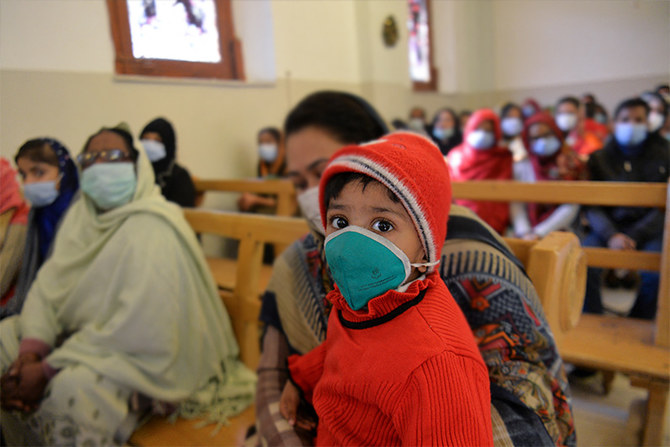
Pakistan reports highest daily number of COVID-19 infections in third wave
https://arab.news/4gumg
Pakistan reports highest daily number of COVID-19 infections in third wave

- 64,685 tests, highest number done in a single day since start of pandemic last February, conducted in last 24 hours
- On Wednesday, Pakistan issued new guidelines for Ramadan, implementing “broader lockdowns” with stringent enforcement protocols

Pakistan urges concessional finance for developing nations to boost clean energy security
- Pakistan has emerged as one of world’s fastest growing solar markets, with 12GWs of off-grid and 6GWs of net-metered capacity in 2025
- PM’s aide says Islamabad remains committed to Paris Agreement, looks for continued support in building a resilient and low-carbon future
ISLAMABAD: Pakistan has urged international partners to scale up concessional financing for developing countries, the country’s Press Information Department (PID) said on Sunday, citing an aide to Prime Minister Shehbaz Sharif.
The call was made by Sharif’s coordinator on climate change, Romina Khurshid Alam, while delivering Pakistan’s national statement at the 16th International Renewable Energy Agency (IRENA) Assembly in Abu Dhabi.
Pakistan has emerged as one of the world’s fastest growing solar markets, with 12 gigawatts (GWs) of off-grid and over 6GWs of net-metered solar capacity by the end of 2025. Last fiscal year, renewables accounted for a historic 53 percent of total electricity generation, according to Alam.
The prime minister’s aide stressed that affordable funding for developing nations is critical to accelerating their transition to clean energy and strengthening energy security amid rising climate and economic challenges.
“Alam reaffirmed Pakistan’s target of achieving 60 percent renewables in the power mix by 2030,” the PID said in a statement.
“In her call to action, she urged IRENA and Member States to increase concessional finance for developing nations, treat technologies such as energy storage and green hydrogen as global public goods, and strengthen regional cooperation for shared energy security.”
IRENA is a global intergovernmental agency for energy transformation that serves as the principal platform for international cooperation, supports countries in their energy transition, and provides state of the art data and analyzes on technology, innovation, policy, finance and investment. Its membership comprises 170 countries and the European Union (EU).
The 16th session of the IRENA Assembly is taking place on Jan. 10-12 in Abu Dhabi and focuses on the theme of “Powering Humanity: Renewable Energy for Shared Prosperity.” The session has gathered global leaders and energy decision-makers to discuss strategies and underline necessary actions for the acceleration of renewable energy across countries, regions, and the world, driving economic inclusion, equity, and human well-being.
Alam shared that Pakistan is taking action against energy poverty through initiatives like the Punjab Solar Panel Scheme 2026, which provides free or subsidized systems to low-income households.
She highlighted how distributed solar kits have restored power and livelihoods in flood-affected communities and offer a replicable model for climate-resilient recovery.
“Pakistan remains fully committed to the Paris Agreement and looks to IRENA for continued technical and financial support in building a resilient, inclusive, and low-carbon future,” Alam said.
Adopted in 2015 to combat climate change, the Paris Agreement binds nations to hold “the increase in the global average temperature to well below 2°C above pre-industrial levels” and pursue efforts “to limit the temperature increase to 1.5°C above pre-industrial levels.”


