

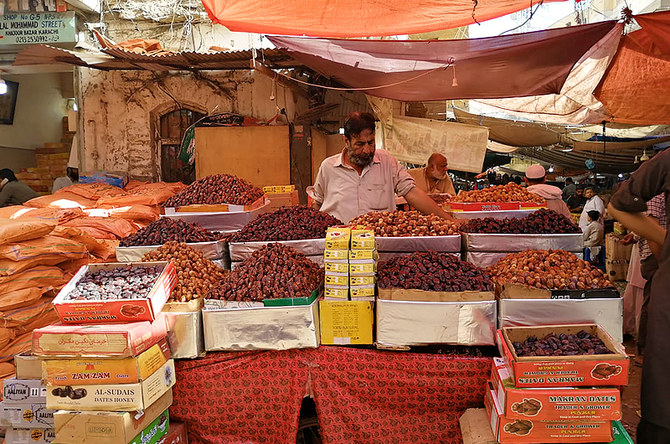
At Pakistan’s oldest date market, 50% less customers this Ramadan despite price cuts

Traders at Khajoor Market wait for customers to buy dates in Karachi, Pakistan, on April 08, 2021, ahead of the start of the holy month of Ramadan. (AN Photo)
Short Url
Updated 14 April 2021
Follow

At Pakistan’s oldest date market, 50% less customers this Ramadan despite price cuts

  • Pakistan meets around 50% of its demand for dates through imports from Iran, Iraq, Saudi Arabia, and other Gulf countries
  • President of the Khajoor Market says “low customer inflow” despite reduced prices and availability of huge stocks

KARACHI: Every year, Karachi’s centuries-old Khajoor Market, which supplies dates not only to the port city but also to the rest of Pakistan, is crowded ahead of the Muslim fasting month of Ramadan.
But this year, wholesale suppliers as well as shopkeepers said despite lower prices and the availability of huge stocks, almost 50 percent fewer customers visited the bazaar compared to previous years.
Muslims around the world, in respect for tradition, break their fasts at sunset through Ramadan by consuming dates.
Muhammad Sabir, president of the market, told Arab News on Tuesday that “despite low prices and availability of huge stocks, we are experiencing reduced customers inflow.”
“Around 50 percent less buying is witnessed this year mainly due to low purchasing power of people impacted by the [coronavirus] pandemic,” he added. “Market is slow this year as compared to the previous years mainly due to the impacts of coronavirus. Dates imported from Iran, Iraq, Saudi Arabia and availability of locally produced commodity has made the market oversupplied which has also impacted the prices … but there is very low customer inflow.”
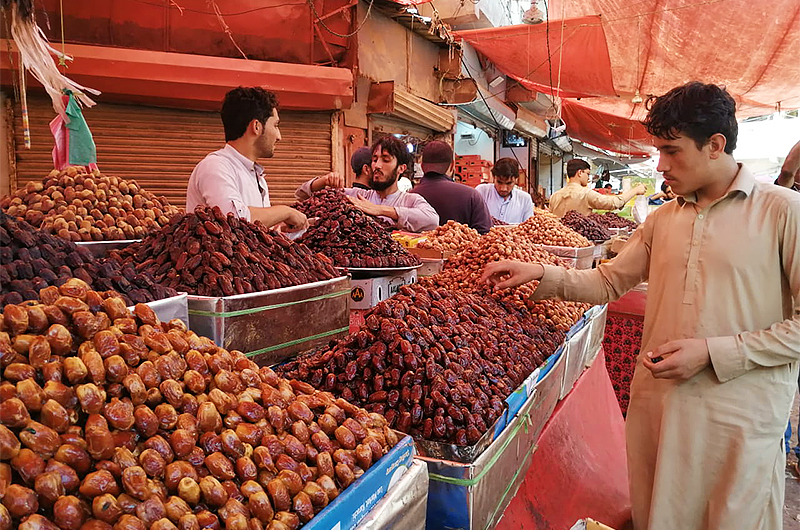


Traders at Khajoor Market wait for customers to buy dates in Karachi, Pakistan, on April 08, 2021, ahead of the start of the holy month of Ramadan. (AN Photo)

Pakistan meets around 50% of its peak demand for dates through imports mostly from Iran, Iraq, Saudi Arabia, and other Gulf countries 
Date dealers say there are few customers even though prices are almost 50 percent lower than last year due to unrestricted imports this year. 
“Last year the border with Iran was closed by authorities to contain the spread of virus but this year the border is open, and huge quantities of dates have been imported,” Hajji Hanif Baloch, a date trader, told Arab News. “The closure of the border last year had moved the prices to almost an all time high but supply has reduced the prices by more than 50 percent this year.”
The most sought after Irani variety of dates, ‘Mazafati,’ which was available for Rs18,000-19,00 per 40-kilogram last year, has come down to Rs7,000-7,500 this year. Similarly, Zahidi dates are being sold for around Rs7,000 as compared to last year’s price of Rs12,000-13,000 per 40 kg. 
“This year large quantities of Saudi dates are also available at reduced prices,” Baloch said, adding: “Ajwa dates are available between Rs1,200 to 1,800 per kilogram this year.”
Last year the Ajwa sold at Rs2,600-2,900 per kilogram, he said. 
Official data shows that 55.74 million people, or 35% of Pakistan’s population, was economically active before the coronavirus pandemic — a figure that has now declined to 22% or 35.04 million people.


Pakistan seeks to boost coffee, tea imports from Rwanda as café culture grows

Updated 5 sec ago
Follow

Pakistan seeks to boost coffee, tea imports from Rwanda as café culture grows

  • Commerce minister attends Rwanda Coffee Festival being held in Islamabad from Jan. 29-30
  • Coffee culture in Pakistan is on the rise among young residents of major urban centers

ISLAMABAD: Pakistan’s Commerce Minister Jam Kamal Khan has expressed interest in increasing coffee and tea imports from Rwanda, according to an official statement on Thursday, as the country’s coffee culture continues to grow with boutique cafes and specialty roasters.

The Rwanda High Commission has organized a two-day Rwanda Coffee Festival in Islamabad starting today, which was also attended by the minister.

Pakistan has primarily been a tea-drinking nation that has witnessed an ascendance of coffee culture, especially among young people in major cities such as Karachi, Lahore and Islamabad, where the expansion of international coffee chains, boutique cafes and specialty roasters has transformed it from a niche beverage into a lifestyle choice.

“Pakistan is interested in increasing imports of coffee and tea from Rwanda,” Khan said while addressing the coffee festival, according to the commerce ministry.

“The Rwanda Coffee Festival is a symbol of strengthening Pakistan-Africa trade ties,” he added. “The Rwanda Coffee Festival will give a new dimension to cultural and trade partnership.”

The ministry said in the statement Khan called for the establishment of a direct import-export supply line between Pakistan and Rwanda, adding that the country was also keen to sign a memorandum of understanding in the near future.

Rwanda’s Trade Minister Prudence Sebahizi announced on the occasion that his country served as a gateway to Africa’s $1.4 billion consumer market, adding it was open to investment from the Pakistani business community.

The ministry said he highlighted that barrier-free exports to African markets were possible after production in Rwanda.

It added Pakistan already exports high-quality rice, textiles and pharmaceutical products to Rwanda, while noting that more than 200 Rwandan traders have visited the country over the past two years.

Pakistan imported coffee, tea, mate and spices worth $846 million in 2023‑24, according to combined data from the State Bank of Pakistan. According to the World Bank’s international trade database, Pakistan imported roasted coffee from around the world valued at $940,000 in 2023.

Rising social media trends and the popularity of specialty brews, cold coffees and artisanal blends are driving demand, while local entrepreneurs experiment with unique flavors and homegrown beans.