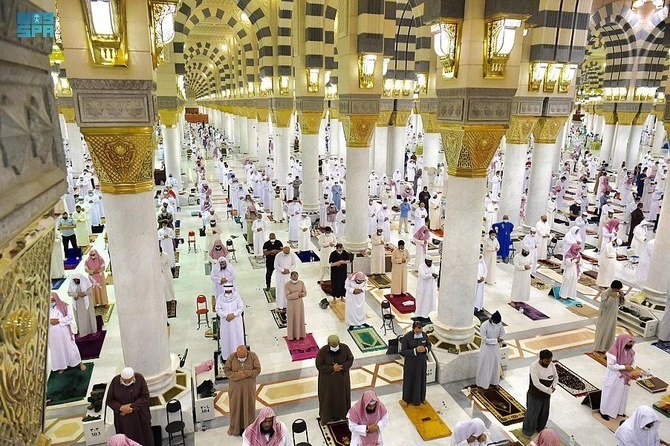
RIYADH: Worshippers performed the first Tarawih prayer at the Two Holy Mosques on Monday amid strict COVID-19 measures.
King Salman issued a decision on Sunday approving the evening prayer in mosques across the Kingdom during the month of Ramadan, but that they be reduced and combined with the Isha prayer.
Only vaccinated or immune worshippers will be allowed to enter the Grand Mosque in Makkah and the Prophet’s Mosque in Madinah and those who do not have a permit will face a hefty fine in a bid to prevent the spread of the virus.
The General Presidency for the Affairs of the Two Holy Mosques said it had intensified disinfection and sterilization operations, and is distributing single-use Zamzam water bottles to the prayer halls, areas, squares and to visitors, in general.
The authority said it had recruited more than 100 personnel to welcome worshippers at entrances and direct them to designated places and installed screening points. Thermal cameras have been set up to detect any signs of illness among those entering the mosques.
Meanwhile, the Ministry of Islamic Affairs said it has completed all preparations for the Muslim holy month. The program includes a number of projects, namely distributing dates through Islamic centers and religious attaches in a number of countries, the King Salman break fast initiative in 16 countries, campaigns to limit the spread of the coronavirus in mosques, as well as a series of virtual lectures throughout the month.
The ministry also issued a circular to all mosques, calling on imams and muezzins to commit the Maghrib and Isha prayers to a two-hour period throughout Ramadan. It also said that the waiting period between the call to prayer and Iqama (the start of the prayer) will be 10 minutes, except for the Fajr prayer, which will be 20 minutes.

Muslims perform first Tarawih prayer at Saudi Arabia's Two Holy Mosques
https://arab.news/ceyj8
Muslims perform first Tarawih prayer at Saudi Arabia's Two Holy Mosques
- Only vaccinated or immune worshippers will be allowed to enter the Two Holy Mosques
- Tarawih and Qiyaam prayers will be combined with the Isha prayer in all mosques across the Kingdom
Minzal brings Saudi traditions to life in Diriyah
- From leather crafts and archery to Saudi coffee, Minzal offers a lesson in ‘Sloum Al-Arab’
RIYADH: This season of Minzal places social norms and traditional etiquette at its center, with tents set up to teach what is locally known as “Sloum Al-Arab” alongside gatherings for coffee, dinner and stargazing around campfires.
“Sloum Al-Arab” refers to the unwritten customers and values that have shaped Arab and Bedouin society for centuries, including generosity, coffee preparation, courage and archery.
In Saudi Arabia, these traditions are closely ties to cultural identity and religious belief.
Leather products and the making of leather goods is one of the crafts featured at Minzal this year and is one of the oldest crafts still practiced in the kingdom.
“The most difficult thing I faced to work on was camel leather because it is a little tough,” Nada Samman, a leather trainer and craftsman at Minzal, told Arab News.
“The work on leather is wonderful whether it is goat leather, cow leather, Sawakni sheep, and of course, camel leather. At Minzal, we are offering multiple handicraft workshops, most specifically the leather handicrafts. We want visitors to spend time at something useful and fun."
Samman explained the workshops allowed participants to preserve heritage while engaging in meaning, hands on activities.
Faisal Al-Khaled, a visual artist and craftsman specializing in Saudi designs at Minzal, shared a similar goal: “I want people to have, by the end of this experience, a unique and traditional art piece created by them, and that I know I helped them to preserve this craft.”
Minzal, which has been organized for several years now, continues to evolve with each season, offering activities that highlight Bedouin values, traditional skills and sports. Archery is a key feature, reflecting its deep roots in Arab and Islamic history.
Mohammed Al-Sharif, a certified archery player and coach with the Saudi Archery Federation since 2028, said the sport was closely connected to Saudi culture. It was encouraged by the Prophet Muhammad, which led people to learn and teach it through generations.
“Our traditional bow is considered one of the most important and widely used bows in Arab culture,” Al-Sharif said. “We have several styles, and professional archers specializing in traditional bow shooting … There are various types of archery, such as horseback archery and standing archery, where bow sizes vary according to specific needs, such as types used for hunting and others used during warfare.”
He explained that archery was historically part of daily life, used for protection and hunting.
Saudi coffee also plays a significant role in the Minzal experience, with live demonstrations. One of the most frequently consumed beverages in the Kingdom, it is a symbol of hospitality and generosity.
Ahmed Al-Shuaibi explained how it was prepared at the Sloum tent, first by roasting the beans and then allowing them to cool. The beans are ground with spices in a Nigr.
“Coffee is passed from our grandparents,” he added. “In significant majlis, you see them offering our local coffee and not other types of coffee. We organized this corner so that young generations can visit and learn this.”


