BRUSSELS: The European Union has imposed sanctions on eight Iranian militia commanders and police chiefs, including the head of the elite Revolutionary Guards, over a deadly crackdown in November 2019, the bloc said in its Official Journal on Monday.
The travel bans and asset freezes are the first EU sanctions on Iran for human rights abuses since 2013, as the bloc had shied away from angering Tehran in the hope of safeguarding a nuclear accord Tehran signed with world powers in 2015.
Their preparation was first reported by Reuters last month.
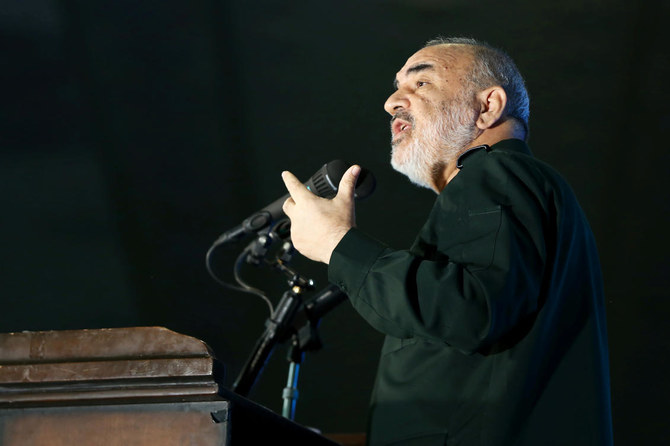
The bloc, which also hit three Iranian prisons with asset freezes, blacklisted Hossein Salami, head of the Revolutionary Guards, the most powerful and heavily armed security force in the Islamic Republic.
“Hossein Salami took part in the sessions that resulted in the orders to use lethal force to suppress the November 2019 protests. Hossein Salami therefore bears responsibility for serious human rights violations in Iran,” the EU said.
The three prisons sanctioned included two in the Tehran area where the EU said those detained after the 2019 protests were deliberately wounded with boiling water and denied medical treatment.
About 1,500 people were killed during less than two weeks of unrest that started on Nov. 15, 2019, according to a toll provided to Reuters by three Iranian interior ministry officials at the time. The United Nations said the total was at least 304.
Iran has called the toll given by sources “fake news.”
Iran, which has repeatedly rejected accusations by the West of human rights abuses, dismissed the EU’s sanctions as “invalid.”
“In response, Iran suspends comprehensive talks with the EU, including human rights talks and all cooperation resulting from these talks, especially in the areas of terrorism, drugs and refugees,” Iranian media quoted Foreign Ministry spokesman Saeed Khatibzadeh as saying.
On March 9, the UN special rapporteur on the situation of human rights in Iran, Javaid Rehman, presented a report saying Tehran used lethal force during the protests and chided it for failing to conduct a proper investigation or failing to hold anyone accountable.
Other individuals targeted with EU sanctions, which take effect on Monday, include members of Iran’s hard-line Basij militia, who are under the command of the Revolutionary Guards, and its head Gholamreza Soleimani.
The eight Iranians were added to an EU sanctions list for human rights abuses in Iran that was first launched in 2011 and which now numbers 89 people and four entities. It includes a ban on exports of equipment that could be used for repression.
Diplomats said the sanctions were not linked to efforts to revive the nuclear deal, which the United States pulled out of but now seeks to re-join. That deal made it harder for Iran to amass the fissile material needed for a nuclear bomb — a goal it has long denied — in return for sanctions relief.


EU sanctions elite Iran commander over 2019 protests
https://arab.news/84e36
EU sanctions elite Iran commander over 2019 protests

- EU has blacklisted Hossein Salami, head of the Revolutionary Guards, the most powerful and heavily armed security force in the country
- About 1,500 people were killed during less than two weeks of unrest that started on Nov. 15, 2019


Morocco deploys army to help evacuate thousands after floods
- More than 20,000 people had been moved to shelter and camps by Saturday
- Authorities set up sandbags and temporary barriers in flood-prone districts as waters began to recede
RABAT: Morocco has deployed army rescue units to help with the evacuation of thousands of people after floods triggered by torrential rains and rising river levels hit parts of the country’s northwest, state TV reported on Saturday.
Weeks of heavy rainfall, combined with water releases from a nearly full dam nearby, increased water levels in the Loukous River and flooded several neighborhoods in the city of Ksar Kbir, about 190 km (118 miles) north of the capital Rabat, a national flood follow-up committee said.
More than 20,000 people had been moved to shelter and camps by Saturday, official media reported.
Authorities set up sandbags and temporary barriers in flood-prone districts as waters began to recede.
Schools in Ksar Kbir have been ordered to remain closed until February 7 as a precaution.
In the nearby province of Sidi Kacem, the Sebou River’s rising levels prompted evacuations from several villages as authorities raised vigilance levels.
The abundant rainfall ended a seven-year drought that drove the country to invest heavily in desalination plants.
The average dam-filling rate has risen to 60 percent, with several major reservoirs reaching full capacity, according to official data.
Last month, 37 people were killed in flash floods in the Atlantic coastal city of Safi, south of Rabat.


