COPENHAGEN: Denmark is facing growing criticism for a decision last year to revoke residence permits for Syrian refugees, citing a “safe” situation around Damascus, but the country is sticking to its position.
The tough Danish stance is a new sign of the country now having one of Europe’s most restrictive migration policies.
“No other country in Europe has adopted such a policy,” Niels-Erik Hansen, a lawyer specializing in migration issues, told AFP.
In the last election in 2019, the Social Democrats, headed by Mette Frederiksen, adopted a restrictive line on immigration and managed to take power from the conservative government propped up by the far-right Danish People’s Party.
Widespread indifference toward the policy change in the Scandinavian country was upended in early April, after one of Hansen’s clients, a teenager about to graduate secondary school, pleaded for her case on Danish television.
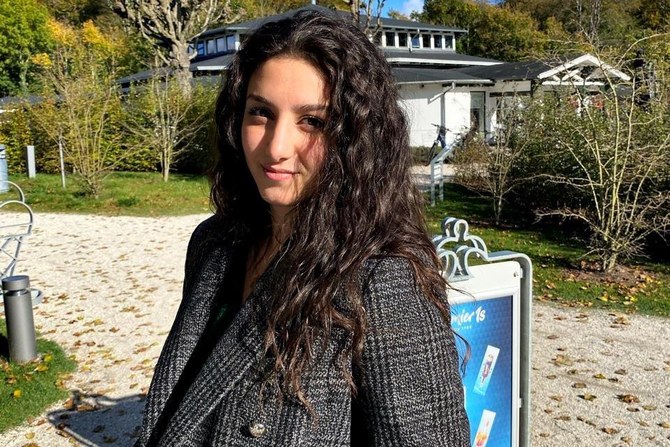
Speaking in fluent Danish, 19-year-old Aya Abu-Daher moved viewers as she asked, holding back tears, what she had “done wrong.”
The “excellent student” according to the headmaster of her high school in Nyborg is campaigning for her family to be allowed to stay.
The young Syrian girl was recently told that her residence permit, which expired at the end of January, would not be renewed.
Like her, 189 Syrians have already had their residence permits revoked since the summer of 2020 after Copenhagen decided to re-examine the cases of around 500 Syrians from Damascus, under the control of Bashar Assad’s regime.
The revocations were on the grounds that “the current situation in Damascus is no longer such as to justify a residence permit or the extension of a residence permit.”
Some of the rejected applicants, who had originally been granted only a temporary permit, have been placed in a detention center.
“Being in a return center, you can’t work nor study and you get food three times a day. Basically they keep you there until you sign a paper saying that you’ll return voluntarily to Syria,” Hansen told AFP.
Under Danish immigration law, temporary residence permits are issued without an end date in cases of a “particularly serious situation in the country of origin characterised by arbitrary violence and attacks against civilians,” but can be revoked once conditions are deemed to have improved.
Some 35,500 Syrians currently live in Denmark, more than half of whom arrived in 2015, according to Statistics Denmark
Last week, the UN High Commissioner for Refugees (UNHCR) said it was concerned about Denmark’s decision, even with deportations currently suspended because of a lack of collaboration between Denmark and the Syrian regime after years of civil war.
UNHCR said it “does not consider that the recent improvements in security in parts of Syria to be sufficiently fundamental, stable or durable to justify ending international protection for any group of refugees.”
Rights group Amnesty International has also denounced the “worrisome development.”
“Denmark keeps sending signals that they don’t want any asylum seekers in the country and scaring the ones who are here into returning to their home countries even when they are not safe,” Lisa Blinkenberg, a senior adviser for Amnesty in Denmark, told AFP.
“Not only is Denmark the worst place in Europe but the country also shows a lack of solidarity with other European countries refusing to take a share in the burden,” Hansen said.
But, despite criticism even from within parliament, the government is sticking to its guns.
“The government’s policy is working, and I won’t back down, it won’t happen,” Social Democratic migration minister Mattias Tesfaye said after Aya Abu-Daher’s plea was broadcast.
“Denmark has been open and honest from day one. We have made it clear to the Syrian refugees that their residence permit is temporary and that the permit can be revoked if the need for protection ceases to exist,” Tesfaye told AFP on Friday.
The Nordic country has a stated goal of “zero asylum seekers,” and also offers special grants for voluntary returnees grants, which were accepted by 137 Syrians in 2020.


Danish plan to repatriate Syrians sparks controversy
https://arab.news/b2pg3
Danish plan to repatriate Syrians sparks controversy

- Speaking in fluent Danish, 19-year-old Aya Abu-Daher moved TV viewers as she asked, holding back tears, what she had ‘done wrong’
- The ‘excellent student’ according to the headmaster of her high school in Nyborg is campaigning for her family to be allowed to stay


Ukraine contacted Musk’s SpaceX over Russian drones using Starlink
- The Russian army used Starlink satellites to guide its drone attacks deep into Ukraine
- ISW said “Russian forces are increasingly using Starlink satellite systems”
KYIV: Ukraine’s Defense Minister Mykhailo Fedorov said on Thursday Kyiv was in contact with Elon Musk’s SpaceX over allegations that Russian drones were using Internet from Starlink satellites during attacks on Ukrainian cities.
“Within hours of Russian drones with Starlink connectivity appearing over Ukrainian cities, the Ministry of Defense team promptly contacted SpaceX and proposed ways to resolve the problem,” Fedorov said on social media.
“I’m grateful to SpaceX President Gwynne Shotwell and personally to Elon Musk for their swift response.”
Fedorov and the US-based Institute for the Study of War said earlier this week that the Russian army used Starlink satellites to guide its drone attacks deep into Ukraine.
Russia has been battering the country’s energy grid as temperatures tumble below freezing and the invasion’s fourth anniversary looms.
The ISW said that “Russian forces are increasingly using Starlink satellite systems to extend the range of BM-35 strike drones to conduct mid-range strikes against the Ukrainian rear.”
Starlink is also widely used by the Ukrainian army for communications.
“Elon Musk’s decision to urgently activate Starlink and send the first batch of terminals to Ukraine at the start of the full-scale invasion was critically important for our country’s resilience,” Fedorov said.
“Western technologies must continue to support the democratic world and protect civilians, not be used for terror and the destruction of peaceful cities.”


