

Report reveals scale of mental health crisis among Syrian refugees

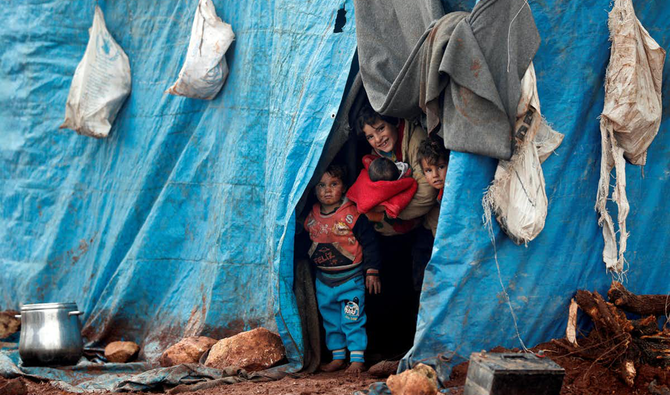
Nearly 12 million Syrians are either refugees or internally displaced — more than half of the pre-war population. (Reuters/File)
Short Url
Updated 01 March 2021
Follow

Report reveals scale of mental health crisis among Syrian refugees

  • 84% of those surveyed reported experiencing multiple symptoms of PTSD
  • ‘It’s very easy to see the need to fix the tangible damage … but we also need to fix the damage we can’t see,’ expert tells Arab News

LONDON: More than three-quarters of Syrian refugees may be suffering from serious mental health problems caused by their country’s 10-year conflict, according to a new report.

UK charity Syria Relief surveyed hundreds of refugees living in Lebanon, Turkey and Syria’s Idlib province, and found that 84 percent of people had at least seven out of 15 key symptoms of post-traumatic stress disorder (PTSD).

People suffering from PTSD, which is usually caused by witnessing or experiencing traumatic events, experience a range of symptoms including panic attacks and anxiety, and it often comes hand in hand with other mental health problems such as depression.

Despite the sky-high rates of PTSD, Syria Relief said accessing professional medical help is difficult, if not impossible, for many refugees.

Only 15 percent of refugees in Lebanon believe there is some mental health support available, and for internally displaced Syrians in Idlib that figure drops to just 1 percent.

One respondent to the survey, Ahmed, was hit by a government airstrike and trapped inside a destroyed building for 12 hours before being rescued.

“We could only see dust and darkness. We remained trapped under the rubble, in the cold for 12 hours until the Syrian Civil Defence (the White Helmets) freed us,” he said.

“What we saw, it cannot be described. The sound of aircrafts was so terrifying. I am, and I always will be, so scared of that sound, even after a hundred years. My fear has become my obsession,” he added.

“Whilst I received medical help, psychologically no one has taken care of me. I don’t even know if there is any mental health support for people like me, or even for people in a worse mental health condition than me.”

Charles Lawley, the report’s author and head of communications at Syria Relief, told Arab News: “There needs to be a change of attitudes toward mental health. It’s very easy to see the need to fix the tangible damage — broken buildings and bodies — but we also need to fix the damage we can’t see.”

He and the team at Syria Relief have urged the international community to “ensure there is funding to meet the psychosocial needs that are bound to result from people becoming victims of conflict and disaster.”

There is a danger that the mental health effects of the conflict on the millions of Syrian refugees could outlast the war itself, Lawley said. 

“One woman I spoke to witnessed her husband being killed in an airstrike on their home, and four months later lost two of her three children in another airstrike. This was six years ago. How is anyone ever going to come to terms with that without the help of a mental health professional?” he added.

“Some of the people I speak to haven’t been inside Syria or an active conflict zone for five, seven, even 10 years, but the symptoms of the trauma from their experiences aren’t healing.”

Nearly 12 million Syrians are either refugees or internally displaced — more than half of the pre-war population.

The conflict began in 2011 when a pro-democracy protest movement was met with brutal force by the Assad regime.


First responders enter devastated Aleppo neighborhood after days of deadly fighting

Updated 12 January 2026
Follow

First responders enter devastated Aleppo neighborhood after days of deadly fighting

  • The US-backed SDF, which have played a key role in combating the Daesh group in large swaths of eastern Syria, are the largest force yet to be absorbed into Syria’s national army

ALEPPO, Syria: First responders on Sunday entered a contested neighborhood in Syria’ s northern city of Aleppo after days of deadly clashes between government forces and Kurdish-led forces. Syrian state media said the military was deployed in large numbers.
The clashes broke out Tuesday in the predominantly Kurdish neighborhoods of Sheikh Maqsoud, Achrafieh and Bani Zaid after the government and the Syrian Democratic Forces, the main Kurdish-led force in the country, failed to make progress on how to merge the SDF into the national army. Security forces captured Achrafieh and Bani Zaid.
The fighting between the two sides was the most intense since the fall of then-President Bashar Assad to insurgents in December 2024. At least 23 people were killed in five days of clashes and more than 140,000 were displaced amid shelling and drone strikes.
The US-backed SDF, which have played a key role in combating the Daesh group in large swaths of eastern Syria, are the largest force yet to be absorbed into Syria’s national army. Some of the factions that make up the army, however, were previously Turkish-backed insurgent groups that have a long history of clashing with Kurdish forces.
The Kurdish fighters have now evacuated from the Sheikh Maqsoud neighborhood to northeastern Syria, which is under the control of the SDF. However, they said in a statement they will continue to fight now that the wounded and civilians have been evacuated, in what they called a “partial ceasefire.”
The neighborhood appeared calm Sunday. The United Nations said it was trying to dispatch more convoys to the neighborhoods with food, fuel, blankets and other urgent supplies.
Government security forces brought journalists to tour the devastated area, showing them the damaged Khalid Al-Fajer Hospital and a military position belonging to the SDF’s security forces that government forces had targeted.
The SDF statement accused the government of targeting the hospital “dozens of times” before patients were evacuated. Damascus accused the Kurdish-led group of using the hospital and other civilian facilities as military positions.
On one street, Syrian Red Crescent first responders spoke to a resident surrounded by charred cars and badly damaged residential buildings.
Some residents told The Associated Press that SDF forces did not allow their cars through checkpoints to leave.
“We lived a night of horror. I still cannot believe that I am right here standing on my own two feet,” said Ahmad Shaikho. “So far the situation has been calm. There hasn’t been any gunfire.”
Syrian Civil Defense first responders have been disarming improvised mines that they say were left by the Kurdish forces as booby traps.
Residents who fled are not being allowed back into the neighborhood until all the mines are cleared. Some were reminded of the displacement during Syria’s long civil war.
“I want to go back to my home, I beg you,” said Hoda Alnasiri.