

Expert reveals details of astonishing archaeological find

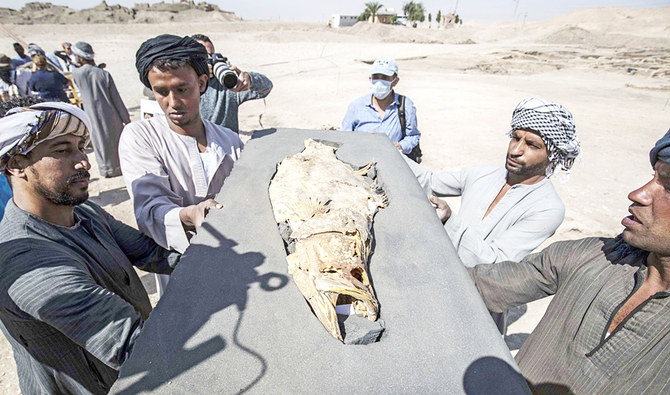
Large quantities of items, including semi-precious stones, were found at the site and it is expected that the discoveries in the city will cover an area of more than 3 kilometers. (AFP)
Short Url
Updated 12 April 2021
Follow

Expert reveals details of astonishing archaeological find

  • Large quantities of semi-precious stones were found and it is expected that the discoveries in the city will cover an area of more than 3 km

CAIRO: Zahi Hawass, the former Egyptian minister of antiquities, said that the discovery of a lost city in Luxor is the most important and greatest archaeological discovery for him.
Hawass believes that the extension of the city belongs to Tutankhamun, and said that the recent discovery shook the world.
The Egyptian archaeological mission, headed by Hawass, discovered the lost city under the sands of Luxor, called Ascension of Aton, which dates back to the reign of King Amenhotep III. The city continued to be used by Tutankhamun 3,000 years ago, and it may even pre-date pharaonic history and add to the archaeological discoveries that Egypt has discovered during recent years.
Hawass said during televised statements that many industrial places were discovered in the lost city, including places for the manufacture of clothes, linen and fishing rods, and 100 molds were discovered for the manufacture of amulets used in the palace.
Large quantities of semi-precious stones were also found and it is expected that the discoveries in the city will cover an area of more than 3 km.
“We found three main areas — one for management, one for workers to sleep (in) and a third for industry — as well as an area for dried meat,” Hawass said.

HIGHLIGHT

Expert believes that the extension of the city belongs to Tutankhamun, and says that the recent discovery shook the world.

He explained that it is the largest ancient city found so far, noting that the discovery was carried out by an Egyptian team.
Hawass said that Betsy Bryan, an archaeologist specializing in the golden age, had praised the discovery of the lost city, describing it as the second most important discovery after the tomb of Tutankhamun.
Hawass said that the process of restoring the city will begin next month. The pottery found in the city dates back 3,000 years, confirming that the discovered pots were used for storing meat.
He said that they had also discovered three kilos of dried meat as well as other significant finds.
“A cemetery dating back to the 26th dynasty, 500 BC, was discovered, and these graves are complete and untouched and are supported because they are made of mud bricks,” Hawass said.
He said that work to discover the lost city began in September 2020.
Hawass said that he had not expected to discover the city. Archaeologists believed that it had disappeared, so the discovery of the first house in the city had astonished scientists, he said.


Israel confirms ban on 37 NGOs in Gaza

A Palestinian woman carries wood for fire in the Nuseirat refugee camp in the central Gaza Strip on December 31, 2025. (AFP)
Updated 3 sec ago
Follow

Israel confirms ban on 37 NGOs in Gaza

JERUSALEM: Israel on Thursday said 37 humanitarian agencies supplying aid in Gaza had not met a deadline to meet “security and transparency standards,” and would be banned from the territory, despite an international outcry.
The international NGOs, which had been ordered to disclose detailed information on their Palestinian staff, will now be required to cease operations by March 1.
The United Nations has warned that this will exacerbate the humanitarian crisis in the war-ravaged Palestinian territory.
“Organizations that have failed to meet required security and transparency standards will have their licenses suspended,” Israel’s Ministry of Diaspora Affairs and Combating Antisemitism said in a statement.
Several NGOS have said the requirements contravene international humanitarian law or endanger their independence.
Israel says the new regulation aims to prevent bodies it accuses of supporting terrorism from operating in the Palestinian territories.
Prominent humanitarian organizations hit by the ban include Doctors Without Borders (MSF), the Norwegian Refugee Council (NRC), World Vision International and Oxfam, according to a ministry list.
In MSF’s case, Israel accused it of having two employees who were members of Palestinian militant groups Islamic Jihad and Hamas.
MSF said this week the request to share a list of its staff “may be in violation of Israel’s obligations under international humanitarian law” and said it “would never knowingly employ people engaging in military activity.”
‘Critical requirement’ 
NRC spokesperson Shaina Low told AFP its local staff are “exhausted” and international staff “bring them an extra layer of help and security. Their presence is a protection.”
Submitting the names of local staff is “not negotiable,” she said. “We offered alternatives, they refused,” hse said, of the Israeli regulators.
The ministry said Thursday: “The primary failure identified was the refusal to provide complete and verifiable information regarding their employees, a critical requirement designed to prevent the infiltration of terrorist operatives into humanitarian structures.”
In March, Israel gave NGOs 10 months to comply with the new rules, which demand the “full disclosure of personnel, funding sources, and operational structures.”
The deadline expired on Wednesday.
The 37 NGOs “were formally notified that their licenses would be revoked as of January 1, 2026, and that they must complete the cessation of their activities by March 1, 2026,” the ministry said Thursday.
A ministry spokesperson told AFP that following the revocation of their licenses, aid groups could no longer bring assistance into Gaza from Thursday.
However, they could have their licenses reinstated if they submitted the required documents before March 1.
Minister of Diaspora Affairs and Combating Antisemitism Amichai Chikli said “the message is clear: humanitarian assistance is welcome — the exploitation of humanitarian frameworks for terrorism is not.”
‘Weaponization of bureaucracy’
On Thursday, 18 Israel-based left-wing NGOs denounced the decision to ban their international peers, saying “the new registration framework violates core humanitarian principles of independence and neutrality.”
“This weaponization of bureaucracy institutionalizes barriers to aid and forces vital organizations to suspend operations,” they said.
UN Palestinian refugee agency chief Philippe Lazzarini had said the move sets a “dangerous precedent.”
“Failing to push back against attempts to control the work of aid organizations will further undermine the basic humanitarian principles of neutrality, independence, impartiality and humanity underpinning aid work across the world,” he said on X.
On Tuesday, the foreign ministers of 10 countries, including France and Britain, urged Israel to “guarantee access” to aid in the Gaza Strip, where they said the humanitarian situation remains “catastrophic.”
A fragile ceasefire has been in place since October, following a deadly war waged by Israel in response to Hamas’s unprecedented October 7, 2023 attack on Israel.
Nearly 80 percent of buildings in Gaza have been destroyed or damaged by the war, according to UN data.
About 1.5 million of Gaza’s more than two million residents have lost their homes, said Amjad Al-Shawa, director of the Palestinian NGO Network in Gaza.