Myanmar’s UN envoy urges action against junta as bloodshed continues

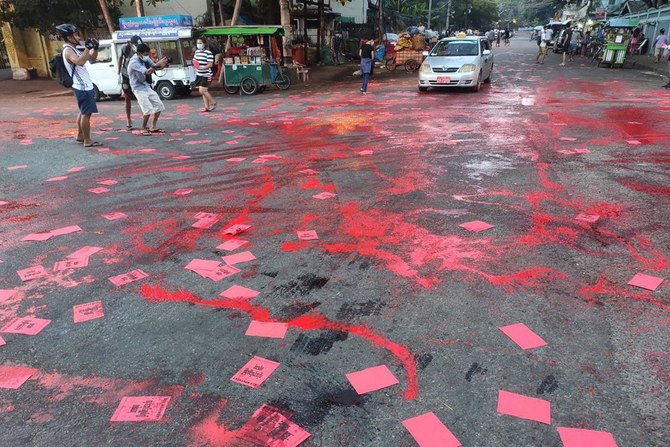
Crimson paint, representing the blood already spilled, was splashed across the streets of Yangon in view of the historic Shwedagon Pagoda on April 10, 2021. (AFP)
Short Url
Updated 10 April 2021
Follow

Myanmar’s UN envoy urges action against junta as bloodshed continues

  • Country has been in turmoil since the military ousted civilian leader Aung San Suu Kyi in February
  • More than 600 people have been killed by security forces trying to quell protesters

YANGON: Myanmar’s own ambassador to the United Nations has urged “strong action” against the junta, as reports emerged of scores killed in the military’s latest crackdown.
The country has been in turmoil since the military ousted civilian leader Aung San Suu Kyi in February, with protesters refusing to submit to the junta regime and continuing to demand a return to democracy.
With more than 600 people killed by security forces trying to quell the movement, the international community has increasingly raised the alarm on the crisis.
During a UN Security Council meeting on Friday, Myanmar’s ambassador pushed for more concrete action – proposing a no-fly zone, an arms embargo and more targeted sanctions against members of the military and their families.
“Your collective, strong action is needed immediately,” Ambassador Kyaw Moe Tun told the meeting.
“Time is of the essence for us,” he said. “Please, please take action.”
An independent analyst with the International Crisis Group also warned the council that Myanmar was “at the brink of state failure.”
“The vast majority of the population does not want military rule and will do whatever it takes to prevent that outcome. Yet the military seems determined to impose its will,” said Richard Horsey.
“Its actions may be creating a situation where the country becomes ungovernable. That should be of grave concern to the region and to the broader international community.”
China and Russia wield veto power at the Security Council and generally oppose international sanctions.
However, Beijing – the top ally of Myanmar’s military – has voiced growing concern about instability, and has said it is speaking to “all parties.”
There have been reports that China has opened contact with the CRPH, a group representing the ousted civilian government.
At least 618 civilians have been killed in the military’s crackdown on protests, according to the Assistance Association for Political Prisoners, a local monitoring group.
Efforts to verify deaths and confirm news of crackdowns have been greatly hindered by the junta’s throttling of mobile data within the country – effectively shunting most of the population into an information blackout.
News emerged Saturday morning of more violence in the city of Bago, 65 kilometers (40 miles) northeast of Yangon – the site of a day-long crackdown that forced residents into hiding in nearby villages.
AFP-verified footage shot early Friday showed protesters hiding behind sandbag barricades wielding homemade rifles, as explosions could be heard in the background.
A resident said that the military crackdown killed at least 40 protesters, and authorities refused to let rescue workers remove the bodies.
“They piled up all the dead bodies, loaded them into their army truck and drove it away,” he said, adding that authorities then proceeded to arrest people around the community.
Local media reports have put the death toll for Bago’s crackdown at far higher.
The junta had branded the victims of anti-coup unrest “violent terrorist people,” putting the total death toll since February 1 at 248, according to a spokesman Friday.
Despite the daily bloodshed, protesters have continued to take to the streets, with dawn strikes sprouting across the country Saturday.
Demonstrators are also manifesting their discontent in pointedly creative ways.
In commercial hub Yangon, crimson paint – representing the blood already spilled – was splashed across the streets in view of the historic Shwedagon Pagoda.
“Let us unite and boldly show in red that the dictatorial regime will not be allowed to rule us at all,” a student activist announced on Facebook.
Flyers with the words “They will not rule us” were scattered across Yangon neighborhoods.
In Mandalay, activists pasted the same flyers on the statue of General Aung San.
The father of Suu Kyi, he is a national hero who is widely regarded as having wrested Myanmar from under the yoke of British colonialism.
Suu Kyi is currently facing a series of charges from the junta – including accusations of corruption and for having unregistered walkie-talkies.
The military has repeatedly justified seizing power by alleging widespread electoral fraud in November’s elections, which Suu Kyi’s party won in a landslide.


Sri Lanka takes custody of an Iranian vessel off its coast after US sank an Iranian warship

Updated 1 sec ago
Follow

Sri Lanka takes custody of an Iranian vessel off its coast after US sank an Iranian warship

  • Sri Lankan President Anura Kumara Dissanayake said the country took control of the vessel after it reported an engine failure and that the decision followed talks with Iranian officials and the ship’s
COLOMBO: Sri Lanka began transferring more than 200 sailors from an Iranian vessel to shore Friday after the ship sought assistance while anchored outside the country’s waters, as tensions mounted in the Indian Ocean following the sinking of an Iranian warship by a US submarine.
Sri Lankan navy spokesperson Cmdr. Buddhika Sampath said 204 sailors of the IRIS Bushehr were brought to the Welisara Naval Base near the capital, Colombo. They underwent border control procedures and medical tests, but none were found to have health issues.
About 15 others have been left aboard the ship with Sri Lankan naval personnel for assistance because they had reported a fault with the ship.
The Iranian sailors are interpreting operational instructions, manuals and logs for their Sri Lankan counterparts because the ship will be in Sri Lankan custody until further notice, Sampath said.
The ship will be taken to the port of Trincomalee in eastern Sri Lanka, Sampath said.
Iranian ship was taking part in naval exercises
The Sri Lankan government took custody of the Bushehr after the US sank an Iranian warship, the IRIS Dena, off Sri Lanka’s coast Wednesday. The strike marked one of the rare instances since World War II in which a submarine sank a surface warship, and highlighted the expanding scope of the US-Israeli military campaign against Iran.
The Dena had participated in naval exercises hosted by India before heading into international waters on its way home. At least 74 countries had joined the events, according to India’s Defense Ministry, including the US Navy, which conducted reconnaissance aircraft and maritime patrol drills.
The Indian navy received a distress signal from the Dena but by the time it launched a search and rescue operation, the Sri Lankan navy had already begun its own rescue efforts, the ministry said.
The Sri Lankan navy rescued 32 sailors and recovered 87 bodies.
Iran’s Foreign Minister Abbas Araghchi said the Dena had been carrying “almost 130” crew. The normal crew size for a warship of that class is 140.
Araghchi called the sinking an “atrocity at sea” and said the US would “bitterly regret” the attack.
Sri Lanka says it acted under international law
Sri Lankan President Anura Kumara Dissanayake said late Thursday that authorities decided to take control of the IRIS Bushehr after discussions with Iranian officials and the ship’s captain, after one of its engines failed.
“We have to understand that this is not an ordinary situation. It’s a request by a ship belonging to one party to enter into our port. We have to consider that according to the international treaties and conventions,” he told journalists Thursday night.
Separately on Friday, he wrote on X: “No civilian should die in wars. Our approach is that every single life is as precious as our own.”
The IRIS Bushehr had been described in previous Iranian media reports as a navy logistics ship equipped with a helicopter pad.
Dissanayake said Sri Lanka was guided by neutrality while seeking to uphold humanitarian principles.
“We have followed a very clear stance. We will not be biased to any state nor we will be submissive to any state,” he said.
Sri Lanka’s neutrality is tested
The broadening Middle East conflict is putting strategically located Sri Lanka in a delicate position as it tries to balance humanitarian obligations, international maritime law and its longstanding policy of non-alignment.
H.M.G.S. Palihakkara, Sri Lanka’s retired former foreign secretary who also served as its permanent representative to the United Nations, said the country had acted responsibly and impartially.
“There has been a distress call from the ship. So naturally Sri Lanka, as a party to the Law of Sea and The Hague Convention, had no option but to do what it did by mounting a humanitarian operation to provide assistance to save lives and provide medical care to the affected,” he said.
Palihakkara said parties to the conflict would understand that Sri Lanka was not taking sides.
“You could not have ignored the distress call. Even the attacking powers cannot leave shipwrecked sailors dying. That is the law,” Palihakkara said.
Katsuya Yamamoto, director of the Strategy and Deterrence Program at the Sasakawa Peace Foundation in Tokyo, said Sri Lanka, which is not at war with either the US or Iran, is considered a neutral state. As such, the Bushehr can enter a Sri Lankan port if granted permission by the government, he said.
Yamamoto said that once the vessel is docked, it falls under Iranian jurisdiction, leaving Sri Lankan authorities without legal grounds to inspect it unless Colombo decides to side with the US
Australians aboard submarine
Australia’s government confirmed on Friday that three Australians were aboard the submarine that sank the IRIS Dena. The Australians were there as part of the trilateral US, Australian and British training program under the AUKUS security pact.
The Australian government has maintained it was not warned that the USand Israel planned to attack Iran. Australia has not commented on the legality of the attack, but supports the objective of preventing Iran from gaining nuclear weapons.
Neil James, executive director of the Australian Defense Association policy think tank, said it is “reasonably rare” for Australians embedded with another nation’s military to go to war against a country such as Iran that Australia wasn’t at war with.
He said an Australian would not have fired the torpedo that sank the Iranian ship
“The Australians wouldn’t have a job where they had to push the button on the torpedo because the captain of the boat gives the order and someone else, perhaps the weapons officer, presses the button but they’re not going to be Australian,” James said.