

Airlines blast UK’s travel restart plan

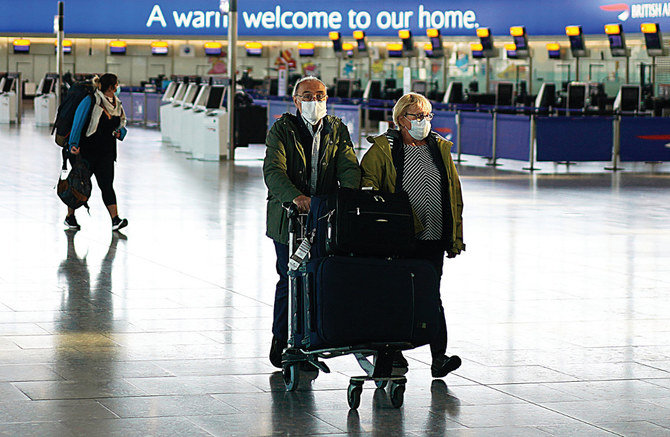
British airlines and travel companies are desperate for a bumper summer. (Reuters/File)
Short Url
Updated 10 April 2021
Follow

Airlines blast UK’s travel restart plan

  • Jet2 says it is canceling holidays until late June, blaming uncertainty in govt's plans for restarting international travel

LONDON:  British travel company Jet2 said it was canceling holidays until late June, blaming uncertainty in UK government plans for restarting international travel, which were condemned by airlines.

Flight operators had been counting on government proposals published on Friday to allow planning for a summer getaway season, but the industry criticized the release for not including a start date for travel or listing which countries would be open for holidaymakers.

“We are extremely disappointed at the lack of clarity and detail,” said Jet2 CEO Steve Heapy. “The framework lacks any rigorous detail about how to get international travel going again.”

Jet2, the UK’s third largest carrier by passenger numbers, said it had no choice but to cancel flights and holidays to June 23, over a month later than the May 17 date the government has said is the earliest for international travel to resume.

The country’s largest airline, easyJet, also criticized the government’s plans, saying the requirement for an expensive PCR COVID-19 test for trips to low-risk countries would mean that only wealthy people could take holidays abroad.

Airlines and travel companies are desperate for a bumper summer after a year of restrictions. Without a high level of unrestricted travel, some could be left struggling to survive or needing fresh funds.

The government has proposed a traffic light system, with countries falling into red, amber or green categories based on COVID-19 risks. Green countries will require a PCR test which costs about 100 pounds ($135) for travelers once they arrive back in the UK.

Airlines will need to wait until early May to hear when international travel can restart, said the government.

“This does not represent a reopening of travel as promised by ministers,” said Airlines UK, an industry body which represents British Airways, easyJet, Ryanair , Virgin Atlantic and others. “It is a further setback for an industry on its knees.”

EasyJet said the PCR test cost is higher than some of its fares, and called on the government to reassess its plan.

“This risks reversing the clock and making flying only for the wealthy,” said easyJet CEO Johan Lundgren.

Britons have embraced the era of low cost travel over the last 20 years and are among Europe’s highest spending tourists. In 2019, more than six in ten Britons took a foreign holiday.

Transport Minister Grant Shapps said that the government wanted to make testing for travel cheaper and suggested that in time, the PCR test could be changed for a more affordable lateral flow test.

“We are committed as a government to work to drive those costs down, and also in time of course review potentially the type of test,” he told the BBC.

The framework for travel will be reviewed at the end of June, July and again in October, the government has said.

“I’m not telling people that they shouldn’t book some holidays now,” Shapps said. “It’s the first time I’ve been able to say that for many months.”

Case numbers in Britain have dropped dramatically since a January peak under a strict lockdown which banned holidays, but a government priority is to avoid undermining the success of its vaccination program by importing vaccine-resistant variants from overseas.

Under the traffic light system, restrictions such as hotel quarantine, home quarantine and compulsory COVID tests will apply differently depending on which category of country a passenger arrives from.

A digital travel certification system would also be part of the plan but the proposals gave few details beyond saying that Britain wanted to play a leading role in developing standards.


US guarantees for Gulf maritime trade ‘doable’ but could take weeks, experts warn

Updated 5 sec ago
Follow

US guarantees for Gulf maritime trade ‘doable’ but could take weeks, experts warn

RIYADH: A pledge by US President Donald Trump to provide insurance and naval escorts for maritime trade in the Gulf has been welcomed, but with concerns over how long it would take to come into force.

In a social media post on March 3, the president said the offer will be available to all shipping lines, and added that “if necessary” the US Navy would escort tankers through the Strait of Hormuz.

The announcement comes as commercial marine insurers and shipping operators reassess risk in and around the Gulf in light of the US-Israel war with Iran.

War-risk premiums have surged, and London’s Joint War Committee has expanded the area it treats as high risk, a move that can increase insurance costs and complicate coverage for voyages in the region. 

Joshua Tallis, a senior research scientist at the Center for Naval Analyzes, said it was “unlikely” the US Navy would be able to defend commercial vessels “over the next seven to 10 days,” according to the Financial Times. Escort missions would probably begin only after “the initial phase of major hostilities,” he added, once a larger portion of Iran’s anti-ship capabilities had been degraded.

Mark Montgomery, a retired US Navy rear admiral and former aircraft carrier strike group commander, said such an operation would be “hard but doable,” but warned it could take up to two weeks before conditions were suitable for escorts. 

He also said diverting naval assets to convoy protection would likely “cause a reduction in the amount of strike[s] the US could carry out,” the Financial Times reported.

Multiple marine insurers have moved to cancel war-risk cover for vessels operating in Iranian and surrounding Gulf waters, underscoring how difficult it has become for shipowners to obtain protection at any price.

It remains unclear whether the DFC can quickly and credibly fill the gap. The agency’s political risk insurance is typically tied to specific investments and projects and covers threats such as war and terrorism.

Expanding that capacity into broad, transit-linked maritime coverage for “all shipping lines” would be a significant operational and policy stretch, and market participants told Reuters they were skeptical that insurance and escorts alone would be enough to restore flows while fighting continues.

Tobias Maier, CEO of DHL Global Forwarding Middle East and Africa, said some shipping lines have already begun diverting cargo away from the Strait of Hormuz as security risks rise.

“Due to safety concerns, several international carriers have halted their operations in the Strait of Hormuz and are diverting their ships away from the Gulf,” Maier said in comments to Arab News.

He added that the logistics company has activated contingency plans to maintain supply chains in the region, including shifting cargo flows through alternative routes.

“We have activated contingency and mitigation plans, including alternative routing and multimodal solutions — at this stage focusing on Oman and Saudi Arabia as gateways into and out of the GCC,” Maier said, adding that “the safety of our employees and our customers’ cargo as well as maintaining supply chain continuity where possible are of the utmost importance to us.”

Even if implemented, Trump’s measure is more likely to reduce the cost of risk than remove the risk itself.

Analysts and shipping sources cited by Reuters said naval escorts would take time to organize and that US naval resources in the region are not unlimited; insurers and shipowners also have to weigh missile, drone and mine threats that can persist despite convoying. 

The net effect, industry participants said, could be a partial easing of war-risk pricing for some voyages, rather than an immediate normalization of traffic through Hormuz.

Energy markets did not appear to stabilize immediately after Trump’s announcement. 

Brent crude settled up sharply on March 3, and prices rose again on March 4 as traders focused on the scale of disruptions and ongoing attacks rather than prospective policy support; Brent was reported around the low-to-mid $80s a barrel and WTI in the mid-to-high $70s. 

Goldman Sachs, in a March 4 note reported by Reuters, raised its near-term oil-price forecasts and warned that a prolonged disruption of flows through Hormuz could push Brent toward $100 under some scenarios. 

The biggest constraint, traders and shipping executives say, is physical movement: if tankers refuse to sail or cannot obtain insurance or safe passage, insurance guarantees alone may not restart volumes. 

Insurance withdrawals and cancelations, as well as sharply higher freight rates, have already disrupted ship scheduling and pushed costs to move crude and liquefied natural gas higher, amplifying the inflationary impact of the conflict for importing countries. 

Moody’s said the immediate credit impact of the Iran conflict on insurers in the Gulf Cooperation Council region is likely to be limited if disruptions remain short-lived, with its baseline scenario assuming the conflict lasts only weeks and that navigation through the Strait of Hormuz eventually resumes at scale. 

Under that scenario, insurers would not face immediate pressure on their credit profiles. The ratings agency said the primary transmission channel would come through insurers’ investment portfolios rather than underwriting losses, as disruptions to oil exports and tourism could weigh on regional asset prices, particularly real estate and equities. 

Moody’s estimates that a 20 percent decline in those asset valuations would reduce the total equity of rated insurers by around 7 percent, a hit that most larger companies could absorb due to existing capital buffers. However, risks would rise if the conflict drags on, potentially weakening premium growth, increasing competitive pricing pressure and eroding capital cushions across the sector.