

Turkey tops Council of Europe list for incarceration rates

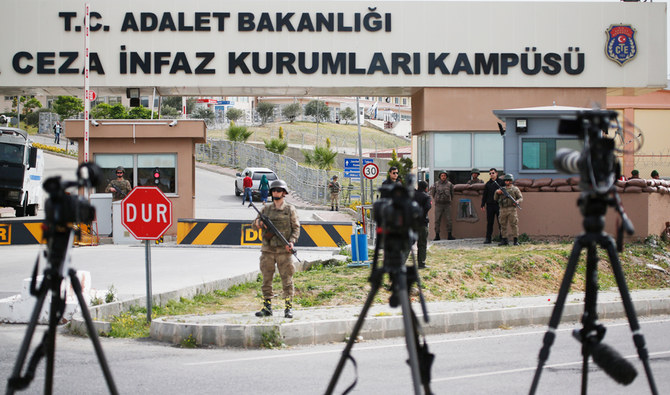
Cameras of members of the media are placed across from the prison complex in Aliaga, Izmir province, western Turkey. (AP)
Short Url
Updated 10 April 2021
Follow

Turkey tops Council of Europe list for incarceration rates

  • About 300,000 people, including pre-trial detainees, are behind bars in Turkey, only second to Russia in numbers

ISTANBUL: Turkey has been ranked first among member states of the Council of Europe (CoE) for its annual incarceration rate, with a record number of inmates convicted for terrorism offenses.

Last year, the Turkish parliament adopted a controversial law to release about 45,000 prisoners to ease overcrowding in prisons and protect detainees from the pandemic.

However, the amnesty law was found to be politically biased as several drug dealers and mafia bosses were released while dissident journalists and politicians were excluded.

The Council of Europe released its Annual Penal Statistics report on Thursday: Turkey topped the list with an incarceration rate of 357.2 inmates per 100,000 inhabitants.

Turkey was followed by Russia, Georgia, Lithuania and Azerbaijan in the report.
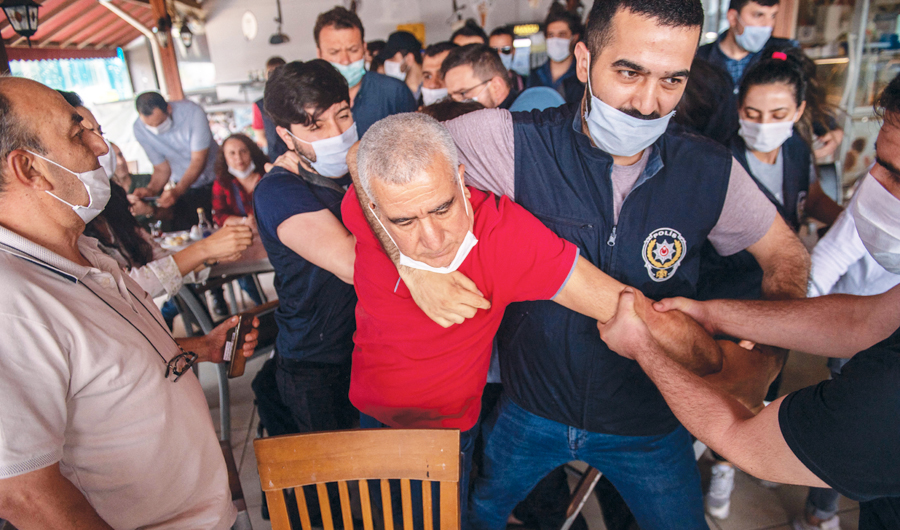


Turkish police arrest a man during a recent protest in Istanbul. (AFP)

According to the report, about 300,000 people, including pre-trial detainees, are behind bars in Turkey — second only to Russia.

FASTFACT

Terrorism offenses are broadly defined in Turkish laws under which dissident activities such as attending demonstrations and exercising critical journalism are punished.

Based on the ratio of the number of inmates to the number of places available in penal institutions, Turkish prisons were also found to be the most overcrowded in the CoE report, with 127 inmates per 100 available places. Turkey was followed by Italy in the report.

Of 30,524 prisoners convicted for terror charges in the European continent, the majority of them — 29,827 people — were found in Turkey alone. Terrorism offenses are broadly defined in Turkish laws under which dissident activities such as attending demonstrations and exercising critical journalism are punished; disregarding European Court of Human Rights’ judgments.

The Council of Europe has repeatedly demanded that Ankara immediately release from prison the prominent businessman and activist, Osman Kavala, and the Kurdish politician, Selahattin Demirtas, after their years-long detention based on political motives.

The country also has Europe’s second largest prison population, at 297,019, after Russia. Over the past decade, the imprisonment rate in Turkey has increased by 115.3 percent.

Separately, the ruling Justice and Development Party (AKP) is working on legal amendments to digitally record and retain all visits to inmates for a period of one year — a move that has been criticized by the opposition as a serious invasion of prisoners’ privacy.

Opposition deputies have called on the AKP to withdraw its controversial bill, saying inmates’ private lives need to be protected.

Turkish penitentiary institutions made headlines recently after opposition party claims about the use of unlawful strip-searching of women as a degrading practice.


UN chief visits Iraq to mark end of assistance mission set up after 2003 invasion

Updated 5 sec ago
Follow

UN chief visits Iraq to mark end of assistance mission set up after 2003 invasion

  • Sudani said his country “highly values” the mission’s work in a region “that has suffered for decades from dictatorship, wars, and terrorism”
  • Guterres praised “the courage, fortitude and determination of the Iraqi people”

BAGHDAD: United National Secretary-General Antonio Guterres was in Baghdad on Saturday to mark the end of the political mission set up in 2003 following the US-led invasion of Iraq that toppled Saddam Hussein.
The UN Security Council, at Iraq’s request, voted last year to wind down the mandate of the United Nations Assistance Mission in Iraq (UNAMI), by the end of 2025. The mission was set up to coordinate post-conflict humanitarian and reconstruction efforts and help restore a representative government in the country.
Iraqi caretaker Prime Minister Mohammed Shia Al-Sudani said his country “highly values” the mission’s work in a region “that has suffered for decades from dictatorship, wars, and terrorism.” He said its conclusion showed Iraq had reached a stage of “full self-reliance.”
“Iraq emerged victorious thanks to the sacrifices and courage of its people,” he said in a joint statement with Guterres.
The ending of UNAMI’s mandate “does not signify the end of the partnership between Iraq and the UN,” Sudani said, adding that it represents the beginning of a new chapter of cooperation focused on development and inclusive economic growth.
The prime minister said a street in Baghdad would be named “United Nations Street” in honor of the UN’s work and in recognition of 22 UN staff who were killed in an Aug. 19, 2003, truck bomb attack on the Canal Hotel in Baghdad, which housed the UN headquarters.
Guterres praised “the courage, fortitude and determination of the Iraqi people” and the country’s efforts to restore security and order after years of sectarian violence and the rise of extremist groups, including the Daesh group, in the years after the 2003 invasion.
“Iraqis have worked to overcome decades of violence, oppression, war, terrorism, sectarianism and foreign interference,” the secretary-general said. “And today’s Iraq is unrecognizable from those times.”
Iraq “is now a normal country, and relations between the UN and Iraq will become normal relations with the end of UNAMI,” Guterres added. He also expressed appreciation for Iraq’s commitment to returning its citizens from the Al-Hol camp, a sprawling tent camp in northeastern Syria housing thousands of people — mostly women and children — with alleged ties to the IS.
Guterres recently recommended former Iraqi President Barham Salih to become the next head of the UN refugee agency, the first nomination from the Middle East in half a century.
Salih’s presidential term, from 2018 to 2022, came in the immediate aftermath of the Daesh group’s rampage across Iraq and the battle to take back the territory seized by the extremist group, including the key northern city of Mosul.
At least 2.2 million Iraqis were displaced as they fled the IS offensive. Many, particularly members of the Yazidi minority from the northern Sinjar district, remain in displacement camps today.