

Top Turkish court reverses ban on news outlets

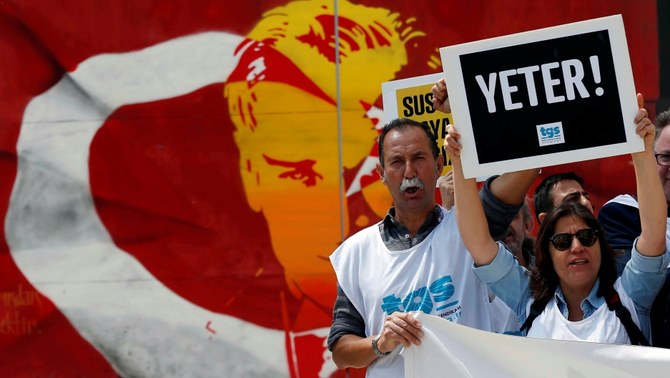
Members of the Journalists Union of Turkey (TGS) shout slogans during a demonstration to mark World Press Freedom Day, Istanbul, Turkey, May 3, 2017. The placard reads: Enough! (Reuters)
Short Url
Updated 09 April 2021
Follow

Top Turkish court reverses ban on news outlets

  • Several news outlets that closed, mostly from the Turkish left-wing and pro-Kurdish political camps, are expected to apply to reopen and demand compensation for financial losses
  • In Turkey, about 90 percent of major media TV and radio outlets are owned by pro-government figures and conglomerates, while independent journalism mainly exists in the digital sphere

ANKARA: Turkey’s top court has reversed a state of emergency decree issued in 2016 that led to the closure of dozens of media outlets that allegedly “threatened domestic security.”

The ruling is expected to pave the way for the return of several independent news channels and radio stations in the country.

The Constitutional Court of Turkey ruled that the decree violated “the principles of necessity and proportionality.”

It also ruled that the closure of media outlets without detailed inspections would constitute a violation of rights and freedoms.

Following the failed Turkish coup attempt in July 2016, several media organizations were forcibly closed after the decree was issued. It led to the main opposition Republican People’s Party (CHP) filing a petition to revoke the decree on grounds that it prevented people from exercising their right to information, which is a constitutional guarantee.

Several news outlets that closed, mostly from the Turkish left-wing and pro-Kurdish political camps, are expected to apply to reopen and demand compensation for financial losses, including seized assets.

Cases will be examined by the State of Emergency Inquiry Commission before a decision is made.

Hayatin Sesi TV was among the television channels that were closed following the decree. As part of the crackdown, the channel’s buildings were raided by police, its website was blocked, it was removed from the national satellite platform and its assets were seized.

The channel’s owners were also handed prison sentences for “spreading terror propaganda.”

The channel has challenged the closure order several times in the past, but an Ankara court overruled the appeals. Lawyers representing the channel are now preparing to apply to receive a broadcasting license.

“We always claimed that the closure was not based on legal grounds. Now we will use all our legal rights to get back our movable and immovable assets and to get back our broadcasting rights,” Devrim Avci, a lawyer representing Hayatin Sesi TV, told Arab News.

The channel, like others who will apply to the court, will also calculate the amount of advertisement revenue lost as a result of the closure.

In Turkey, about 90 percent of major media TV and radio outlets are owned by pro-government figures and conglomerates, while independent journalism mainly exists in the digital sphere.

Alpay Antmen, a CHP MP and lawyer by profession, said that authorities used the opportunity of the coup to target dissident media outlets and journalists under the pretext of fighting terror.

“But these were politically motivated moves to make the emergency state a permanent state. Authorities bypassed the parliament, tried to govern the country with presidential decrees, ignored checks and balances in governance and made the country dependent on one-man rule,” he told Arab News.

Antmen said that in the period following the coup, the economy, the rule of law and democracy all “collapsed,” while the media environment was “seriously polarized.”

He added: “The relevant clause that was annulled was a restriction of freedom of expression, press and the right to information.”


Grok faces more scrutiny over deepfakes as Irish regulator opens EU privacy investigation

Updated 31 sec ago
Follow

Grok faces more scrutiny over deepfakes as Irish regulator opens EU privacy investigation

  • The regulator says Grok has created and shared sexualized images of real people, including children. Researchers say some examples appear to involve minors
  • X also faces other probes in Europe over illegal content and user safety
LONDON: Elon Musk’s social media platform X faces a European Union privacy investigation after its Grok AI chatbot started spitting out nonconsensual deepfake images, Ireland’s data privacy regulator said Tuesday.
Ireland’s Data Protection Commission said it notified X on Monday that it was opening the inquiry under the 27-nation EU’s strict data privacy regulations, adding to the scrutiny X is facing in Europe and other parts of the world over Grok’s behavior.
Grok sparked a global backlash last month after it started granting requests from X users to undress people with its AI image generation and editing capabilities, including putting females in transparent bikinis or revealing clothing. Researchers said some images appeared to include children. The company later introduced some restrictions on Grok, though authorities in Europe weren’t satisfied.
The Irish watchdog said its investigation focuses on the apparent creation and posting on X of “potentially harmful” nonconsensual intimate or sexualized images containing or involving personal data from Europeans, including children.
X did not respond to a request for comment.
Grok was built by Musk’s artificial intelligence company xAI and is available through X, where its responses to user requests are publicly visible.
The watchdog said the investigation will seek to determine whether X complied with the EU data privacy rules known as GDPR, or the General Data Protection Regulation. Under the rules, the Irish regulator takes the lead on enforcing the bloc’s privacy rules because X’s European headquarters is in Dublin. Violations can result in hefty fines.
The regulator “has been engaging” with X since media reports started circulating weeks earlier about “the alleged ability of X users to prompt the @Grok account on X to generate sexualized images of real people, including children,” Deputy Commissioner Graham Doyle said in a press statement.
Spain’s government has ordered prosecutors to investigate X, Meta and TikTok for alleged crimes related to the creation and proliferation of AI-generated child sex abuse material on their platforms, Spanish Prime Minister Pedro Sánchez said on Tuesday.
“These platforms are attacking the mental health, dignity and rights of our sons and daughters,” Sánchez wrote on X.
Spain announced earlier this month that it was pursuing a ban on access to social media platforms for under-16s.
Earlier this month, French prosecutors raided X’s Paris offices and summoned Musk for questioning. Meanwhile, the data privacy and media regulators in Britain, which has left the EU, have opened their own investigations into X.
The platform is already facing a separate EU investigation from Brussels over whether it has been complying with the bloc’s digital rulebook for protecting social media users that requires platforms to curb the spread of illegal content such as child sexual abuse material.