

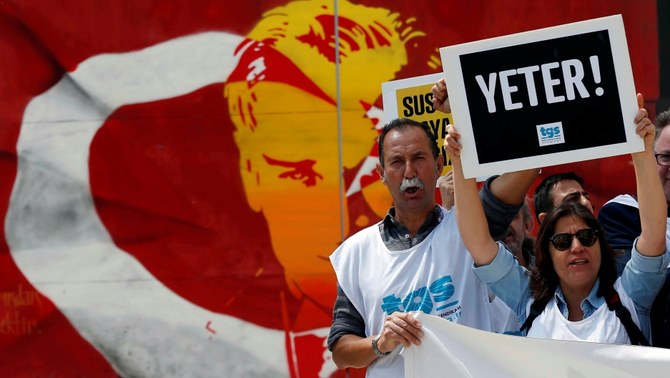

ANKARA: Turkey’s top court has reversed a state of emergency decree issued in 2016 that led to the closure of dozens of media outlets that allegedly “threatened domestic security.”
The ruling is expected to pave the way for the return of several independent news channels and radio stations in the country.
The Constitutional Court of Turkey ruled that the decree violated “the principles of necessity and proportionality.”
It also ruled that the closure of media outlets without detailed inspections would constitute a violation of rights and freedoms.
Following the failed Turkish coup attempt in July 2016, several media organizations were forcibly closed after the decree was issued. It led to the main opposition Republican People’s Party (CHP) filing a petition to revoke the decree on grounds that it prevented people from exercising their right to information, which is a constitutional guarantee.
Several news outlets that closed, mostly from the Turkish left-wing and pro-Kurdish political camps, are expected to apply to reopen and demand compensation for financial losses, including seized assets.
Cases will be examined by the State of Emergency Inquiry Commission before a decision is made.
Hayatin Sesi TV was among the television channels that were closed following the decree. As part of the crackdown, the channel’s buildings were raided by police, its website was blocked, it was removed from the national satellite platform and its assets were seized.
The channel’s owners were also handed prison sentences for “spreading terror propaganda.”
The channel has challenged the closure order several times in the past, but an Ankara court overruled the appeals. Lawyers representing the channel are now preparing to apply to receive a broadcasting license.
“We always claimed that the closure was not based on legal grounds. Now we will use all our legal rights to get back our movable and immovable assets and to get back our broadcasting rights,” Devrim Avci, a lawyer representing Hayatin Sesi TV, told Arab News.
The channel, like others who will apply to the court, will also calculate the amount of advertisement revenue lost as a result of the closure.
In Turkey, about 90 percent of major media TV and radio outlets are owned by pro-government figures and conglomerates, while independent journalism mainly exists in the digital sphere.
Alpay Antmen, a CHP MP and lawyer by profession, said that authorities used the opportunity of the coup to target dissident media outlets and journalists under the pretext of fighting terror.
“But these were politically motivated moves to make the emergency state a permanent state. Authorities bypassed the parliament, tried to govern the country with presidential decrees, ignored checks and balances in governance and made the country dependent on one-man rule,” he told Arab News.
Antmen said that in the period following the coup, the economy, the rule of law and democracy all “collapsed,” while the media environment was “seriously polarized.”
He added: “The relevant clause that was annulled was a restriction of freedom of expression, press and the right to information.”


