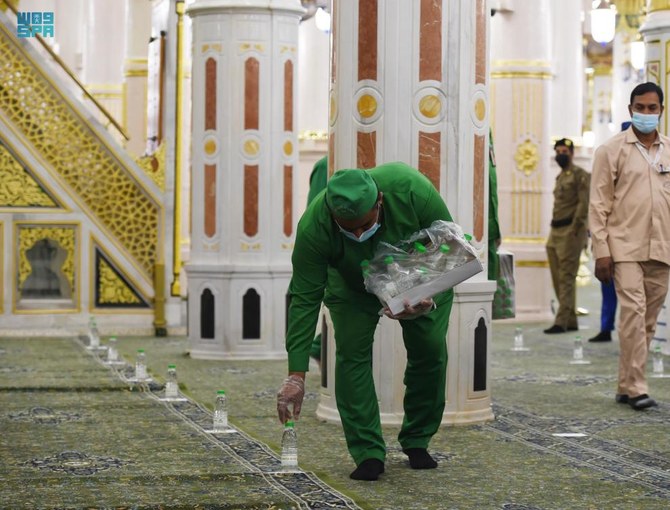
MADINAH: The General Presidency for the Affairs of the Prophet’s Mosque is intensifying efforts to prepare the mosque ahead of the holy month of Ramadan in line with COVID-19 precautionary measures.
Only people who have received two doses of a coronavirus vaccine or have recovered from the virus or have had one shot of a vaccine more than 14 days prior to visiting the mosque may visit or pray in the Rawdah, Saudi Press Agency (SPA) reported.
The Rawdah lies between the Sacred Chamber (known as the Prophet’s house), and the Prophet’s Minbar (pulpit).
Each person’s vaccination status will need to be registered on Saudi Arabia’s COVID-19 app, Tawakkalna.
Three million bottles of Zamzam water will be distributed to worshipers and visitors during Ramadan which amounts to 100,000 bottles of water per day, the presidency said.
Each worshipper will be individually presented with dates and water for Iftar and social distancing is to be observed at all times.
Arranging and distributing sahoor meals in the mosque’s courtyards is prohibited, the presidency said.
Itikaf (staying in a mosque for a certain number of days whilst devoting oneself to worship) will be suspended for the second year running due to the pandemic.
Worshippers are also required to use the national parking app “Mawqif” to facilitate their exit from the mosque.
Ramadan 2021 is due to start on either Monday or Tuesday in the Kingdom.

Prophet’s Mosque in Madinah prepares for Ramadan amid pandemic
https://arab.news/ph8nm
Prophet’s Mosque in Madinah prepares for Ramadan amid pandemic
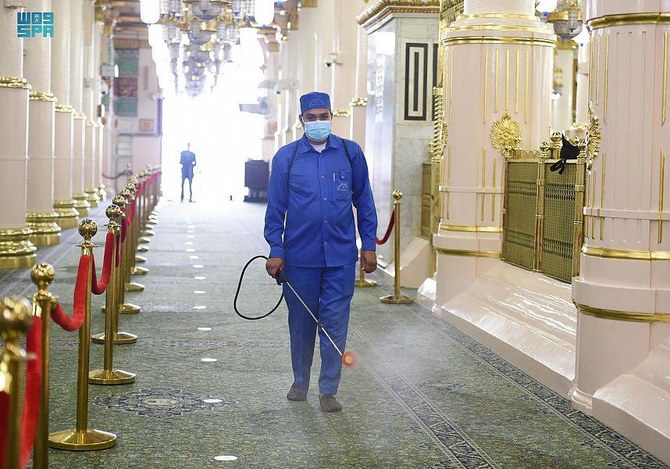
- Three million bottles of Zamzam water will be distributed to worshipers and visitors during Ramadan
- Each worshipper will be individually presented with dates and water for Iftar
Saudi reserve records critically endangered Ruppel’s vulture
RIYADH: King Abdulaziz Royal Reserve Development Authority has announced the sighting and documentation of a Ruppel’s vulture (Gyps rueppellii) within the boundaries of the reserve — a landmark environmental and historical event.
This is the third officially documented record of the species at national level and the first of its kind in the central and eastern regions of the Kingdom, the Saudi Press Agency reported.
The sighting carries global significance given the conservation status of the vulture, which is classified as critically endangered by the International Union for Conservation of Nature, following the loss of more than 90 percent of its population throughout its original range in Africa over the past three decades.
The appearance of this rare bird in King Abdulaziz Royal Reserve adds a new entry to the limited record of its sightings in the Kingdom, which began in Aseer region in 1985, followed by a sighting in 2018, and another in AlUla in September 2025.
Its latest recording in central and eastern Saudi Arabia is considered an important environmental indicator of the quality of natural habitats provided by the reserve.
Globally, Ruppel’s vulture faces major threats, including poisoning from pesticides, electrocution, collisions with power lines, and the loss of nesting sites as a result of urban expansion and land-use change.
Additional challenges include the decline of carrion resulting from changes in livestock-rearing practices, illegal hunting for use in traditional beliefs, and the adverse effects of climate change on its breeding areas and migratory routes.
The vulture is primarily found in the African Sahel and is considered extremely rare in the Arabian Peninsula. Its sighting in King Abdulaziz Royal Reserve underscores the Kingdom’s leading role in conserving biodiversity and supporting the objectives of Saudi Vision 2030 for protecting ecosystems.
It also reflects the success of the authority’s efforts to protect wildlife and restore ecosystems, positioning the reserve as a safe and attractive habitat for rare and native species.