South Africa, Pakistan clash in shadow of Indian Premier League

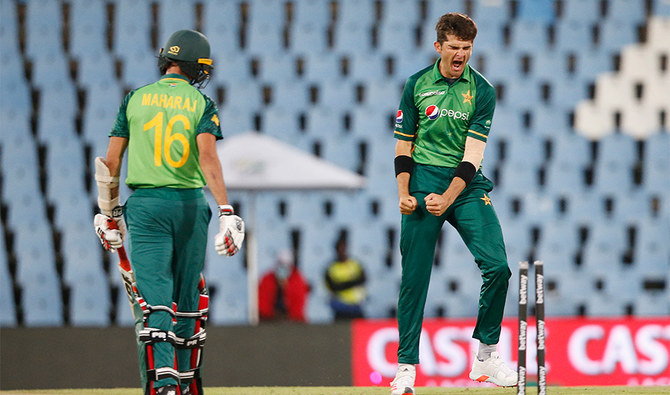
Pakistan's Shaheen Shah Afridi (R) celebrates after the dismissal of South Africa's Keshav Maharaj (L) during the third one-day international cricket match between South Africa and Pakistan at SuperSport Park in Centurion on April 7, 2021. (AFP)
Short Url
Updated 09 April 2021
Follow

South Africa, Pakistan clash in shadow of Indian Premier League

  • Cricket South Africa want to stay on the right side of their Indian counterparts by releasing their stars
  • Cannot afford to pay the sort of money that would persuade their leading players to put country ahead of club

Johannesburg: Many of South Africa’s best cricketers will be involved in Twenty20 matches on Saturday — but only some of them will be playing for their country in the first of four T20 internationals against Pakistan at the Wanderers Stadium in Johannesburg.
The series is being played at the same time as the early stages of the Indian Premier League and the juxtaposition provides a clear illustration of the relative standing of the two international teams.
As the first innings in Johannesburg draws to a close on Saturday, Chennai Super Kings and Delhi Capitals will take the field in the IPL.
Former South African captain Faf du Plessis, fast bowler Lungi Ngidi and leg-spinner Imran Tahir are in the CSK squad, while fast bowlers Kagiso Rabada and Anrich Nortje are contracted to Delhi.
Although they may sit out the first round of IPL games because of quarantine restrictions, all three of South Africa’s pace battery in the first two one-day internationals against Pakistan last weekend — Rabada, Nortje and Ngidi — will be in Mumbai instead of playing in Johannesburg.
Also in India after playing in the first two games against Pakistan are batsmen Quinton de Kock and David Miller, while IPL stars AB de Villiers and Chris Morris appear to have been lost to international cricket.
Pakistan, by contrast, have not lost any players to the IPL.
The non-participation of Pakistan players in cricket’s richest league owes more to politics than playing ability because the likes of Babar Azam, Fakhar Zaman and Shaheen Shah Afridi would slot comfortably into any IPL side.
South Africa’s situation is one of pragmatism.
Cricket South Africa want to stay on the right side of their Indian counterparts by releasing their stars and in any case cannot afford to pay the sort of money that would persuade their leading players to put country ahead of club, especially for a tournament that was arranged less than two months ago.
South Africa head coach Mark Boucher put a positive spin on the loss of key players to the IPL, noting that they will be sharpening their skills against world-class opponents in the country where the T20 World Cup will be played later this year.
And the holes left in the national side provide opportunities for fringe players to push longer-term claims.
There are four uncapped men in the South African squad.
Pakistan won the one-day series that finished on Wednesday and will start favorites to win the T20 games as well.
They appear to be stronger in both batting and bowling, with South Africa’s batting further weakened by the likely absence through injury of captain Temba Bavuma and Rassie van der Dussen.
Pakistan, though, will be looking for bigger contributions from their middle order batsmen after the bulk of their runs in the one-day games came from their top three, Fakhar Zaman, Imam-ul-Haq and Babar Azam.
Imam is not in the T20 squad but Fakhar, not originally in the squad, has been added, while Sharjeel Khan and Haider Ali will be vying for game time.


Survivor recalls ‘chaos’ after suicide bomber struck Islamabad mosque

Updated 5 sec ago
Follow

Survivor recalls ‘chaos’ after suicide bomber struck Islamabad mosque

  • Witnesses say worshippers were bowing in prayer when blast tore through imambargah
  • Authorities blame Daesh network, say attack planned and bomber trained in Afghanistan

ISLAMABAD: Hamza Ali Naqvi was bowing with his hands on his knees during Friday prayers when the first shot rang out. The 21-year-old university student initially mistook the sharp crack for distant fireworks. Seconds later, a second shot, much louder and much closer, resounded through the Qasr-e-Khadijatul Kubra mosque.

“We were prostrating,” Naqvi recalled, his eyes still showing signs of fear as he described the moment the floor beneath him shook from the force of the blast. “I immediately got up, looked around and [saw that] chaos had broken out.”

Friday’s suicide bombing in the Tarlai Kallan area on the outskirts of Islamabad has left 32 people dead and over 150 injured, marking the deadliest assault on the Pakistani capital in nearly two decades. On Saturday, a police officer was killed and four suspects, including an “Afghan Daesh mastermind” behind the attack, were arrested in overnight raids in Peshawar and Nowshera, according to a statement released by Pakistan’s Interior Ministry on social media.

For the survivors, everything else is secondary to the carnage they witnessed in the moments that followed the blast. Naqvi, who had been standing near the door in the fifth or sixth row, said that he stepped over the bodies to reach the epicenter of the explosion.

“When I reached there, I saw a severed head,” he said. “I found out later that it was the head of the attacker.”

“Because people were prostrating, most injuries were to the legs and backs,” he added. “When we lifted the injured, their legs were broken. Those whom I personally helped had broken legs. As we were lifting them, they were screaming and crying.”

Among the screams was the voice of a child, no older than 10, standing over the body of his father, Naqvi recalled as he prayed for the departed souls at the graves of those laid to rest on Saturday.

“I have become an orphan,” he said, quoting the boy who was screaming.

“We were helpless,” he added. “There was nothing we could do.”

While Naqvi was trying to help the injured, 24-year-old Malik Aon Abbas did not survive the attack. Abbas, who had just been engaged and was set to be married later this year, is being hailed as a hero by his family who say he prevented an even higher death toll.

His younger brother, Muntazir Mehdi, said Abbas was in the back rows when two attackers stormed into the mosque. One of them reportedly fled, but the other, already wounded by gunfire from security guards, rushed toward the main congregation.

“The attacker continued firing inside, but my brother abandoned his prayer and caught him,” Mehdi said. “He restrained him and grabbed him. As soon as my brother took hold of him, the attacker detonated himself.”

Mehdi, who shared a deep bond with his brother through their mutual love of religious gatherings and Abbas’s hobby of going live on TikTok, said the family stood between grief and pride.

“Because of my brother, had he, God forbid, not stopped this man, a very major tragedy would have occurred,” Mehdi continued. “He has raised all our heads with pride.”

Pakistan’s interior ministry said on Saturday the attack was carried out by Daesh, with its planning and the bomber’s training being done in Afghanistan.

“The nexus of terrorism under Afghan Taliban patronage remains a serious threat to regional peace,” it said in a social media post, adding that a law enforcement official was killed during the raids carried out to capture the facilitators of the attacker.

Taliban’s Afghan government has denied any role in the attack advising Pakistani authorities to “fulfil their obligations, responsibly review their policies, and adopt a constructive approach based on positive engagement and cooperation.”

For survivors like Naqvi, the horror of that Friday is far from over.

“I went to university, but even there, the same images kept coming back,” he said. “It keeps replaying in my mind. It is difficult to come out of it.”