



ISLAMABAD: Civil society activists organized a protest at the National Press Club on Thursday, demanding an apology from Prime Minister Imran Khan for a recent statement on sexual violence against women, where he said wearing the veil, the traditional Islamic head covering, would protect women from sexual assault and not lead men into temptation.
In a statement that has caused outrage among activists and opposition politicians, Khan said rising “vulgarity” was responsible for an increase in the number of cases of sexual violence.
Members of the ruling Pakistan Tehreek-e-Insaf (PTI) party have said Khan’s statement was misinterpreted and misunderstood.
Arslan Khalid, the prime minister’s focal person on digital media, told Arab News the prime minister had “never engaged in victim blaming,” adding that certain segments of his interview were lumped together, causing “misunderstanding.”
“Initially, he spoke about how the government had put in place robust rape laws to deal with the rising cases of sexual assault,” Khalid said in a phone interview. “And then, in a different context, he spoke about society, mentioning pardah [veil] which is not just a piece of cloth for women but also [a symbol of] respect.”
“People understand it as being specific to women, but it applies to both genders,” Khalid said. “It is about respecting other people’s space, about yourself when you interact with others.”
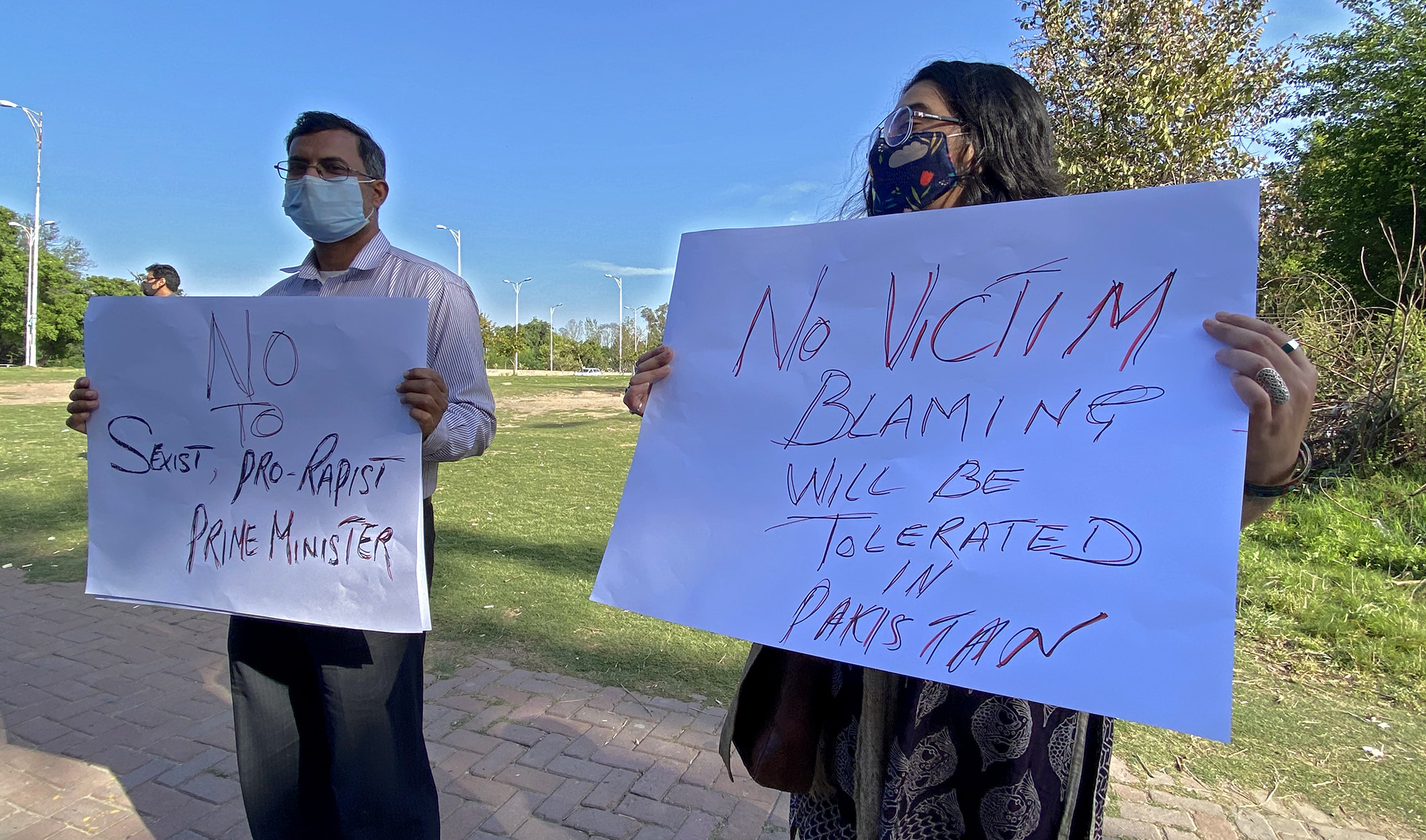
Protestors gather at the National Press Club in Islamabad to demand an apology from Prime Minister Imran Khan for his controversial remarks regarding rising sex crime cases in the country on April 8, 2021. (AN photo)
Asked what the prime minister meant when he spoke about “vulgarity” giving rise to sexual assault cases, ruling party senator Faisal Javed Khan said the PM could not be accused of victim-blaming.
“He did not put the responsibility on the victims [of sexual violence] or what they were wearing when he used that word,” Khan said in a phone interview. “Nowhere did he explicitly say that. He said that the root cause was the presence of such media being readily available on phones which everyone has, and we need to fight this together as a society.”
The government issued an official statement on Wednesday saying Khan’s comments had been “distorted to mean something that he never intended.”
“The Prime Minister said that our strict anti-rape laws alone will not be able to stem the rise in sex crime,” the statement said. “The whole society has to fight it together.”
Major clerics and religious bodies also announced their support on Thursday for PM Khan’s statement, saying “obscenity and nudity played a key role behind instances of molestation and abuse” and the prime minister’s stance would be “lauded” at Friday congregation prayers around the country.
But women’s rights activists say they were dismayed.
“The prime minister needs to have some gender awareness,” said Farzana Bari, an organizer of Thursday’s protest. “How can a head of a government make such irresponsible statements which are indirectly creating sympathy for rapists? This is why we are here since we demand something better from him and the state.”
Bari said Khan’s comments reflected a lack of understanding about crimes of sexual violence.
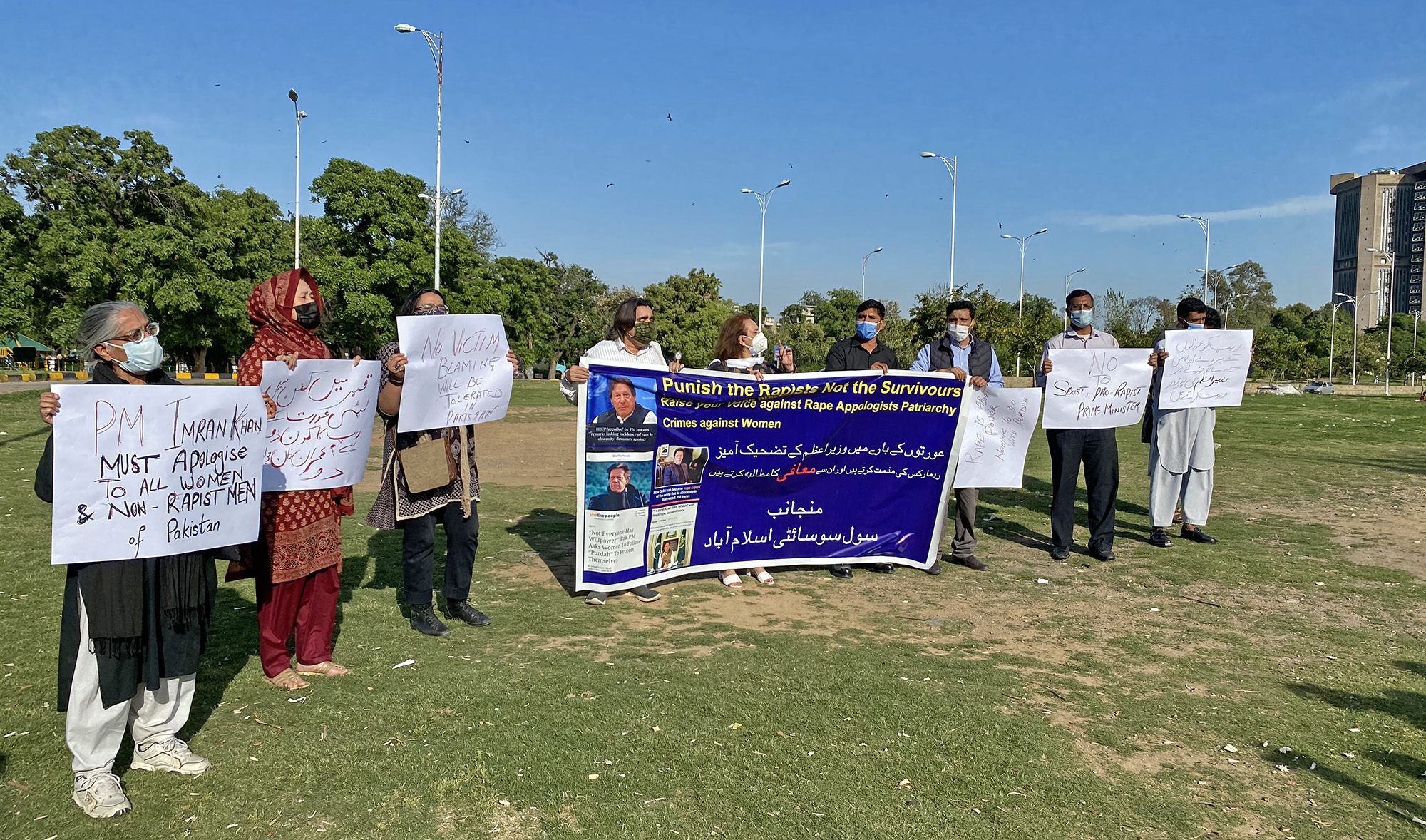
Protestors gather at the National Press Club in Islamabad to demand an apology from Prime Minister Imran Khan for his controversial remarks regarding rising sex crime cases in the country on April 8, 2021. (AN photo)
Renowned women’s rights activist Tahira Abdullah said the prime minister’s statement betrayed a “misogynistic” mindset.
“He has gone beyond the pale, absolutely, of what is acceptable,” she told Arab News.
Abdullah said Khan not only owed an apology to women but also to Pakistani men.
“To say that men cannot control themselves and resist the temptation of women without a veil in the public is to imply that men cannot control their ‘rapist tendencies,’” she said.
The demands made by activists for an apology in Thursday’s protest were also mirrored by opposition leaders like Senator Sherry Rehman of the Pakistan Peoples Party (PPP).
“Blaming vulgarity for the rise in rape cases is ridiculous as this removes the onus of responsibility from the rapist,” she said in a written message. “Rape is an act of violence where the rapist wants to establish his power and authority. A person’s body and autonomy are violated. Is the PM telling the women of this country that it is their fault if they get raped?“
Muhammad Zubair, a Pakistan Muslim League-Nawaz (PML-N) politician, had the same query.
“His analysis is not just completely wrong, but it is dangerous for the prime minister of a country to suggest that the blame [for sexual assaults] falls on women and the way they dress up,” he told Arab News over the phone. “Victims of rape can be as young as 5 or 6 years of age … How can you blame them or imply that they somehow provoked men into committing such act of violence?“
“Without question, there must be an apology,” Zubair added.


