

Italian opera star hits the high notes in world-first AlUla concert

1 / 4
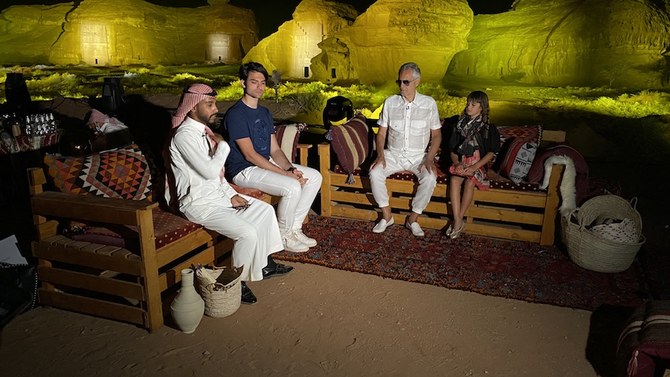
The performance will see Andrea Bocelli, 62, perform against the backdrop of Nabataean tombs in the ancient city of Hegra. (Supplied)
2 / 4
Andrea Bocelli with family, including son Matteo, at Hegra, AlUla. (Supplied)
3 / 4
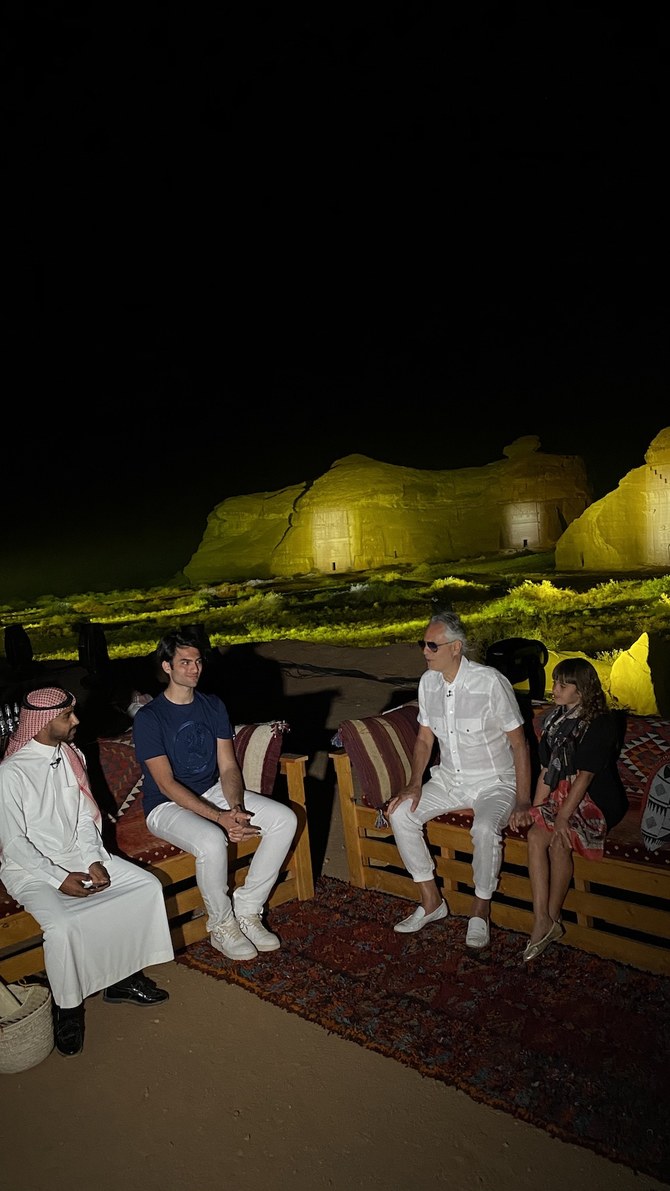
Andrea Bocelli with family, including son Matteo, at Hegra, AlUla. (Supplied)
4 / 4
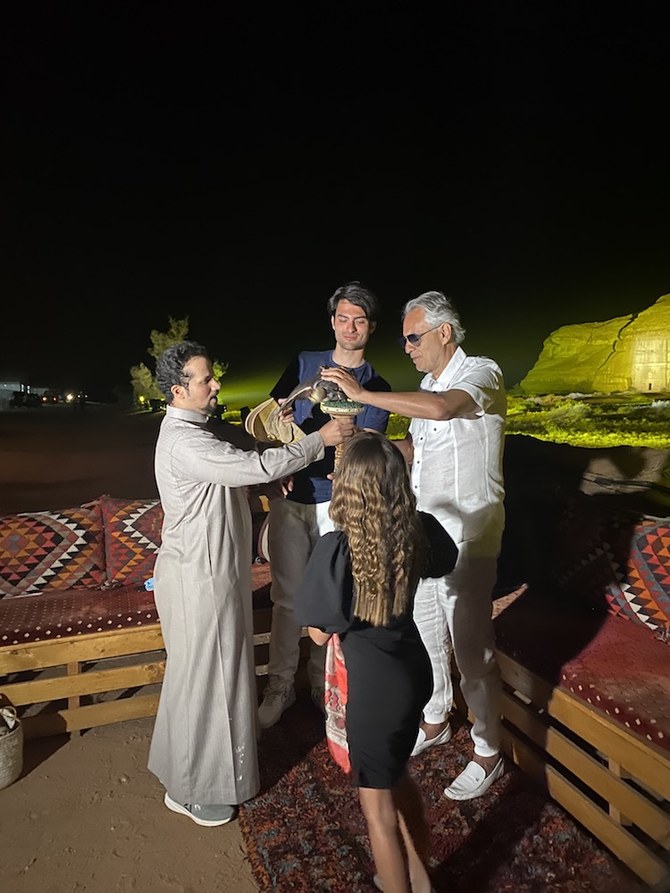
Andrea Bocelli with family, including son Matteo, at Hegra, AlUla. (Supplied)
Short Url
Updated 09 April 2021
Follow

Italian opera star hits the high notes in world-first AlUla concert

  • Only 300 people will be allowed to attend the concert in person
  • Performance is being live-streamed live on Bocelli's YouTube channel

ALULA: Italian opera tenor Andrea Bocelli enchanted an audience in AlUla on Thursday in what is believed to be the first-ever performance within the walls of the ancient desert city.

In his third performance in the Kingdom, Bocelli serenaded a limited number of concert-goers at the heritage site due to social distancing measures, but the concert was no less mesmerising than his previous shows at Maraya Concert Hall as part of the Winter at Tantora Festival.

The biggest surprise of the evening was the tenor’s 9-year-old daughter Virginia Bocelli, making a Middle East debut with her father on the stage playing the guitar and singing the lyrics the iconic Leonard Cohen song “Hallelujah”.
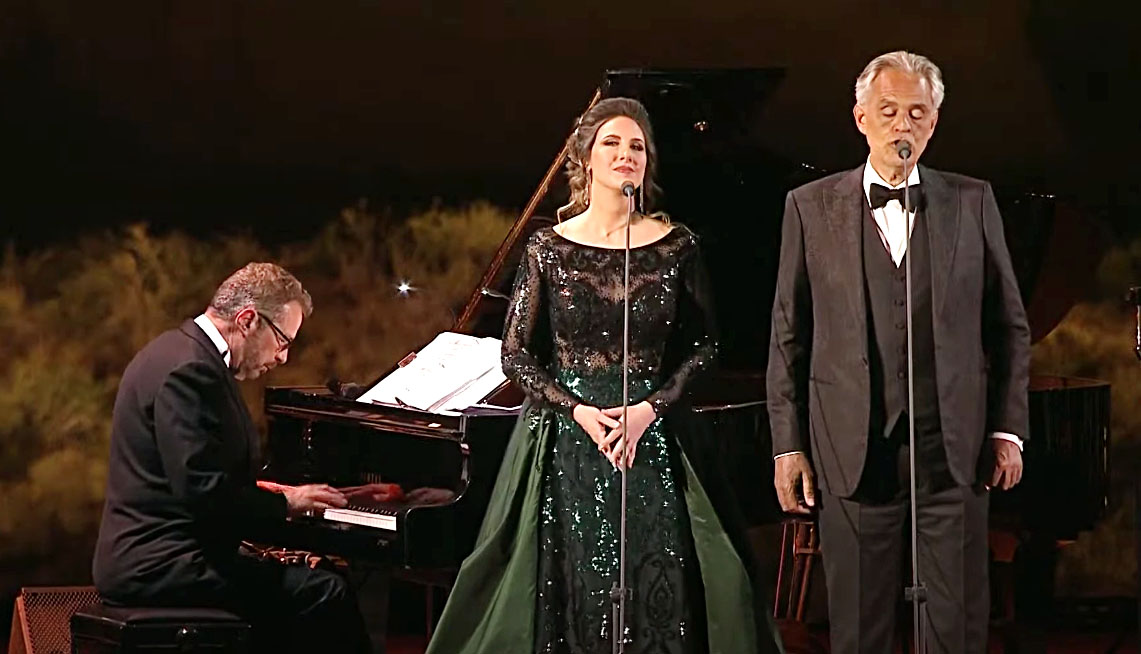


The master tenor delivered a stripped- back set with musicians from the Arabian Philharmonic, and special guests Loren Allred, Matteo Bocelli, soprano Francesca Maionchi and Eugene Kohn at the piano.

The spectacular backdrop to the concert and the response of the audience left him eager to perform in other Saudi cities.

“It is rare to perceive such a strong empathy such as that experienced in your land,” Bocelli told Arab News.

“At each concert, I am amazed by the warmth with which I am welcomed, and I feel alive and privileged to witness the brotherly power of music,” he said.

Bocelli’s performance to fewer than 300 people is believed to be the first within the walls of the ancient desert city of Hegra.
 
Recalling his previous concerts in the Kingdom, the master tenor said that is happy to see how popular his music is among Saudis. “It is a nice surprise that keeps on increasing every time I return.”
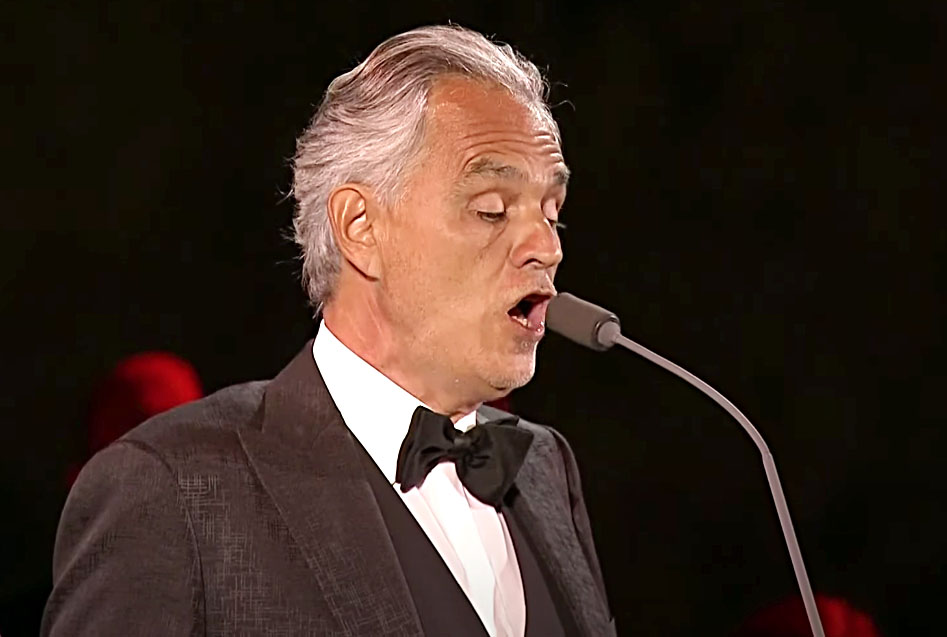


The spectacular backdrop to the concert and the response of the audience left him eager to perform in other Saudi cities.

Bocelli said that he has heard about the “refined culture of hospitality” that distinguishes Saudis, but experiencing it firsthand was overwhelming and “exceeded all expectations.”
 
The tenor shared a few tips for professional and aspiring Saudi opera singers, reminding them that a beautiful voice is only one of many “necessary ingredients.”

“To be able to sing well, in a convincing way, you need to have a passion. If you want to excite those who listen to you, you need to have something to tell, values to communicate and share.

“It takes determination, frankness and discipline, but always proceeding with optimism and confidence in one’s passions,” he said.
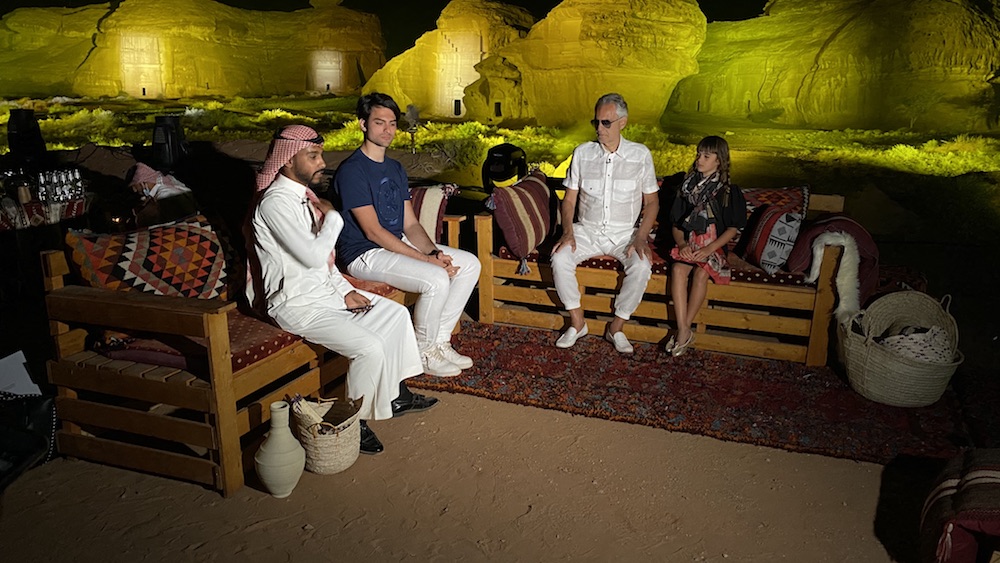


Andrea Bocelli with family, including son Matteo, at Hegra, AlUla. (Supplied)

Bocelli advised Saudi opera singers not to be intimidated by the challenges, but to “treasure any accidents along the way, and do not give up, do not stop believing in your potential.”

AlUla’s captivating beauty and serenity, and the welcoming nature of its locals were among many memories the musician said he will take home.

“I think of the splendor of the clear air that dominates your views. Having to choose one favorite thing about Saudi Arabia, I cannot fail to mention the enchanted place that is AlUla, a spectacular and magical witness to man’s quest for beauty.”

The master tenor delivered a stripped-back set with musicians from the Arabian Philharmonic, and special guests Loren Allred, Matteo Bocelli, soprano Francesca Maionchi and Eugene Kohn at the piano.
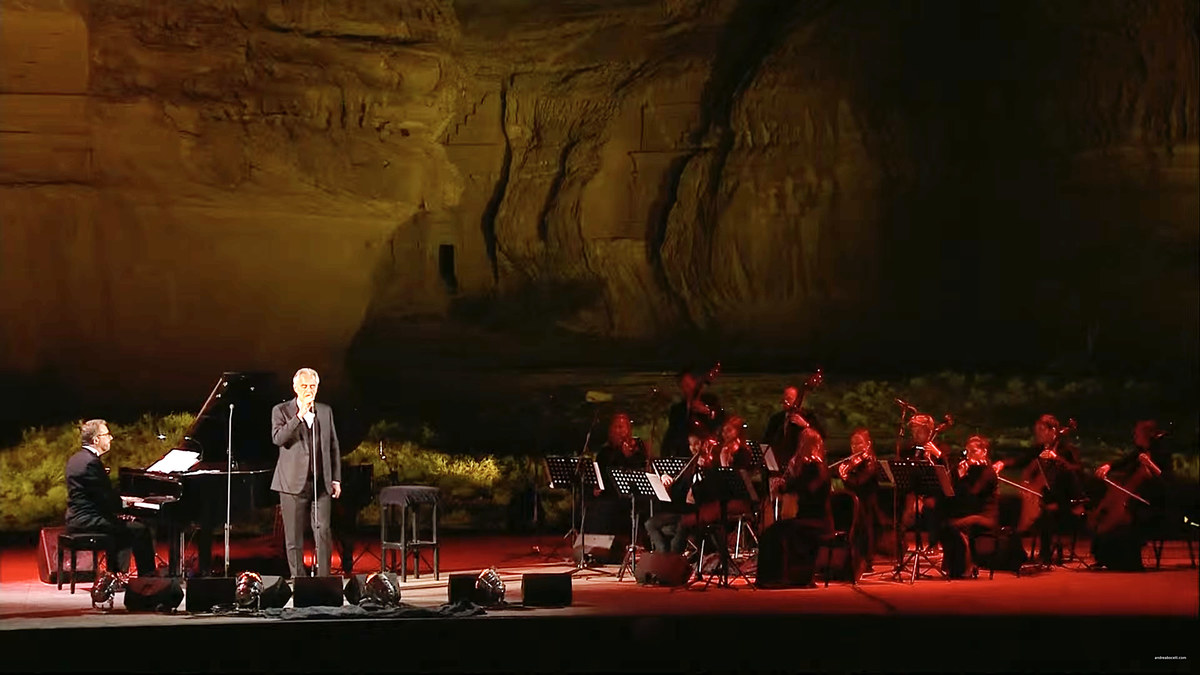


Bocelli performed against a backdrop of 20 carved tombs of Al-Khuraymat.

Hegra, built in the first century by the Nabataean kingdom, is an ancient desert city home to thousands of tombs cut into sandstone mountains. At least 100 tombs have elaborate carved facades, a signature of the skilled Nabataean craftsmen.

Bocelli performed against a backdrop of 20 carved tombs of Al-Khuraymat.

Archaeologists say the tombs are among the best preserved in Hegra, and feature elegant gynosphinxes (spirit guardians with women’s heads, lions’ bodies and wings) adorning the pediments.


These shy, scaly anteaters are the most trafficked mammals in the world

Updated 21 February 2026
Follow

These shy, scaly anteaters are the most trafficked mammals in the world

CAPE TOWN, South Africa: They are hunted for their unique scales, and the demand makes them the most trafficked mammal in the world.
Wildlife conservationists are again raising the plight of pangolins, the shy, scaly anteaters found in parts of Africa and Asia, on World Pangolin Day on Saturday.
Pangolins or pangolin products outstrip any other mammal when it comes to wildlife smuggling, with more than half a million pangolins seized in anti-trafficking operations between 2016 and 2024, according to a report last year by CITES, the global authority on the trading of endangered plant and animal species.
The World Wildlife Fund estimates that over a million pangolins were taken from the wild over the last decade, including those that were never intercepted.
Pangolins meat is a delicacy in places, but the driving force behind the illegal trade is their scales, which are made of keratin, the protein also found in human hair and fingernails. The scales are in high demand in China and other parts of Asia due to the unproven belief that they cure a range of ailments when made into traditional medicine.
There are eight pangolin species, four in Africa and four in Asia. All of them face a high, very high or extremely high risk of extinction.
While they’re sometimes known as scaly anteaters, pangolins are not related in any way to anteaters or armadillos.
They are unique in that they are the only mammals covered completely in keratin scales, which overlap and have sharp edges. They are the perfect defense mechanism, allowing a pangolin to roll up into an armored ball that even lions struggle to get to grip with, leaving the nocturnal ant and termite eaters with few natural predators.
But they have no real defense against human hunters. And in conservation terms, they don’t resonate in the way that elephants, rhinos or tigers do despite their fascinating intricacies — like their sticky insect-nabbing tongues being almost as long as their bodies.
While some reports indicate a downward trend in pangolin trafficking since the COVID-19 pandemic, they are still being poached at an alarming rate across parts of Africa, according to conservationists.
Nigeria is one of the global hot spots. There, Dr. Mark Ofua, a wildlife veterinarian and the West Africa representative for the Wild Africa conservation group, has rescued pangolins for more than a decade, which started with him scouring bushmeat markets for animals he could buy and save. He runs an animal rescue center and a pangolin orphanage in Lagos.
His mission is to raise awareness of pangolins in Nigeria through a wildlife show for kids and a tactic of convincing entertainers, musicians and other celebrities with millions of social media followers to be involved in conservation campaigns — or just be seen with a pangolin.
Nigeria is home to three of the four African pangolin species, but they are not well known among the country’s 240 million people.
Ofua’s drive for pangolin publicity stems from an encounter with a group of well-dressed young men while he was once transporting pangolins he had rescued in a cage. The men pointed at them and asked him what they were, Ofua said.
“Oh, those are baby dragons,” he joked. But it got him thinking.
“There is a dark side to that admission,” Ofua said. “If people do not even know what a pangolin looks like, how do you protect them?”