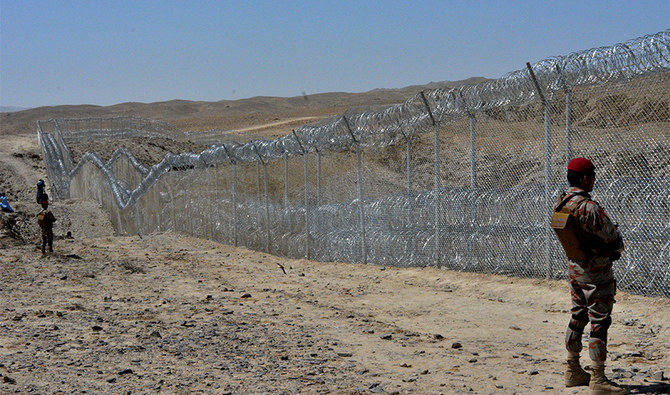
KARACHI: Pakistan is ‘speedily’ fencing its border with Iran and Afghanistan to curb militant attacks, Balochistan’s home minister told Arab News in an exclusive interview this week, admitting that the measure would impact the livelihood of people who depended on cross-border trade but adding that maintaining peace was the government’s top priority.
In recent years, relations between Iran and Pakistan have been strained with both sides accusing each other of not doing enough to stamp out militants allegedly sheltering across their 900-km border.
In 2019, the two nations said they would form a joint quick reaction force to combat militant activity on their shared border, frequently used for trade and by minority Shia Muslims who travel from Pakistan to Iran for religious pilgrimages. The border is also the entry point of a lucrative, illegal fuel trade that authorities have struggled to crackdown on for decades.
“Our long [western] border is not safe, due to which terrorism happens on a daily basis and people’s lives are under threat,” Mir Ziaullah Langau said in an interview on Monday.
“So, the first thing you do is to [protect] the lives of people,” he said, adding that work on fencing was “underway speedily.”
Pakistan started fencing its western border two years ago, with the country’s Economic Coordination Committee allocating Rs3 billion ($18.6 million) in additional funding to fence the stretch along Iran in April last year.
Almost all border districts of Balochistan heavily rely on the illegal trade of Iranian fuel and other products, with many arguing that the complete fencing of the border would deprive a large population of its primary source of income if the government did not provide alternative means of livelihood.
Langau admitted it was the responsibility of the state to help people make a living, adding that a committee under his chairmanship was already looking into the issue.
“We are making a free economic zone and trying to promote legal businesses,” he said. “We have decided to employ people who may suffer due to border fencing in four government departments: police, levies, frontier constabulary and the provincial disaster management authority.”
Balochistan has for decades been the site of a a low-level insurgency by separatist groups seeking a greater share of the province’s gas and mineral revenue. While authorities say they have largely quelled the insurgency, sporadic incidents of violence continue to take place across the region.
Asked about the overall security situation in the province, the Balochistan home minister said it had improved though more work needed to be done.
“There was a time when we were witnessing daily suicide attacks,” Langau said. “However, the sacrifices of our security forces have brought down the number of such incidents to a significant extent, though terrorism has not entirely disappeared.”
Langau said his government believed in resolving issues through negotiations, adding that peace talks with disgruntled Baloch leaders could not happen in an “atmosphere of terrorism.”
“Our government wants to talk to everyone and resolve issues through negotiations, but terrorism should stop,” he said. “It is not possible to hold dialogue in an atmosphere of terrorism.”
The provincial home minister denied any official deliberations on the idea of turning Gwadar into the province’s southern capital.
“Balochistan is a very big province and constitutes about half of Pakistan’s landmass,” he said. “There is no harm if such a decision was taken for administrative purposes. However, this thing has not been discussed in the cabinet or any official forum.”
However, he said turning Gwadar into a capital would benefit the area’s people.
“If the chief minister and his cabinet are there in Gwadar,” Langua said, “they will be able to address the challenges faced by locals in their native environment instead of Quetta.”


![]()

Fencing Iran, Afghan border may impact locals but peace first priority — Balochistan home minister
Short Url
https://arab.news/mquau
Fencing Iran, Afghan border may impact locals but peace first priority — Balochistan home minister
- Mir Ziaullah Langau rules out talks with disgruntled Baloch separatist leaders in an ‘atmosphere of terrorism’
- Says plan to make Gwadar southern capital of Balochistan not discussed at any official forum
Latest updates


© 2026 SAUDI RESEARCH & PUBLISHING COMPANY, All Rights Reserved And subject to Terms of Use Agreement.