

Unearthed Arabian treasures reveal fate of one of history’s most brutal pirates

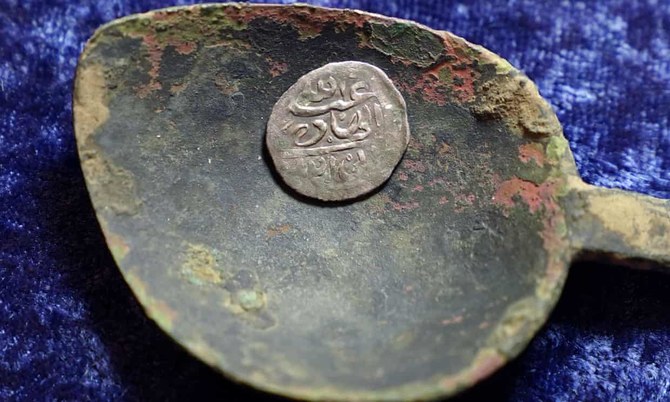
A 17th-century Arabian silver coin that research shows was struck in 1693 in Yemen. (AP Photo)
Short Url
Updated 01 April 2021
Follow

Unearthed Arabian treasures reveal fate of one of history’s most brutal pirates

  • In 1693, Capt. Henry Every captured a boatload of pilgrims returning from Makkah
  • An amateur historian’s discovery of coins in New England reveals what happened to the pirate

LONDON: Ancient coins unearthed in a New England orchard have given historians a clue as to the fate of one of history’s most heinous, and until now mysterious, pirates.

Amateur historian Jim Bailey discovered a series of ancient Arabian coins while metal detecting in a pick-your-own orchard in Rhode Island in the US.

Their provenance has shed light on how a man who was once the world’s most wanted criminal disappeared into thin air.

The coins, the oldest ever found in North America, reveal the previously unknown story of Capt. Henry Every.

In 1695, he made a name for himself when he and his crew ransacked wealthy Indian pilgrims, returning home from Makkah, aboard a ship owned by one of the world’s wealthiest men.

They killed the men, raped the women and made off to the Bahamas with tens of millions of dollars’ worth of gold and silver coins. 

They quickly became the world’s most wanted pirates, with even England’s King William III placing a huge bounty on their heads. “Everybody was looking for these guys,” said Bailey.

Until now it was known that they landed in Ireland at one point, but from there the trail went cold. Bailey’s discovery is evidence that they ultimately landed in the US.

The Arabic text on the coins that Bailey found was the first clue as to the importance of his discovery.

Research confirmed that the coins were minted in 1693 in Yemen, and since his first discovery in 2014 many more have been found.

“It seems like some of (Every’s) crew were able to settle in New England and integrate,” said Sarah Sportman, the state archaeologist for Connecticut, where one of the coins was found in 2018 in the ongoing excavation of a 17th-century farm site. “It was almost like a money-laundering scheme.”

Records show that the crew posed as slave traders — even purchasing four dozen slaves in French colonies to look the part, Sportman said — before reaching their final destination of the American colonies.

By posing as a slave trader — then a booming new profession in New England — one of the world’s most brutal pirates was able to hide in plain sight.


Berlinale responds to backlash over Gaza-related comments

Updated 16 February 2026
Follow

Berlinale responds to backlash over Gaza-related comments

The Berlin International Film Festival has issued a statement after what organisers described as a growing “media storm” linked to comments about the war in Gaza and the broader role of politics in cinema.

Festival director Tricia Tuttle released a lengthy note late Saturday following criticism directed at several high-profile guests. The controversy began during the opening day press conference when jury president Wim Wenders was asked about the conflict in Gaza. He responded: “We have to stay out of politics because if we make movies that are dedicatedly political, we enter the field of politics,” a remark that sparked swift backlash online.

Indian author Arundhati Roy later withdrew from the festival, reportedly angered by the remarks.

Other prominent figures, including Michelle Yeoh and Neil Patrick Harris, also faced online criticism after responding cautiously to questions about politics. Harris stated that he was interested in “doing things that were ‘apolitical,’” a comment that further fuelled debate.

In her statement, Tuttle defended the festival and its participants, stressing the importance of artistic freedom. “People have called for free speech at the Berlinale. Free speech is happening at the Berlinale. But increasingly, filmmakers are expected to answer any question put to them. They are criticised if they do not answer. They are criticised if they answer and we do not like what they say. They are criticised if they cannot compress complex thoughts into a brief sound bite when a microphone is placed in front of them when they thought they were speaking about something else,” she said.

She added: “It is hard to see the Berlinale and so many hundreds of filmmakers and people who work on this festival distilled into something we do not always recognise in the online and media discourse… It is a large, complex festival.”

“Artists are free to exercise their right of free speech in whatever way they choose… nor should they be expected to speak on every political issue raised to them unless they want to,” Tuttle said.