

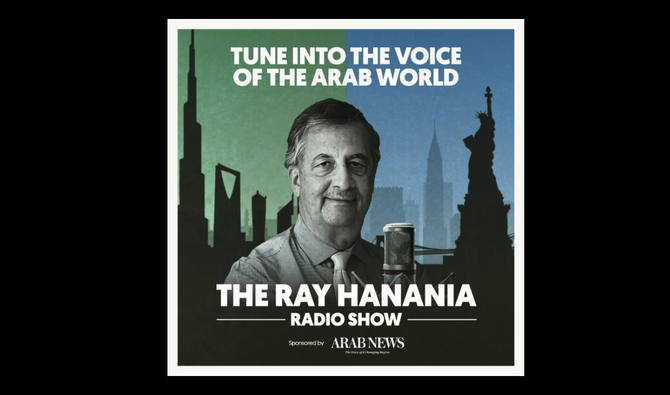
Turn on, tune in: Ray Hanania radio show returns for 2nd season

Short Url
Updated 05 April 2022
Follow

Turn on, tune in: Ray Hanania radio show returns for 2nd season

  • The show, sponsored by Arab News, will be broadcast on the US Arab Radio Network every Wednesday from 8 a.m. to 9 a.m. EST, with a new guest each week
  • Apart from hosting regular guests, the show will also showcase a writer from Arab News each week to discuss a feature from the paper

LONDON: The Ray Hanania radio show returns for its second season on Wednesday with a wide array of guests tackling crucial topics in the Arab world — a timely return at the start of Arab American Heritage Month.

“Although we are Arab American and Middle East oriented, in English, our audiences are not just Arab American but Americans and others who are interested in understanding the Middle East issues and events,” Hanania told Arab News.

“I’m hoping that President Biden will tune in when he is getting up in the morning at the White House because we will be talking about him and his administration, and about the American people.”

The show, sponsored by Arab News, will be broadcast on the US Arab Radio Network every Wednesday from 8 a.m. to 9 a.m. EST, with a new guest each week.

Arab News Editor-in-Chief Faisal J. Abbas said: “We are delighted to sponsor Ray’s radio show because it allows Arab voices from the region to reach listeners in the US, and at the same time allows the American perspective to get regional coverage, given that we also report on the show through our various digital platforms and Arab News print edition.”

This season’s first guest is the politician and activist Dr. Hanan Ashrawi, former spokesperson for the Palestinian delegation to the Middle East peace process, who will talk about the Biden administration and the everyday challenges of Palestinian life.

Apart from hosting regular guests, the show will also showcase a writer from Arab News each week to discuss a feature from the paper.

This week Shounaz Mekky will unpack her piece on the “curse of the pharaohs” and other superstitions that gullible Egyptians blame for modern disasters.

“Our aim is to be on top of the stories that mean the most for Arab American and Middle East audiences,” Hanania said. “

The goal of the radio show is to be the ‘Talk of the Town’ and help audiences understand events and issues in the Middle East.”

The radio show will be a podcast and available after the live broadcast on Arab News and on iTunes, Spotify and other podcast platforms.


Israel arrests 2 Turkish CNN journalists over live broadcast outside IDF HQ

Updated 03 March 2026
Follow

Israel arrests 2 Turkish CNN journalists over live broadcast outside IDF HQ

  • Police said reporter Emrah Cakmak and cameraman Halil Kahraman were detained on suspicion of filming a sensitive security facility
  • Since the Gaza war began, restrictions have expanded significantly, including tighter limits on filming soldiers on duty and sensitive or strategic sites

LONDON: Israeli police have arrested two Turkish CNN journalists who were broadcasting live outside the Israel Defense Forces’ headquarters in Tel Aviv.

Police said the pair were detained on suspicion of filming a sensitive security facility, according to the Israel Police Spokesperson’s Unit.

Reporter Emrah Cakmak and cameraman Halil Kahraman, from the network’s Turkish-language channel, had been reporting near the IDF’s Kirya military headquarters on Tuesday after Iran launched another missile barrage at Tel Aviv and other parts of central Israel.

During the live broadcast, two men believed to be soldiers approached the crew and seized the reporter’s phone, according to initial reports and a video circulating online that could not be independently verified.

Police said officers were dispatched after receiving reports of two people carrying cameras and allegedly broadcasting in real time for a foreign outlet.

Israel’s long-standing military censorship system, overseen by the IDF Military Censor, has long barred journalists and civilians from publishing material deemed harmful to national security.

Since the Gaza war began, restrictions have expanded significantly, including tighter limits on filming soldiers on duty and sensitive or strategic sites.

After a series of similar incidents involving foreign media — most of them Palestinian citizens of Israel working for Arab-language and international media, along with foreign journalists — during the 12-Day War, Israeli police halted live international broadcasts from missile impact sites, citing concerns that exact locations were being revealed.

The Government Press Office later imposed a blanket ban on live coverage from crash and impact areas.

Communications Minister Shlomo Karhi and National Security Minister Itamar Ben-Gvir subsequently ordered that all foreign journalists obtain prior written approval from the military censor before broadcasting — live or recorded — from combat zones or missile strike locations.

Police said that when officers asked the CNN Turk crew to identify themselves, they presented expired press cards and were taken in for questioning.

Burhanettin Duran, head of Turkiye’s Directorate of Communications, condemned the arrests as an attack on the press and said Ankara is working to secure the journalists’ release.