

No buffet services in Makkah restaurants, as virus cases continue to rise in Saudi Arabia

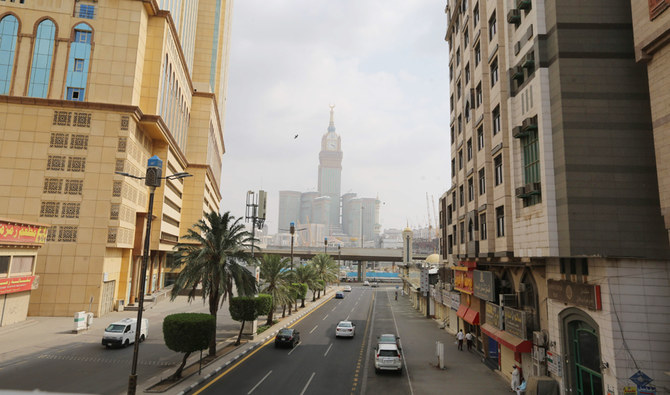
An aerial view shows deserted streets in the Saudi holy city of Makkah on April 8, 2020, during the novel coronavirus pandemic crisis. (AFP)
Short Url
Updated 31 March 2021
Follow

No buffet services in Makkah restaurants, as virus cases continue to rise in Saudi Arabia

  • The Health Ministry reported 410 new recoveries on Tuesday

JEDDAH: Makkah municipality has intensified its effort to check the spread of the coronavirus disease (COVID-19), as the number of infections in the Kingdom continues to rise.
With the month of Ramadan approaching, local authorities are taking extra measures to ensure people follow social distancing measures.
As a precaution, the municipality has ordered suspension of buffet services in restaurants and prohibited public iftar gatherings in neighborhood during Ramadan.
Raad bin Mohammed Al-Sharif, a municipality spokesman, said inspection teams have been formed to enforce strict implementation of health protocols in the holy city, particularly in food outlets.
He said shops and malls will be allowed to operate 24 hours to reduce the number of shoppers during the usual peak hours.

HIGHLIGHTS

• The Kingdom reported 556 new cases of COVID-19 on Tuesday.

• The number of recoveries has risen to 377,714.

• With seven new fatalities, the death toll due to virus-related complications has risen to 6,663.

• Saudi Arabia has administered more than 4.3 million COVID-19 vaccine doses so far.

Al-Sharif said the authorities are also making efforts to ensure the safety of food items.
On Tuesday, the Kingdom reported 556 new cases of COVID-19 meaning 389,422 people have contracted the virus since the beginning of the outbreak. There are 5,045 active cases and 694 are in critical condition.
The Health Ministry also reported 410 new recoveries on Tuesday.
The number of recoveries has risen to 377,714. With seven new fatalities, the death toll due to virus-related complications has risen to 6,663.
Saudi Arabia has administered more than 4.3 million COVID-19 vaccine doses so far. A total of 57,626 PCR tests conducted in the past 24 hours, raising the total number of tests in the Kingdom to over 15 million.


Threat to Kingdom’s security is ‘red line’ that will be ‘addressed and neutralized,’ Saudi envoy says

Updated 56 min 29 sec ago
Follow

Threat to Kingdom’s security is ‘red line’ that will be ‘addressed and neutralized,’ Saudi envoy says

  • Abdulaziz Alwasil tells UN Security Council the situation in southern Yemen is ‘a just cause with social and historic dimensions’ that can only be resolved through dialogue
  • Recent military activity in the south was unilateral, resulting in an escalation that harms the interests of Yemeni people and undermines efforts to address issues in the south, he said

NEW YORK CITY: Any attempt to threaten Saudi Arabia’s national security is a “red line” and will be met with decisive action, the Kingdom’s ambassador to the UN told the Security Council on Wednesday.

Speaking during a meeting of the council to discuss Yemen, Abdulaziz Alwasil said the situation in the south of the country is “a just cause with social and historic dimensions” that can only be resolved through dialogue.

“We stress that any attempt to threaten our national security is a red line, and we will not hesitate to take the necessary actions and steps to address it and neutralize it,” he added.

Alwasil reaffirmed Saudi Arabia’s support for Yemeni President Rashad Al-Alimi, the Presidential Leadership Council, and the Yemeni government in their efforts to achieve security, stability, development and peace while preserving national unity.

He said military activity by Southern Transitional Council forces in Hadramout and Al-Mahra on Dec. 2, 2025, was unilateral, did not have the approval of the Presidential Leadership Council, and was not carried out in coordination with the Coalition to Restore Legitimacy in Yemen.

It had resulted in an unjustified escalation that harmed the interests of the Yemeni people, undermined efforts to address the issues in the south, and ran counter to the coalition’s objectives, Alwasil added.

The Kingdom, working with its coalition partners, the Presidential Leadership Council and the Yemeni government, had moved to contain the situation by dispatching a military force to coordinate arrangements with the Southern Transitional Council in Aden, he said.

The aim was to ensure the return of the southern council’s forces to their previous positions outside of Hadramout and Al-Mahra, and the handover of camps to legitimate government forces and local authorities in line with agreed procedures, Alwasil added.

He expressed regret over the military operations that took place in Hadramout and Al-Mahra, close to Saudi Arabia’s southern border, which he said posed a direct threat to the Kingdom’s national security, as well as the security of Yemen and regional stability. Such steps were extremely dangerous, he added, and contradicted the principles on which the Coalition to Restore Legitimacy in Yemen had been founded.

Alwasil welcomed a prisoner and detainee exchange agreement signed in Muscat on Dec. 23, which he described as an important humanitarian measure to alleviate suffering and build confidence.

He praised Oman for hosting and sponsoring the consultations and supporting negotiations, and commended the efforts of UN’s special envoy for Yemen, Hans Grundberg, the International Committee of the Red Cross and all others that has played a part.

Regarding the political efforts to resolve the crisis, Alwasil said Saudi Arabia welcomed President Al-Alimi’s call for an inclusive conference in Riyadh to bring together all stakeholders to discuss just solutions to the situation in southern Yemen.

Preparations for the conference have begun, he added, in cooperation with the Yemeni government and southern representatives, reflecting the close ties between the two countries and their shared interests in stabilizing Yemen.

He urged all southern stakeholders to participate actively and constructively in the talks, to help find comprehensive and just solutions that meet the legitimate aspirations of the people of southern Yemen.

Alwasil called on all Yemeni forces and stakeholders to cooperate and intensify their efforts to reach a lasting political settlement that would ensure security and stability.

He described the southern issue as “a just cause with social and historic dimensions,” adding that “the only way to address it is through dialogue that leads to a comprehensive political solution” based on nationally and internationally agreed terms of reference.