Oman hopes cease-fire in Yemen is agreed ‘very soon’

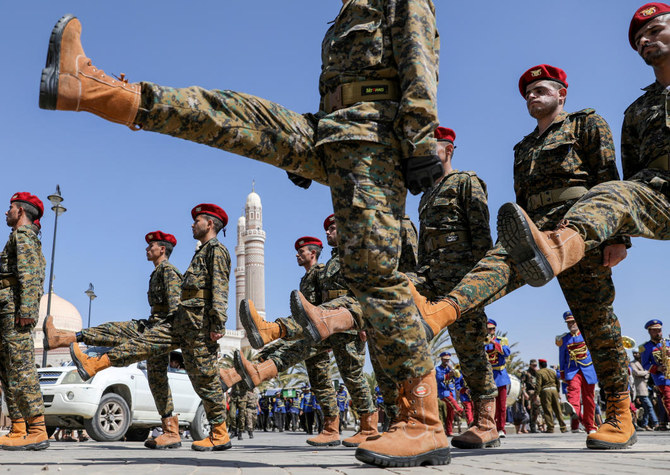
Houthis march during a funeral procession for Houthi fighters killed in recent fighting against government forces in Marib province, in Sanaa, Yemen February 17, 2021. (File/Reuters)
Updated 30 March 2021
Follow

Oman hopes cease-fire in Yemen is agreed ‘very soon’

DUBAI: Oman, a mediator in cease-fire talks between Saudi Arabia and Yemen’s Houthi group, said on Tuesday it hoped an agreement between the warring parties would be reached “very soon.”
Yemen’s six-year-old conflict has killed tens of thousands of people, mostly civilians, and pushed the country to the verge of starvation.
Muscat has been working closely with Riyadh, Washington and the United Nations to reach a comprehensive political solution to the crisis.
“The sultanate hopes that these contacts will achieve the desired result very soon, in order to restore security and stability to brotherly Yemen and preserve the security and interests of the countries in the region,” a statement carried by the Omani state news agency ONA said.
Saudi Arabia, which leads a coalition that has been fighting the Houthis, offered a cease-fire proposal last week.
Despite the offer, the Houthis have continued their drone and missile strikes against Saudi Arabia as well as a ground offensive on the gas-producing region of Marib.
The coalition said on Tuesday it destroyed two drones launched by the Houthis toward Saudi Arabia, Saudi state TV reported.


Syria Kurds chief says ‘all efforts’ being made to salvage deal with Damascus

Updated 25 December 2025
Follow

Syria Kurds chief says ‘all efforts’ being made to salvage deal with Damascus

  • Abdi said the Syrian Democratic Forces (SDF), the Kurds’ de facto army, remained committed to the deal
  • The two sides were working toward “mutual understanding” on military integration and counter-terrorism

DAMASCUS: Syrian Kurdish leader Mazloum Abdi said Thursday that “all efforts” were being made to prevent the collapse of talks on an agreement with Damascus to integrate his forces into the central government.
The remarks came days after Aleppo saw deadly clashes between the two sides before their respective leaders ordered a ceasefire.
In March, Abdi signed a deal with Syrian President Ahmed Al-Sharaa to merge the Kurds’ semi-autonomous administration into the government by year’s end, but differences have held up its implementation.
Abdi said the Syrian Democratic Forces (SDF), the Kurds’ de facto army, remained committed to the deal, adding in a statement that the two sides were working toward “mutual understanding” on military integration and counter-terrorism, and pledging further meetings with Damascus.
Downplaying the year-end deadline, he said the deal “did not specify a time limit for its ending or for the return to military solutions.”
He added that “all efforts are being made to prevent the collapse of this process” and that he considered failure unlikely.
Abdi also repeated the SDF’s demand for decentralization, which has been rejected by Syria’s Islamist authorities, who took power after ousting longtime ruler Bashar Assad last year.
Turkiye, an important ally of Syria’s new leaders, sees the presence of Kurdish forces on its border as a security threat.
In Damascus this week, Turkish Foreign Minister Hakan Fidan stressed the importance of the Kurds’ integration, having warned the week before that patience with the SDF “is running out.”
The SDF control large swathes of the country’s oil-rich north and northeast, and with the support of a US-led international coalition, were integral to the territorial defeat of the Daesh group in Syria in 2019.
Syria last month joined the anti-IS coalition and has announced operations against the jihadist group in recent days.