

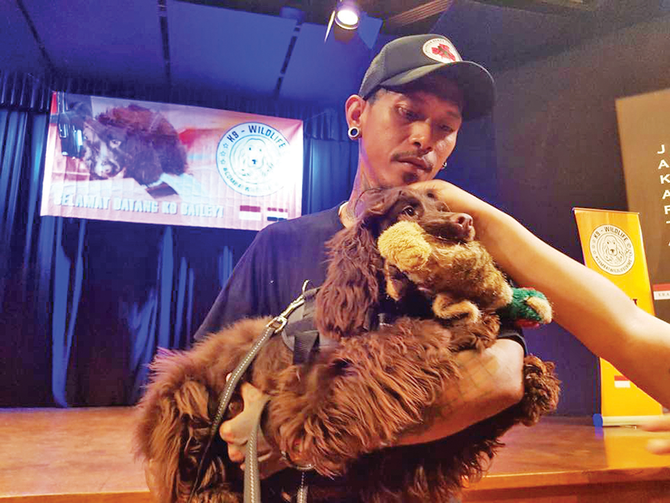

JAKARTA: An Indonesian group of animal rights activists is giving rescue dogs a chance to put their paws on a new career path by detecting and tracking smuggled wildlife in the country, which is a global hub of illicit trade for endangered and protected animals.
The canine scheme, promoted by Indonesian animal rights activists, looks to tackle the rampant problem in one of the most biodiverse countries in the world.
The training of new sniffer dogs follows the success of Bailey, Indonesia’s first wildlife detection dog, who was first deployed by authorities in 2018.
A brown female cocker spaniel who turns four in May, Bailey has put her nose to good use in the past few years by sniffing out wild animals that are smuggled through some of the busiest ports and inter-island crossings across Indonesia, helping authorities foil several wildlife trafficking cases in high-profile busts.
“We have eight dogs being trained, and we are expanding, but we are not training specific dog breeds since they are rescue dogs. Some of them are even mixed breeds. Basically, we are giving them a second chance in life,” Femke den Haas, an animal rights activist and co-founder of the Jakarta Animal Aid Network (JAAN), told Arab News.
Bailey and her posse work for the National Police canine squad, which includes big, bulky German Shepherds, Belgian Malinoises, and Golden or Labrador Retrievers that can be intimidating for some people. Therefore, Bailey, as a friendly, cuddly dog, is an ideal fit for the force.
“We work together with authorities to put the dogs at work, but it is our team handling them, because they need to have a handler that is always with them and whom they trust,” Den Haas said, adding that it was “very important” to provide the dogs with the best possible care, train them professionally and keep them motivated to do the job.
“It needs to be fun for them. It is like a game for them, and we make the game more fun. The nice thing about it is that while they are having fun, we can catch the smugglers, so, it is a great combination,” Den Haas said, adding that the dogs and their handlers constantly travel to harbors and airports across Indonesia.
The training times of the working dogs depends on the breed, and because endangered animals are so diverse, JAAN handlers ensure that the dogs learn the scents of various species through training programs.
JAAN works with the Netherlands-based Scent Imprint for Dogs (SIFD) program, which helps train police and service dogs.
The SIFD supervises projects and trains dogs to detect unique wildlife species and commonly trafficked animal parts, such as skin and ivory.
It was in the program where Den Haas first met Bailey when she was attending a course to establish a wildlife detection program in JAAN.
The family that owned Bailey gave her up for adoption as a wildlife detection dog, because they thought Bailey “did not belong inside a house” and needed to be in working mode.
To instill a sense of confidence in the family that Bailey was being put to good use, Den Haas offered to try her for Indonesia’s wildlife detection program.
“This is how we got Bailey. She is our pioneer and the leader of the project, having found most of the smuggled animals. She is really the star,” Den Haas said.
Bailey’s skill was apparent from her first day on the job. She was introduced to the public during an event at the Dutch Embassy’s cultural center in Jakarta, with then-ambassador Rob Swartbol and officials from the police and agriculture ministry’s animal quarantine center in attendance.
Before her introduction, Bailey went through a quarantine and health check-up and hit the ground running during her probation period to detect cargo in Sumatra’s Lampung and Jakarta’s Tanjung Priok ports, where she showed off her sniffing prowess.
Indonesia is home to more than 300,000 wildlife species — about 17 percent of the world’s wildlife — including hundreds with threatened, endangered, vulnerable, and critically endangered status, according to the International Union for Conservation of Nature.
Wildlife trafficking is a lucrative global business that rakes in between $7 and $23 billion per year around the world.
In Indonesia, it is the third most rampant crime, and is worth more than 13 trillion Indonesian rupiahs per year ($900 million), according to Environment and Forestry Minister Siti Nurbaya Bakar.
Tens of thousands of animals, including common birds, reptiles, mammals, primates and turtles, are smuggled across Indonesia, despite many having protected or endangered status.
M. Hariyanto, a spokesman for the Environment and Forestry Ministry Sumatra regional law enforcement office, told Arab News that sniffer dogs had helped officials locate 272 birds kept in a bus bound for the ferry crossing to Java on Friday.
Personnel from the conservation, quarantine agencies, and JAAN categorized 135 of the birds as protected.
“The smugglers stashed the birds in the engine compartment, but the dogs were able to detect the birds,” Hariyanto said.
On March 3, Lampung authorities seized 1,090 birds stashed in plastic and cardboard boxes in a minivan, with 145 of them having protected status. On Feb. 25, authorities also confiscated 105 protected birds from a villager in East Lampung district.
“A dog’s nose can always be trusted. It’s the best detection tool there is,” Den Haas said.


