Egypt opens region’s first factory for archaeological replicas 

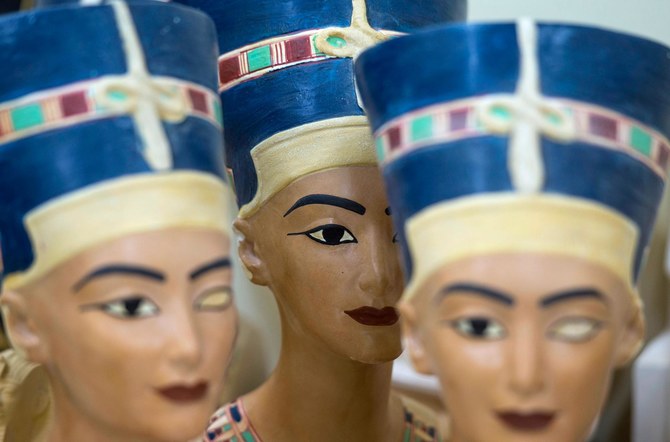
Replicas of the Nefertiti Bust in the workshop of the Replica Production Unit at Salah Al Din Citadel, Cairo, Egypt. (EPA)
Short Url
Updated 29 March 2021
Follow

Egypt opens region’s first factory for archaeological replicas 

  • Factory for archaeological replicas will help introduce Egyptian history to the world, and protect the country’s cultural heritage and intellectual property rights
  • Antique pieces will feature a symbol with information in both Arabic and English, including material names, weight, and the title and location of the original antique

CAIRO: A factory for archaeological replicas in Egypt’s El-Obour City, the first of its kind in the region, was inaugurated by Egyptian Minister of Tourism and Antiquities Khaled Al-Anani.

The facility was established in cooperation with the Egyptian Kenouz Company for Archaeological Models.

Al-Anani said that the factory will help introduce Egyptian history to the world, and protect the country’s cultural heritage and intellectual property rights.

He added that antique clones produced in the factory include special stamps from the Supreme Council of Antiquities and a certificate from the ministry certifying replica status.

Antique pieces will also feature a symbol with information in both Arabic and English, including material names, weight, and the title and location of the original antique.

The minister said that archaeological replicas are “among the most important products” marketed in the tourism sector, as consumers buy them locally and internationally as souvenirs.

He added that the production of Egyptian archaeological models has been a long-term demand of many tourists, and that the replicas will be available in hotels and tourist bazaars at special prices.

Al-Anani said that the first official sale for the pieces will open in the National Museum of Egyptian Civilization on April 4, following the museum’s official opening and a mummy exhibition.

Outlets will then open in all Egyptian governorates, museums and markets in the near future, he said, adding that some products will also be exported overseas and will feature in foreign exhibitions.

The inaugurated factory employs about 150 artists and craftsmen with long-term experience — many having previously worked with the Ministry of Tourism.

Hisham Shaarawi, chairman of the Kenouz Company for Archaeological Models, said that the factory was completed at the end of last year. It then began a trial period, during which it produced 6,400 different pieces, including wood, ceramic stone and metal antique replicas.

The facility, which extends about 10,000 square meters, is equipped with the latest technology and specialized machinery.

It includes manual production lines and tools for foundry metals, a line for wood and carpentry, and a line for making molds.

Molds for production lines, sculpting, printing, drawing and coloring, including colored glass and t-shirts, are also available.

There is also an exhibition hall for replicas produced in the factory.

The company has also started a production line for recycling that utilizes waste from the production of artworks and paintings, such as eggshells and tree leaves.


In the light of Andalusia: Luis Olaso’s new body of work

Updated 23 February 2026
Follow

In the light of Andalusia: Luis Olaso’s new body of work

  • Luis Olaso transforms Andalusian landscapes and light into abstract art, creating canvases that reflect culture, nature, and the artist’s inner state
  • Each work in ‘Photosynthesis’ acts as a sensory and meditative portrait — an immersion into the Andalusian experience and the artist’s emotional universe

DUBAI: Spanish artist Luis Olaso is presenting “Photosynthesis,” his new exhibition, until March 9 at the JD Malat Gallery in Downtown Dubai. The series marks a turning point in his career, born from his recent move to Cadiz, in Andalusia, where the sun, light, and Mediterranean landscapes have profoundly transformed his practice.

For Olaso, relocating to southern Spain was not merely a change of scenery but an immersion into a culture and environment that nourishes his art at every moment.

“It’s very important for me because this is the first exhibition I have created in my new studio … I built it in the middle of the garden, surrounded by nature, fruit trees and olive trees, with a fantastic landscape. The influence of Andalusia and the colors of that place are the driving force behind my work,” said Olaso.

Located at the heart of an estate surrounded by olive, almond, and orange trees, his studio is designed to allow nature to enter the creative process both physically and psychologically. Yet, rather than depicting these elements directly, Olaso absorbs them as a sensory catalyst: Each color, texture, and gesture becomes the expression of a lived moment.

“Even when I work with plants or flowers, I’m not aiming for literal representation; they are vehicles to express abstract metaphors of myself and the moment I’m living while creating the work,” he said.

His artistic process is both spontaneous and meditative. Olaso often works on several canvases simultaneously to free himself from the pressure of the “perfect painting,” allowing intuition to guide his brush. Music —  the Spanish band Triana and 1970s psychedelic flamenco — plays a central role in his focus and inner connection.

“Painting, for me, is similar to meditation. I need to be in that precise moment and feel connected with myself,” said Olaso.

“Photosynthesis” also reflects a profound cultural and artistic dialogue. The artist’s work draws from Spanish tradition— with references to Antoni Tapies and Manolo Millares — as well as major international abstract movements, including American gestural abstraction and the San Francisco Bay Area Figurative Movement.

This meeting point between abstraction, culture, and emotion transforms each canvas into a portrait of a lived instant and the artist’s inner state.

After Dubai, Olaso is expected to present a solo exhibition in Madrid in March 2026, followed by another solo exhibition in Helsinki in April. An art fair is scheduled for September, with additional fairs planned throughout the year, notably with the JD Malat Gallery.

These milestones illustrate his universal approach to art, deeply rooted in a specific cultural context: the light, color, and sensory memory of Andalusia. With “Photosynthesis,” the artist offers viewers an experience in which painting becomes a mirror of the self, an emotional journey, and an encounter with a singular place.