

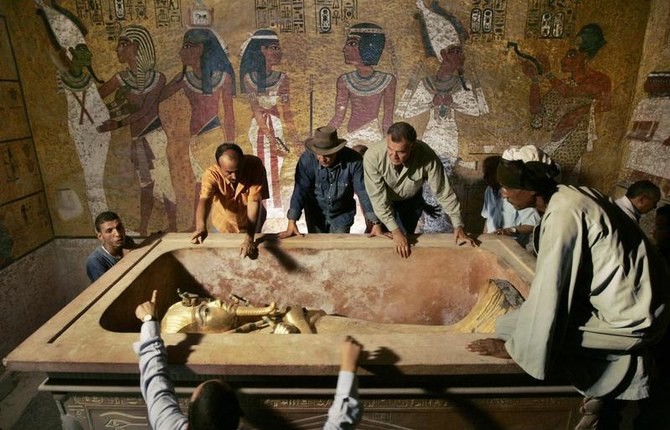

CAIRO: Claims that a series of recent disasters in Egypt have been brought about by a pharaohs’ curse were on Monday dismissed by archaeologists.
Plans over the coming days to move 22 royal mummies from the Egyptian Museum in Tahrir to a permanent exhibition space in the National Museum of Egyptian Civilization have coincided with a string of major incidents in the country.
And some reports have suggested that the serious occurrences are linked to the pending transfer of the preserved ancient monarchs.
Egypt has been in the international spotlight after a giant cargo ship ran aground and blocked the Suez Canal, preventing billions of dollars-worth of trade per day passing through the strategic waterway.
The country has also witnessed a fatal train crash in Sohag, the collapse of a 10-storey property at Suez Bridge, a shops fire at Zagazig railway station, the collapse of a concrete pillar on a bridge under construction in Mariotia, and blazes at the Maadi Tower and a house in Minya.
All the events have taken place as the Egyptian Ministry of Tourism and Antiquities prepares to shift the mummified pharaohs as part of the nation’s ongoing efforts to develop and modernize Cairo and other cities through the completion of various archaeological and cultural activities.
Some social media users put the timing of the incidents down to a curse of the pharaohs quoting the ancient leaders as warning that, “death will come on quick wings for those who disturb the king’s peace.”
However, former Egyptian Minister of Antiquities Zahi Hawass poured cold water on the claims. “The occurrence of these accidents is just fate and there is no connection between them and the mummies at all,” he said.
The archaeologist pointed out that he had supervised the discovery of some of the tombs of ancient Egyptians and had not been harmed.
Among the museum exhibits to be transferred are the mummies of kings Ramesses II, Seqenenre Tao, Thutmose III, and Seti I, and queens Hatshepsut, Meritamen, the wife of King Amenhotep I, and Ahmose-Nefertari, wife of King Ahmose.
Egyptian historian and writer, Bassam El-Shammaa, also rejected rumors of a pharaohs’ curse on the country. He said that phrases and shapes carved on the walls of temples simply expressed the imagination of ancient Egyptians.
He added that some mummies were moldy, causing a build up on tomb walls of bacteria which could attack the respiratory system and be fatal.
He also pointed out that ammonia gas could also leak from coffins, resulting in burning to the eyes and nose, pneumonia, and sometimes death, and that bat excrement found inside some graves carried a fungus that could bring on respiratory disease similar to influenza.


