

Ship ‘partially refloated,’ but still stuck in Suez Canal

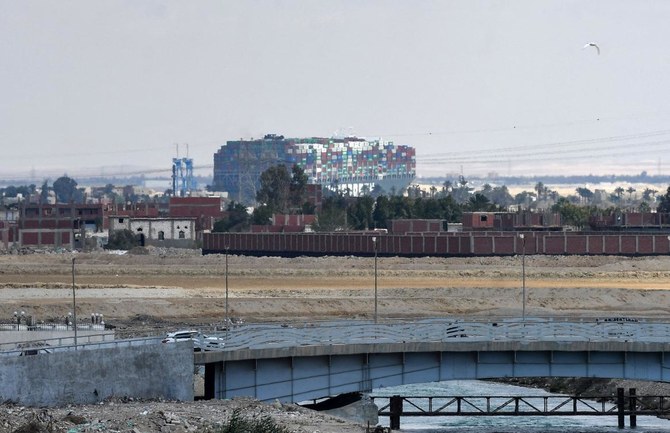
This picture taken on March 28, 2021 shows a distant view of the Panama-flagged MV 'Ever Given' container ship. (File/AFP)
Short Url
Updated 29 March 2021
Follow

Ship ‘partially refloated,’ but still stuck in Suez Canal

SUEZ: Engineers on Monday “partially refloated” the colossal container ship that continues to block traffic through the Suez Canal, authorities said, without providing further details about when the vessel would be set free.
Satellite data from MarineTraffic.com showed that the ship’s bulbous bow, once lodged deep in the canal’s eastern bank, had been partly wrested from the shore — although it remained stuck at the canal’s edge. The ship’s stern had swung around and was now in the middle of the waterway, tracking data showed.

Although the development marked the vessel’s most significant movement since getting stuck last week, the salvage crew urged caution as obstacles loomed.
“Don’t cheer too soon,” Peter Berdowski, CEO of Boskalis, the salvage firm hired to extract the Ever Given, told Dutch NPO Radio 1.
Last Tuesday, the skyscraper-sized Ever Given got stuck sideways in the crucial waterway, creating a massive traffic jam. The obstruction has held up $9 billion each day in global trade and strained supply chains already burdened by the coronavirus pandemic. At least 367 vessels, carrying everything from crude oil to cattle, were still waiting to pass through the canal, while dozens were taking the alternate route around the Cape of Good Hope at Africa’s southern tip — a detour that adds some two weeks to journeys and costs ships hundreds of thousands of dollars in fuel and other costs.
With canal transits stopped, Egypt already has lost over $95 million in revenue, according to the data firm Refinitiv. If the ship is freed in the next few days, clearing the backlog of ships already waiting to pass through the canal would take at least 10 days, Refinitiv added.
The partial freeing of the vessel came after intensive efforts to push and pull the vessel with 10 tugboats when the full moon brought spring tide, canal services firm Leth Agencies said, raising the canal’s water level and hopes for a breakthrough. Videos shared widely on social media showed tugboats in the canal sounding their horns in celebration of the Ever Given being partly wrenched from the shore.
However, the rescue team said the ship’s bow remained stuck in the sandy clay at the canal’s edge.
“The good news is that the stern is free but we saw that as the simplest part of the job,” said Berdowski, noting that the toughest challenge remained at the front of the ship, where workers would struggle to haul the fully laden 220,000-ton vessel over the clay of the canal bank.
An official at Shoei Kisen Kaisha Ltd., the company that owns the Ever Given, confirmed the vessel’s bow had moved slightly, but warned the bottom of the ship was still touching the seafloor. The official spoke on condition of anonymity due to the sensitivity of the issue.
On Monday morning, an Associated Press journalist could see that the ship’s position had distinctly changed — where previously only the ship’s stern was visible, the ship’s side could now be seen.
Lt. Gen. Osama Rabei, the head of the Suez Canal Authority, said the vessel had responded well to “pull-and-push maneuvers” early Monday. He said that workers had straightened the vessel’s position by 80% and that the stern had moved 102 meters (334 feet) from the canal bank.
The price of international benchmark Brent crude dropped some 2% to just over $63 on the news.
When high tide returns at 11:30 a.m. local time on Monday, salvage crews will resume their attempts to tow the ship into the middle of the waterway and toward the Great Bitter Lake, a wide stretch of water halfway between the north and south end of the canal, where it will undergo technical examination, Rabei said.
Overnight, several dredgers had toiled to vacuum up 27,000 cubic meters of sand and mud around the ship. Another powerful tugboat, the Italian-flagged Carlo Magno, arrived at the scene to join the work Monday, and the flotilla would now focus its efforts on the front of the ship, said Berdowski.
Although the vessel is vulnerable to damage in its current position, the vessel’s owner dismissed concerns on Monday, saying that the ship’s engine was functional and it would head north when freed. It wasn’t decided whether the Panama-flagged, Japanese-owned ship, hauling goods from Asia to Europe, would continue to its original destination of Rotterdam or if it will need to enter another port for repairs, the Shoei official said.
Ship operators did not offer a timeline for the reopening of the crucial canal, which carries over 10% of global trade, including 7% of the world’s oil. Over 19,000 ships passed through last year, according to canal authorities. Millions of barrels of oil and liquified natural gas flow through the artery from the Arabian Gulf to Europe and North America. Goods made in China — furniture, clothes, supermarket basics — bound for Europe also must go through the canal, or else take the detour around Africa.
The unprecedented shutdown has threatened to disrupt oil and gas shipments to Europe from the Middle East and raised fears of extended delays, good shortages and rising costs for consumers.
Canal authorities have desperately tried to free the vessel by relying on tugs and dredgers alone, even as analysts warned that 400-meter-long ship may be too heavy for such an operation. As a window for a breakthrough narrows with high tide receding this week, fears have grown that authorities would be forced to lighten the vessel by removing the ship’s 20,000 containers — a complex operation, requiring specialized equipment not found in Egypt, that could take days or weeks.
The salvage team’s next step is dredging beneath the vessel’s bow with high pressure water jets to wrench the ship from the clay, said Berdowski.
“If that doesn’t work, then in the end you will have to remove weight and that can only happen by removing containers from the front,” he added. “But that is a process that will take time.”


Aidarous Al-Zubaidi: Fugitive at large

Updated 6 sec ago
Follow

Aidarous Al-Zubaidi: Fugitive at large

  • Yemen appoints committee to probe allegations against former STC leader after the group’s collapse and his reported flight from the country
  • Preliminary findings accuse Al-Zubaidi of exploiting public office for personal gain, fueling political division and instability in south

LONDON: A special committee formed on presidential authority by Yemen’s public prosecutor’s office has made a series of findings against Maj. Gen. Aidarous Al-Zubaidi, the sacked vice-president of the country’s Presidential Leadership Council (PLC).
Al-Zubaidi, who is accused of high treason and other crimes against the state, is currently on the run.
Arab News has seen a copy of preliminary findings by the committee which reveal that Al-Zubaidi is accused of abuses of power including corruption, land grabbing and oil trading for personal gain.
On Jan. 7, the PLC issued a decree revoking Al-Zubaidi’s membership of the PLC and accusing him of high treason and other serious crimes, including forming an armed gang, killing military officers and soldiers, and undermining the country’s sovereignty.
At the same time it authorized the public prosecutor’s office to form a special committee to investigate allegations against Al-Zubaidi, empowering it to summon and arrest individuals, gather evidence and take necessary actions according to the law, with a mandate to complete the investigation quickly and to provide periodic reports to the PLC.
The committee’s preliminary findings identify a series of serious allegations against Al-Zubaidi, who is said to be responsible for multiple abuses “which have contributed to creating a state of political and popular division in the southern governorates.”
Al-Zubaidi is the leader of the Southern Transitional Council (STC). On Jan. 7, Al-Zubaidi was due to attend talks in Riyadh with a 50-member delegation from the STC, but at the last minute, he fled instead.
The committee’s findings include allegations that Al-Zubaidi is alleged to have seized large plots of land, including in the Aden Free Zone, on Al-Ummal Island, in Bir Fadl and the Ras Omran area.
The committee has also uncovered allegations that pressure was exerted on the Yemen Petroleum Company and its director, Tareq Al-Walidi, to prevent the import of fuel except through a company affiliated with Al-Zubaidi’s brother-in-law, Jihad Al-Shoudhabi, and the Minister of Transport, Abdul Salam Humaid.
For nearly two years, it is claimed, Al-Shoudhabi has been the sole supplier, earning large profits that have gone to Al-Zubaidi’s treasury.
The report also identifies commercial companies owned by Al-Shoudhabi and, “behind him,” it is claimed, Al-Zubaidi. Two are named in the report: Alahlia Exchange &  Transfers Company and Arabian Furniture Center, one of Yemen’s largest furniture companies. Both are headquartered in Aden.
All these and other “deeply regrettable acts of seizure, plunder, and financial and administrative corruption,” the committee says, “have had serious repercussions in southern circles and were a direct cause of southern division and the emergence of many grievances.”
On Thursday, a spokesman for the Saudi-led coalition in Yemen said there was reliable intelligence indicating that on the night of Jan. 7, Al-Zubaidi had departed from Aden on a ship bound for Somaliland — probably the port of Berbera, 260 kilometers south across the Gulf of Aden.
From there he is believed to have been flown on a cargo aircraft to Abu Dhabi, capital of the UAE, via Mogadishu, the coastal capital of Somalia, a flight of about 2,600 km.
Some of the crimes of which Al-Zubaidi is accused relate to the largescale military offensive launched by STC forces across southern Yemen in December.
“We know that the Southern Transitional Council worked to storm the eastern cities militarily,” a source close to the Yemeni government told Arab News.
“The pattern and scale of grave human-rights violations and acts of security and military escalation witnessed by the eastern cities in the south of the homeland — Hadhramout, Al-Mahra and Shabwah — as a result of the military incursion by the forces of the Transitional Council during the monitoring period extending from Dec. 3, are considered heinous crimes against the Yemeni people.”
According to the Yemeni Ministry of Legal Affairs and Human Rights, a total of 2,358 individual offences have been identified, including cases of extrajudicial killing and physical injuries, arbitrary arrests and captivity, enforced disappearance and displacement, and the destruction and looting of public and private property.
Backed by Saudi airstrikes, in the first week of January, the Yemeni government quickly regained the captured territories, Al-Zubaidi was sacked from the PLC and charged with treason, and the UAE announced it would withdraw its remaining troops from the country.
Following Al-Zubaidi’s disappearance on the eve of the planned talks in Riyadh, Saudi Arabia has accused the UAE of helping to smuggle the wanted man out of the country.
The same source told Arab News there is evidence that Al-Zubaidi “was receiving YER 10 billion ($42 million) monthly … deducted from the aid that Yemen was receiving.
“While Al-Zubaidi was receiving those funds, Yemeni citizens had not been receiving their lawful salaries for years, including the diplomatic corps.”
Last Thursday, Mohammed Al-Jaber, the Saudi ambassador to Yemen, announced that the Kingdom would assume responsibility for the salaries of Yemeni state employees, including military personnel, giving $90 million to cover salaries for two months.
On Friday evening, Al-Zubaidi, his whereabouts still unconfirmed, made his first public statement since his disappearance 10 days ago.
“We will no longer accept any solutions that diminish our rights or impose an unacceptable reality upon us,” he wrote in a social media post that left no doubt about his determination to undermine the internationally recognized government of Yemen.
He added: “I pledge to you ... that we will continue together until we achieve the desired national goal.
“With your determination, we will prevail. With your unity, the South will be protected, and with your will, the future state will be established.”