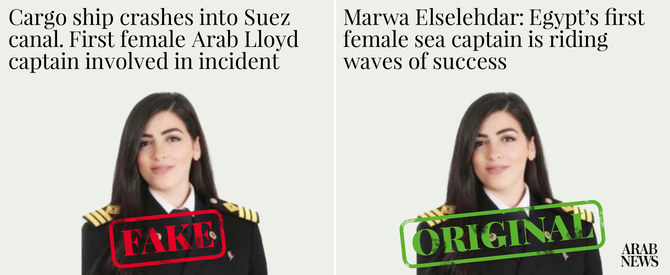
Anti-feminist trolls target first Egyptian woman captain with fake Arab News profile

Short Url
Updated 28 March 2021
Follow

Anti-feminist trolls target first Egyptian woman captain with fake Arab News profile

  • Anti-feminist trolls are using social media to spread fake news targeting Marwa Elselehdar
  • Elselehdar took to social media and published a video explaining the incident

LONDON: Anti-feminist trolls are using social media to spread fake news targeting Marwa Elselehdar, Egypt’s first female sea captain, claiming that she piloted the Suez canal-jammed ship Ever Given.

The trolls falsified an Arab News article on Elselehdar by changing the headline of a profile on the sea captain from “Marwa Elselehdar: Egypt’s first female sea captain is riding waves of success” to “Cargo ship crashes into Suez canal. First female Lloyd Arab captain involved in incident.”

Apart from the glaring grammatical mistakes in the fake headline — enough for many to see that it is false — the wording also suggests that Elselehdar works for Hapag-Lloyd, which in reality is a competitor of Ever Given’s operator Evergreen.

Elselehdar also took to social media and published a video explaining the incident. She thanked Arab News for the profile, which detailed her work in charge of the Aida IV during the opening ceremony of the expanded Suez Canal in 2015.

“Frankly, when I read the news, I was upset, because I worked really hard to reach the position I have reached, and anyone who works in this field knows how much effort a person has made over the years to reach this rank,” Elselehdar said.

“One has to spend many years at sea, studying and taking exams before reaching this level.

I graduated in 2013 and got an MBA, then I was promoted from second officer to first officer, and now I am a captain,” she added.

“So, it is difficult to see that someone is trying to cancel all this effort and credit it to himself, or accuse me of being a failure or that I neglect my work.”

Anti-feminist trolls jumped on the opportunity to launch a smear campaign against Elselehdar, and promoted a baseless “this is what happens when you let a woman captain a ship” argument.
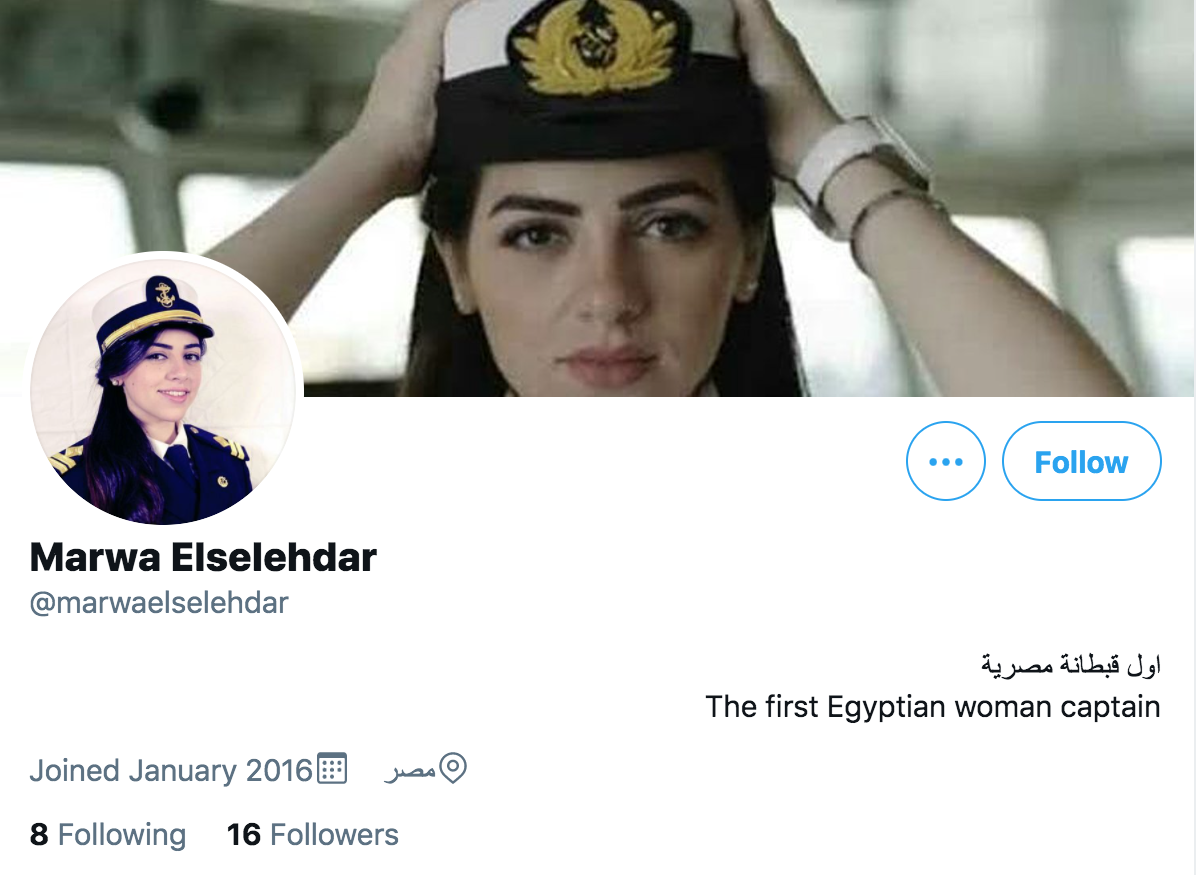


A fake Twitter account of Marwa Elselehdar. (Screenshot)

Several fake accounts claiming to be the sea captain were created on Twitter as part of the smear campaign targeting Elselehdar.

“Believe me that I am not trying to promote myself, but it is not nice for someone to speak in your name in a way that has nothing to do with your personality, your upbringing, your career or anything else,” she said.
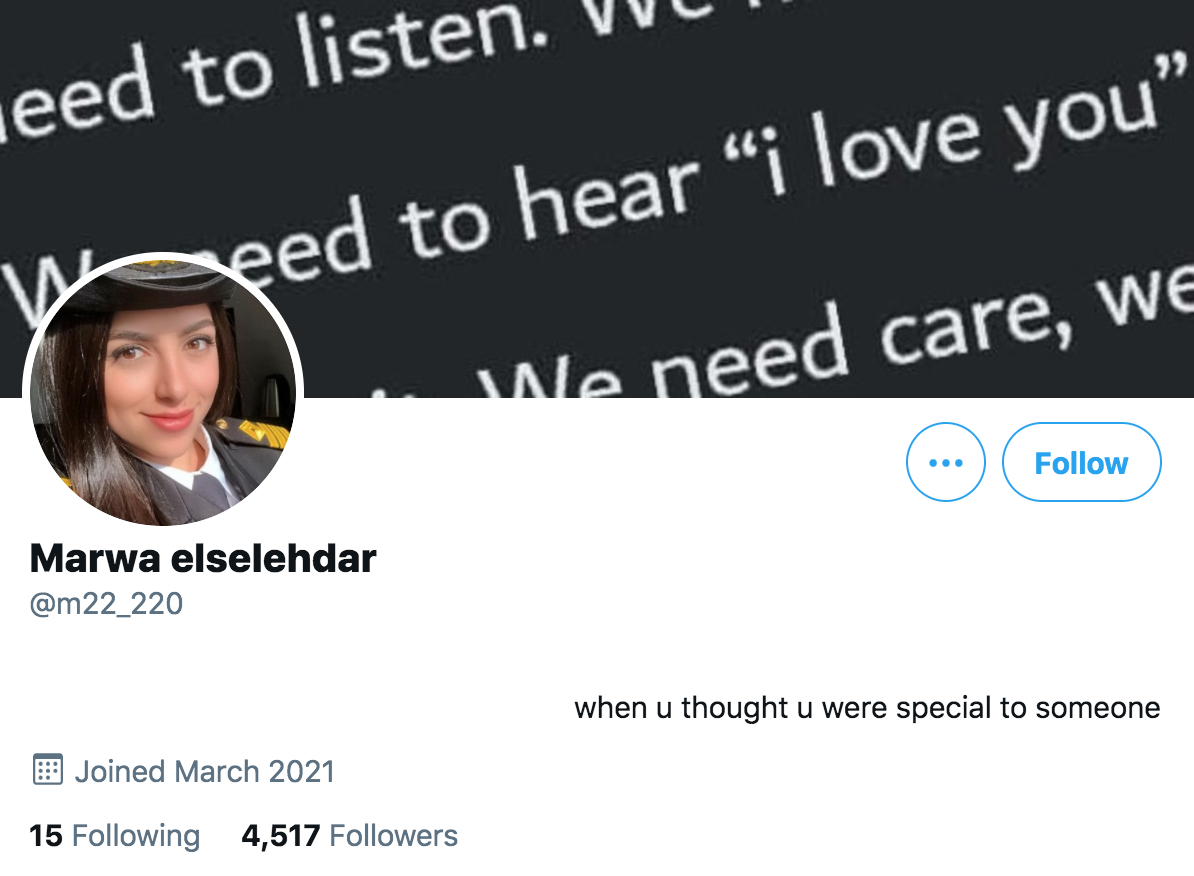


Another fake Twitter account of Marwa Elselehdar. (Screenshot)

“It’s my reputation, and I definitely don’t want it damaged like this.”


Disinformation the new enemy in disaster zones, says Red Cross

Updated 05 March 2026
Follow

Disinformation the new enemy in disaster zones, says Red Cross

  • “Harmful information and dehumanizing narratives” undermines humanitarian aid and putting lives of aid workers at risk
  • Between 2020 and 2024, disasters affected nearly 700 million people, displaced over 105 million, and killed more than 270,000 — doubling the number in need of humanitarian aid

GENEVA: The rise of disinformation is undermining humanitarian aid and putting lives at risk, while disasters are affecting ever more people, the Red Cross warned Thursday.
“Between 2020 and 2024, disasters affected nearly 700 million people, caused more than 105 million displacements, and claimed over 270,000 lives,” the International Federation of Red Cross and Red Crescent Societies said.
The number of people needing humanitarian assistance more than doubled in the same timeframe, the IFRC said in its World Disasters Report 2026.
But the world’s largest humanitarian network said that “harmful information and dehumanizing narratives” were increasingly undermining trust, putting the lives of aid workers at risk.
“In polarized and politically-charged contexts, humanitarian principles such as neutrality and impartiality are increasingly misunderstood, misrepresented or deliberately attacked online,” it said.
The IFRC has more than 17 million volunteers across more than 191 countries.
“In every crisis I have witnessed, information is as essential as food, water and shelter,” said the Geneva-based federation’s secretary general Jagan Chapagain.
“But when information is false, misleading or deliberately manipulated, it can deepen fear, obstruct humanitarian access and cost lives.”
He said harmful information was not a new phenomenon, but it was now moving “with unprecedented speed and reach.”
Chapagain said digital platforms were proving “fertile ground for lies.”
The IFRC report said the challenge nowadays was no longer about the availability of information but its reliability, noting that the production and spread of disinformation was easily amplified by artificial intelligence.

- ‘Life and death’ -

The report cited numerous recent examples of harmful information hampering crisis response.
During the 2024 floods in Valencia, false narratives online accused the Spanish Red Cross of diverting aid to migrants, which in turn fueled “xenophobic attacks on volunteers,” the IFRC said.
In South Sudan, rumors that humanitarian agencies were distributing poisoned food “caused people to avoid life-saving aid” and led to threats against Red Cross staff.
In Lebanon, false claims that volunteers were spreading Covid-19, favoring certain groups with aid and providing unsafe cholera vaccines eroded trust and endangered vulnerable communities, the IFRC said.
And in Bangladesh, during political unrest, volunteers faced “widespread accusations of inaction and political alignment,” leading to harassment and reputational damage, it added.
Similar events were registered by the IFRC in Sudan, Myanmar, Peru, the United States, New Zealand, Canada, Kenya and Bulgaria.
The report underlined that around 94 percent of disasters were handled by national authorities and local communities, without international interventions.
“However, while volunteers, local leaders and community media are often the most trusted messengers, they operate in increasingly hostile and polarized information environments,” the IFRC said.
The federation called on governments, tech firms, humanitarian agencies and local actors to recognize that reliable information “is a matter of life and death.”
“Without trust, people are less likely to prepare, seek help or follow life-saving guidance; with it, communities act together, absorb shocks and recover more effectively,” said Chapagain.
The organization urged technology platforms to prioritize authoritative information from trusted sources in crisis contexts, and transparently moderate harmful content.
And it said humanitarian agencies needed to make preparing to deal with disinformation “a core function” of their operations, with trained teams and analytics.