Pakistani judge orders blasphemy probe against organizers of Women’s Day march 

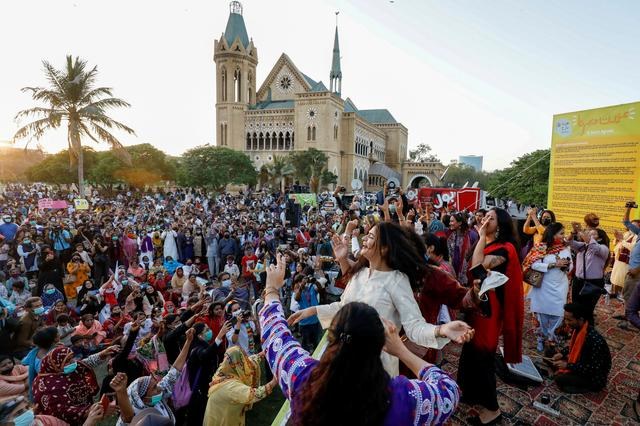
People participate in Aurat March or Women's March, to mark the International Women's Day in Karachi Pakistan on March 8, 2021. (REUTERS)
Short Url
Updated 27 March 2021
Follow

Pakistani judge orders blasphemy probe against organizers of Women’s Day march 

  • Police in Islamabad had previously refused to open a case, saying the allegations were based on fake social media posts
  • March organizers called on the government to provide protection for the activists in the wake of the court order

ISLAMABAD/PESHAWAR: A judge in the Pakistani city of Peshawar ordered police on Friday to open an investigation into the organizers of a march marking International Women’s Day over allegations they committed blasphemy.
Police in Islamabad had previously refused to open a case, saying the allegations were based on fake social media posts after doctored images and video from the March 8 event went viral.
The petition, lodged by a group of lawyers in Peshawar, alleges slogans and messages on placards and banners on display during the march in Islamabad were “un-Islamic and obscene” and insulted the Prophet Muhammad and one of his wives.
The organizers of the march said in a statement: “These lies and the outrageous allegations of blasphemous slogans and banners in particular have been definitively debunked many times over.”
Blasphemy is punishable by death in Pakistan, and although no executions have been carried out, suspects are often killed by vigilantes.
Protests calling for vigilante violence against the march organizers followed the social media storm and on March 12 the Pakistan Taliban issued a statement threatening the activists.
The march organizers called on the government to provide protection for the activists in the wake of the court order. 


Pakistani president arrives in Iraq to deepen trade, energy cooperation

Updated 20 December 2025
Follow

Pakistani president arrives in Iraq to deepen trade, energy cooperation

  • Visit follows recent high-level contacts as Islamabad seeks to expand limited commercial ties with Baghdad
  • Talks are expected to cover investment, manpower and facilitation of Pakistani pilgrims visiting holy sites in Iraq

ISLAMABAD: President Asif Ali Zardari arrived in Iraq on Saturday on an official visit aimed at expanding cooperation in trade, energy and investment, as Pakistan seeks to deepen ties with Baghdad after years of limited engagement.

Pakistan and Iraq established diplomatic relations in 1947 and have traditionally maintained cordial ties, though commercial links remain modest, with officials and business groups identifying scope for cooperation in construction services, pharmaceuticals, manpower and agricultural exports.

“President Asif Ali Zardari arrived in Baghdad on a four-day official visit to Iraq,” his office said in a post on X. “He was received by Culture Minister Dr. Ahmed Fakkak Al-Badrani. During the visit, meetings with senior Iraqi leadership are expected to advance cooperation and further strengthen Pakistan-Iraq relations.”

Zardari’s visit follows a series of recent high-level contacts between the two countries, reflecting efforts to broaden bilateral engagement beyond traditional diplomatic ties and explore collaboration across economic, political and people-to-people domains.

According to Pakistan’s foreign office, the president is expected to hold meetings with Iraq’s senior leadership to discuss cooperation in various areas such as trade and investment, energy, technology, education and manpower.

He is also expected to discuss regional and international issues with Iraqi officials.

Earlier this month, Pakistan’s Interior Minister Mohsin Naqvi met his Iraqi counterpart, Abdul Ameer Al-Shammari, on the sidelines of meetings in Brussels, where both sides agreed to enhance cooperation on security and facilitate travel for Pakistani Shia pilgrims to Najaf and Karbala.

The two officials discussed measures to ensure the smoother movement of these pilgrims and their compliance with visa regulations.