

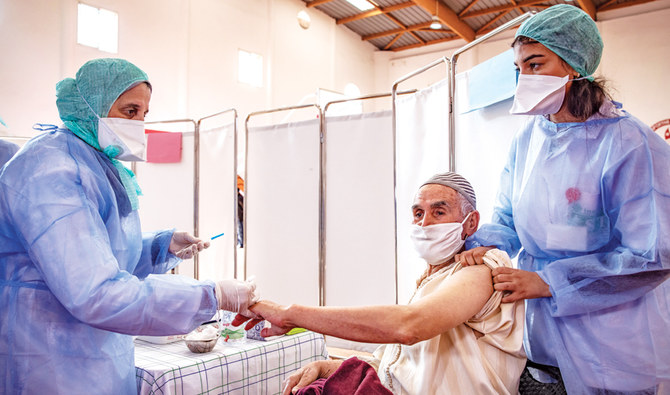

RABAT: Morocco expects new batches of coronavirus vaccine to arrive soon from Russia, South Korea and China, allowing it to continue its rapid immunization rollout despite a pause in exports from India, Health Ministry sources said.
Morocco has already received 8.5 million doses of AstraZeneca vaccine, made in India, and Sinopharm vaccine, made in China, allowing it to administer more jabs than any other African country.
It expects 4.2 million more doses soon, said Health Ministry scientific committee member Said Afif, keeping it on track to reach its target of herd immunity before the summer.
These include 2 million more Sinopharm doses, 1 million of Russia’s Sputnik V shot and another 1.2 million AstraZeneca doses made in South Korea and bought through the Covax vaccine-sharing scheme, Afif said.
The Health Ministry has approved use of the Sputnik and South Korean-made AstraZeneca vaccines.
“Morocco is adopting a strategy of anticipation to ensure the vaccination campaign continues steadily regardless of the delays announced by AstraZeneca manufacturer in India,” Afif said.
India has put a temporary hold on all major exports of the AstraZeneca coronavirus shot made by the Serum Institute of India (SII), the world’s biggest vaccine-maker, to meet domestic demand as infections rise, Reuters reported on Wednesday.
A source from Morocco’s Health Ministry said the new vaccine shipments are expected in the coming days without offering further details.
By Friday, 4.29 million people had received a first jab in Morocco and 3 million the second dose.
France has accused Russia of using its Sputnik V vaccine as a tool to spread Moscow’s influence and message rather than as way to fight the global health crisis.
“In terms of how it is managed, it (the Sputnik V vaccine) is more a means of propaganda and aggressive diplomacy than a means of solidarity and health aid,” Foreign Minister Jean-Yves Le Drian told France Info radio.
Morocco is adopting a strategy of anticipation to ensure the vaccination campaign continues steadily regardless of the delays announced by AstraZeneca manufacturer in India.
Said Afif, Health Ministry scientific committee member
The Russian vaccine has come under much criticism in Western countries, while President Vladimir Putin — who got a Sputnik jab himself on Tuesday — has dismissed the skepticism as “strange.”
Le Drian said both Russia and China were using their vaccines to gain influence abroad “even before vaccinating their own populations.”
The minister said Russia had announced “with a lot of media attention” that it would deliver 30,000 vaccine doses to Tunisia.
But the UN-backed Covax initiative had already delivered 100,000 doses to the north African country, with 400,000 more to come by May, he said.
“That is what real solidarity work looks like, that is true health cooperation,” Le Drian said.


