

Pakistani PM tells advisor to step down for transparent inquiry into fuel crisis

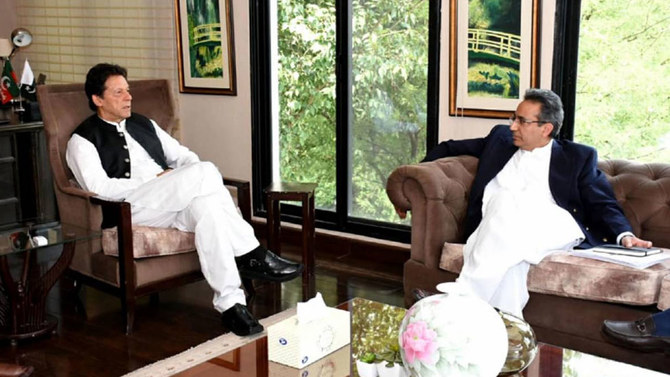
Special Assistant to the Prime Minister on Petroleum Nadeem Babar calls on Prime Minister of Pakistan Imran Khan at the Prime Minister's House in Islamabad on July 19, 2019. ( Press Information department / File photo)
Short Url
Updated 02 August 2021
Follow

Pakistani PM tells advisor to step down for transparent inquiry into fuel crisis

  • The country witnessed a fuel shortage in June 2020 after the government stopped importing oil amid declining demand caused by lockdowns
  • Oil marketing companies in Pakistan are legally obliged to maintain significant fuel stocks that can last for 20 days

KARACHI: Prime Minister Imran Khan has asked his advisor on petroleum to step down from his position to ensure a transparent inquiry into a fuel crisis witnessed by the country in June 2020, announced a senior cabinet member on Friday. 

“The Federal Investigation Agency will complete the forensic investigation within 90 days,” Federal Minister for Planning Asad Umar told a news conference in Islamabad. “During this period, the prime minister has directed his special assistant, Nadeem Babar, to relinquish the portfolio. Similarly, the petroleum secretary will also be directed to report to the establishment division as soon as his replacement is decided. This will be done before the investigation begins.” 

Umar clarified the decision was only taken to address any misgivings that the two officials would take advantage of their position and interfere with the probe. 

“The prime minister wants to ascertain the reasons behind the shortages of petroleum in the country, and the whole chain needs to be investigated,” he added. “The inquiry will be carried out into the losses of billions of rupees that the nation had to suffer.” 

Pakistan witnessed an acute fuel shortage in June last year after the government decided to halt the petroleum import amid rising COVID-19 infections and the oil industry restricted market supplies to avoid inventory losses. 

The government's decision was announced in the last week of March to support the domestic refining industry and deal with the declining market demand due to strict lockdowns in the country. 

However, Pakistani consumers had to face significant problems after the virus-related restrictions were lifted and the demand for fuel went up again.

The situation created a widespread perception that the fuel shortage was deliberately created to mint money since the country’s oil marketing companies are legally bound to maintain significant fuel stocks for a period of 20 days. 

“There was no element of corruption and the crisis was primarily triggered by the inability of our decision makers,” Dr. Nazar Abbas Zaidi, former secretary of Oil Companies Advisory Council, told Arab News. 

“The June 2020 crisis was triggered by a ban on the import of petroleum products by the ministry officials,” Zaidi, who was also part of a preliminary probe team constituted by the prime minister, said. “Due to that decision, the country was deprived of cheapest oil imports in its history.” 

He informed the initial finding of the team was that officials in the country’s regulatory offices and the petroleum ministry lacked “intellectual capacity required for the job.” 

Umar said during his news conference, however, that the prime minister was determined to identify all those individuals who had committed the crime since the government wanted to throw them behind bars. 

“Tough time has started for the energy ministry which implies improvement of processes in the petroleum sector management,” Tahir Alam, general secretary of the Petroleum Club of Pakistan, said while talking to Arab News. “I hope the findings of this investigation will lead to a reduction in the miseries of petroleum consumers in Pakistan.” 

However, other experts did not sound too optimistic.

“No material impact of the outcome of forensic investigation is expected because these things usually take a political turn,” Khurram Hussain, a senior business and economy journalist, commented. “Whenever this report will come, politics will begin to revolve around it.” 

Hussain said it was also to be seen if Babar had only been removed for 90 days or the government had fired him in a polite way.

He added that the removal of the prime minister’s advisor was also recommended by a committee that initially looked into the fuel shortage.


Pakistan opposition to continue protest over ex-PM Khan’s health amid conflicting reports

Updated 16 February 2026
Follow

Pakistan opposition to continue protest over ex-PM Khan’s health amid conflicting reports

  • Pakistan’s government insists that the ex-premier’s eye condition has improved
  • Khan’s personal doctor says briefed on his condition but cannot confirm veracity

ISLAMABAD: Pakistan’s opposition alliance on Monday vowed to continue their protest sit-in at parliament and demanded “clarity” over the health of jailed former prime minister Imran Khan, following conflicting medical reports about his eye condition.

The 73-year-old former cricket star-turned-politician has been held at the high-security Adiala prison in Rawalpindi since 2023. Concerns arose about his health last week when a court-appointed lawyer, Barrister Salman Safdar, was asked to visit Khan at the jail to assess his living conditions. Safdar reported that Khan had suffered “severe vision loss” in his right eye due to central retinal vein occlusion (CRVO), leaving him with just 15 percent sight in the affected eye.

On Sunday, a team of doctors from various hospitals visited the prison to examine Khan’s eye condition, according to the Adiala jail superintendent, who later submitted his report in the court. On Monday, a Supreme Court bench led by Chief Justice Yahya Afridi observed that based on reports from the prison authorities and the amicus curiae, Khan’s “living conditions in jail do not presently exhibit any perverse aspects.” It noted that Khan had “generally expressed satisfaction with the prevailing conditions of his confinement” and had not sought facilities beyond the existing level of care.

Having carefully perused both reports in detail, the bench observed that their general contents and the overall picture emerging therefrom are largely consistent. The opposition alliance, which continued to stage its sit-in for a fourth consecutive day on Monday, held a meeting at the parliament building on Monday evening to deliberate on the emerging situation and discuss their future course of action.

“The sit-in will continue till there is clarity on the matter of [Khan's] health,”  Sher Ali Arbab, a lawmaker from Khan's Pakistan Tehreek-e-Insaf (PTI) party who has been participating in the sit-in, told Arab News, adding that PTI Chairman Gohar Ali Khan and Opposition Leader in Senate Raja Nasir Abbas had briefed them about their meeting with doctors who had visited Khan on Sunday.

Speaking to reporters outside parliament, Gohar said the doctors had informed them that Khan’s condition had improved.

“They said, 'There has been a significant and satisfactory improvement.' With that satisfactory improvement, we also felt satisfied,” he said, noting that the macular thickness in Khan’s eye had reportedly dropped from 550 to 300 microns, a sign of subsiding swelling.

Gohar said the party did not want to politicize Khan’s health.

“We are not doctors, nor is this our field,” he said, noting that Khan’s personal physician in Lahore, Dr. Aasim Yusuf, and his eye specialist Dr. Khurram Mirza had also sought input from the Islamabad-based medical team.

“Our doctors also expressed satisfaction over the report.”

CONFLICTING ACCOUNTS

Despite Gohar’s cautious optimism, Khan’s personal physician, Dr. Yusuf, issued a video message on Monday, saying he could neither “confirm nor deny the veracity” of the government’s claims.

“Because I have not seen him myself and have not been able to participate in his care... I’m unable to confirm what we have been told,” Yusuf said.

He appealed to authorities to grant him or fellow physician, Dr. Faisal Sultan, immediate access to Khan, arguing that the ex-premier should be moved to Shifa International Hospital in Islamabad for specialist care.

Speaking to Arab News, PTI’s central information secretary Sheikh Waqas Akram said Khan’s sister and their cousin, Dr. Nausherwan Burki, will speak to media on Tuesday to express their views about the situation.

The government insists that Khan’s condition has improved.

“His eye [condition] has improved and is better than before,” State Minister Talal Chaudhry told the media in a brief interaction on Monday.

“The Supreme Court of Pakistan is involved, and doctors are involved. What medicine he receives, whether he needs to be hospitalized or sent home, these decisions are made by doctors. Neither lawyers nor any political party will decide this.”