DHAKA: Deadly heatwaves in South Asia, including Pakistan, are likely to become more common in the future, with the region’s exposure to lethal heat stress potentially nearly tripling if global warming isn’t curbed, researchers said.
But the threat could be halved if the world meets a goal set under the Paris Agreement on climate change to limit warming to 1.5 degrees Celsius above pre-industrial times, researchers said in a study published this week by the American Geophysical Union, an international scientific association.
“The future looks bad for South Asia, but the worst can be avoided by containing warming to as low as possible,” Moetasim Ashfaq, a climate scientist at the US-based Oak Ridge National Laboratory, said in a statement.
Still, with global temperatures already having risen more than 1C, “the need for adaptation over South Asia is today, not in the future. It’s not a choice anymore,” said Ashfaq, the study’s author.
The Intergovernmental Panel on Climate Change has said global climate-heating emissions must fall by about 45% by 2030, compared to 2010 levels, to limit warming to below 2C, the higher temperature goal in the Paris Agreement.
But updated plans to reduce emissions, submitted by at least 75 nations ahead of planned COP26 UN climate talks in November, barely made a dent in the huge cuts needed to meet the global climate goals a UN report said last month.
The new study used climate simulations and projected population growth to estimate the number of people who could experience dangerous levels of heat stress at warming levels of 1.5C and 2C.
It looked at the predicted “wet bulb temperature”, which accounts for humidity and temperature and aims to more accurately reflects what people experience on a hot day.
Health experts and scientists say that at a wet bulb temperature of 32C labor becomes unsafe and at 35C the body can no longer cool itself.
If warming hits 2C, the number of South Asians exposed to unsafe temperatures could rise two-fold, and nearly three times as many people could face lethal heat, the study said.
In a region home to a quarter of the world’s population that could have a big impact on the ability of workers to produce crops in breadbasket regions such as West Bengal and Uttar Pradesh in India and Punjab and Sindh in Pakistan, study authors said.
Workers in increasingly steamy cities such as Karachi, Kolkata, Mumbai and Peshawar could also be affected, particularly as many do not have access to air conditioning, the study noted.
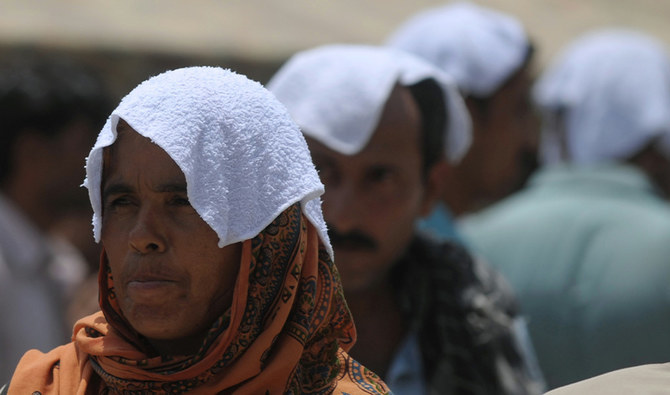
Pakistan and India already experience deadly heatwaves, with one in 2015 causing about 3,500 deaths, the study noted.
As temperatures rise as a result of climate change, “a policy framework is...needed to fight against heat stress and heat wave-related problems,” said T.V. Lakshmi Kumar, an atmospheric scientist at India’s SRM Institute of Science and Technology, who was not involved in the study.


![]()

Climate change set to drive more deadly heat in South Asia, Pakistan at risk
Short Url
https://arab.news/wywpk
Climate change set to drive more deadly heat in South Asia, Pakistan at risk
- Threat could be halved if world meets Paris Agreement goal to limit warming to 1.5 degrees Celsius above pre-industrial times
- Pakistan and India already experience deadly heatwaves, with one in 2015 causing about 3,500 deaths
Latest updates




© 2026 SAUDI RESEARCH & PUBLISHING COMPANY, All Rights Reserved And subject to Terms of Use Agreement.