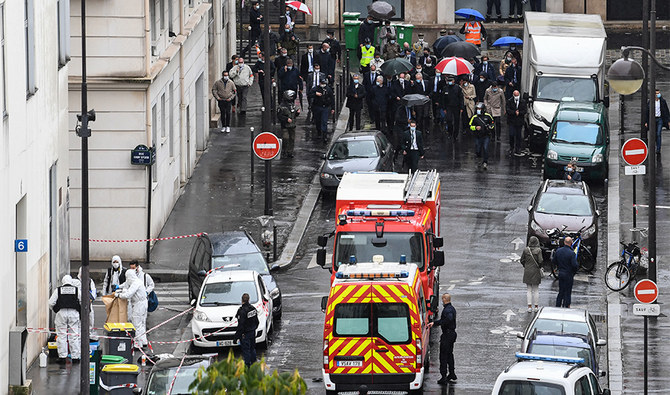
Paris: A Pakistani man who attacked the former offices of the Charlie Hebdo magazine last September was radicalised by videos of preachers in his home country and anti-France demonstrations at the time, he told police according to a report published on Wednesday.
The 26-year-old had spent the days leading up to his knife attack watching extremist preachers on YouTube and TikTok denouncing France and Charlie Hebdo, Le Parisien newspaper reported, citing the police investigation.
"I couldn't eat. I was crying watching the videos," Zaheer Hassan Mahmood told investigators.
Weeks before, the magazine had republished cartoons of the Prophet Mohammed (pbuh), considered blasphemous by many Muslims, to mark the start of a trial of men linked to a 2015 attack on its offices.
Mahmood said he did not realise the magazine had moved offices after the 2015 attack and presumed the two people he slashed with a meat cleaver were employees of the publication, the paper said.
Both victims, who worked for a TV production company with no links to Charlie Hebdo, sustained serious injuries.
Mahmood, from the village of Kothli Qazi in Punjab province, had entered France with false papers showing him as an unaccompanied minor, enabling him to claim asylum.
Islamist groups organised demonstrations in Pakistan in September against Charlie Hebdo and French President Emmanuel Macron, who defended freedom of expression and blasphemy, which is legal in France.
Mahmood watched videos by Khadim Hussain Rizvi, the late founder of the Islamist Tehreek-e-Labbaik Pakistan (TLP) party, and other radical preachers. He was also influenced by Prime Minister Imran Khan, who accused Macron of "attacking Islam," the paper said.
Blasphemy is a criminal act in conservative Pakistan, where laws allow for the death penalty for anyone deemed to have insulted Islam or Islamic figures.
Mahmood said he initially intended to damage the office building, rather than attack people, and has offered to apologise to his victims.
Investigators have found a video he sent to a friend the day before his attack which called for the decapitation of blasphemers, and he received a call from Greece the same day which appeared to refer to a premeditated assault.
He has been charged with "attempted murder with relation to a terrorist enterprise".


Charlie Hebdo office attacker tells investigators he was 'radicalised’ by Pakistani preachers
https://arab.news/69gzz
Charlie Hebdo office attacker tells investigators he was 'radicalised’ by Pakistani preachers

- 26-year-old told police he spent days leading up to knife attack watching extremist preachers on YouTube and TikTok
- Mahmood, from Pakistan's Punjab province, had entered France with false papers showing him as an unaccompanied minor

World Bank president in Pakistan to discuss development projects, policy issues
- Pakistan, World Bank are currently gearing up to implement a 10-year partnership framework to grant $20 billion loans to the cash-strapped nation
- World Bank President Ajay Banga will hold meetings with Pakistan Prime Minister Shehbaz Sharif and other senior officials during the high-level visit
ISLAMABAD: World Bank President Ajay Banga has arrived in Pakistan to hold talks with senior government officials on development projects and key policy issues, Pakistani state media reported on Sunday, as Islamabad seeks multilateral support to stabilize economy and accelerate growth.
The visit comes at a time when Pakistan and the World Bank are gearing up to implement a 10-year Country Partnership Framework (CPF) to grant $20 billion in loans to the cash-strapped nation.
The World Bank’s lending for Pakistan, due to start this year, will focus on education quality, child stunting, climate resilience, energy efficiency, inclusive development and private investment.
"World Bank President Ajay Banga arrives in Pakistan for a high-level visit," the state-run Pakistan TV Digital reported on Sunday. "During his stay, he will meet Prime Minister Shehbaz Sharif and other senior officials to discuss economic reforms, development projects, and key policy issues."
Pakistan, which nearly defaulted on its foreign debt obligations in 2023, is currently making efforts to stabilize its economy under a $7 billion International Monetary Fund (IMF) program.
Besides efforts to boost trade and foreign investment, Islamabad has been seeking support from multilateral financial institutions to ensure economic recovery.
“This partnership fosters a unified and focused vision for your county around six outcomes with clear, tangible and ambitious 10-year targets,” Martin Raiser, the World Bank vice president for South Asia, had said at the launch of the CPF in Jan. last year.
“We hope that the CPF will serve as an anchor for this engagement to keep us on the right track. Partnerships will equally be critical. More resources will be needed to have the impact at the scale that we wish to achieve and this will require close collaboration with all the development partners.”
In Dec., the World Bank said it had approved $700 million in financing for Pakistan under a multi-year initiative aimed at supporting the country's macroeconomic stability and service delivery.
It followed a $47.9 million World Bank grant in August last year to improve primary education in Pakistan's most populous Punjab province.


