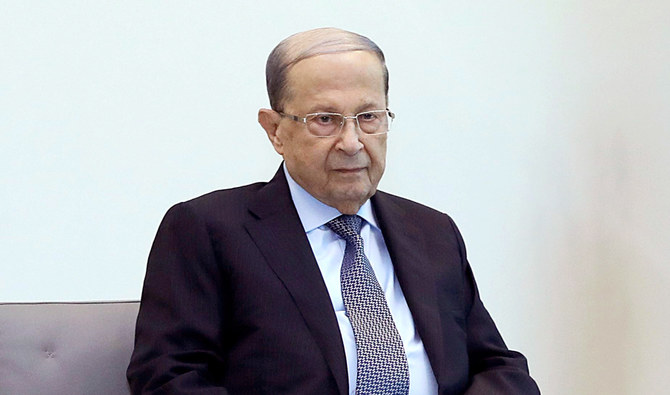

BEIRUT: Lebanese President Michel Aoun asked for diplomatic assistance on Tuesday in an attempt to overcome the political deadlock surrounding the attempted formation of the country’s new government.
The move came after Monday’s meeting with Prime Minister-designate Saad Hariri failed yet again to agree on a new cabinet as Aoun insisted on getting a “blocking third” in the proposed government.
Saudi Ambassador to Lebanon Walid bin Abdullah Bukhari was one of two diplomats to visit with Aoun on Tuesday.
“I told President Aoun that the Kingdom is committed to Lebanon’s sovereignty, independence and territorial integrity,” Bukhari said after his first visit to Lebanon in almost two years.
“I stressed the importance of putting the national interest first in order to move forward with the implementation of drastic reforms that could restore the international community’s confidence.”
Bukhari also called on parties to accelerate the formation of a government capable of achieving the aspirations of the Lebanese people.
“Saudi Arabia has always expressed its support and solidarity with the brotherly Lebanese people, steadfast in the face of crises,” he said.
French Ambassador to Lebanon Anne Griot also met with Aoun on Tuesday but did not make a statement.
Another failed attempt to form a government sparked more security and economic concerns on Tuesday. The dollar exchange rate reached 15,000 Lebanese Pounds (LBP) to the dollar, which was an increase of LBP4,000 in a single day.
I told President Aoun that KSA is committed to Lebanon’s sovereignty, independence and territorial integrity.
Walid bin Abdullah Bukhari, Saudi ambassador to Lebanon
According to a security source that spoke to Arab News, there has been an increase in armed robberies during the economic crisis, which has also led to the theft of government property.
Iron manhole covers have been stolen off the roads in several regions in an attempt to be sold for scrap, while a high-tension tower in Northern Bekaa reportedly fell because the steel mesh corners supporting the tower were taken by thieves. The fall cut transmission lines between the Deir Ammar Power Plant and other power stations.
Lebanon’s national electricity company, Electricite du Liban (EDL), said: “We found out that the corners of other towers were stolen, putting them at risk of falling. Repairs will require time and there is a difficulty finding the necessary financing in foreign currencies.”
The country’s critical situation prompted UN Deputy Special Coordinator for Lebanon Najat Rushdie to call on political leaders for action.
“Lebanese leaders should put their differences aside, assume their responsibilities, put an end to the current state of failure, listen to the people’s desperate calls and provide them with solutions,” Rushdie said.
“The UN remains committed to supporting the Lebanese people and the country’s stability, political independence and sovereignty.”
The Arab League, represented by assistant secretary-general Hossam Zaki, called upon the political parties “to put the national interest first and work urgently to overcome the political deadlock that has exacerbated the suffering of the people.”
According to Sky News, Zaki said Arab League Secretary-General Ahmed Aboul Gheit is greatly concerned by the Lebanese political disputes and feels the country is headed toward a severe crisis.
“The Arab League is ready to do whatever is asked of it in order to bridge the gap and find an agreed-upon solution that would allow the prime minister-designate to form his government,” Zaki said.
“It should be a government that operates through the skills of specialists in order to save Lebanon from its difficult current situation by implementing the necessary reforms that meet the ambitions and aspirations of the Lebanese people.”
UN Secretary-General Antonio Guterres called Maronite Patriarch Bechara Boutros Al-Rai on Monday and expressed “his great interest in the situation in Lebanon,” stressing the importance of forming a government and keeping Lebanon away from all conflicts.