JERUSALEM: Palestinian militants in Gaza fired a rocket at southern Israel on Tuesday, the army said, shortly after Prime Minister Benjamin Netanyahu toured the region on election day.
“A short while ago, a projectile was fired from the Gaza Strip into Israeli territory. As a result, an alert was activated in open areas only,” a statement from the Israeli army said, with a spokeswoman confirming a rocket hit an open field.
There were no immediate reports of damage or casualties caused by the rocket, the first fired from the Palestinian enclave since January, and there was no immediate claim of responsibility.
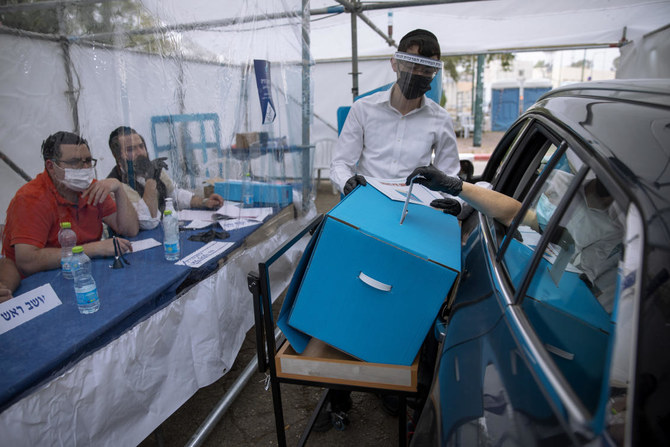
The launch came a short while after Netanyahu visited the southern Israeli city of Beersheba as part of his efforts to whip up support among voters, as the country was holding the fourth election in less than two years.
Netanyahu, 71, is Israel’s longest-serving premier but his inability to unite a stable governing majority behind him has mired the country in political gridlock.
He hopes to be rewarded by voters for establishing ties with a series of Arab countries, and for a Covid vaccination campaign that has inoculated half of Israel’s roughly nine million people.

Gaza rocket hits southern Israel on election day: army
Short Url
https://arab.news/myx83
Gaza rocket hits southern Israel on election day: army
Iran’s currency drops to record low against dollar, tracking websites say
DUBAI: Iran’s currency dropped to a record low of 1,500,000 rials to the US dollar on Tuesday, according to Iranian currency tracking websites, weeks after protests sparked by the rial’s dwindling value rocked the country.
The rial has lost about 5 percent of its value over the course of this month, according to data from the currency tracking website Bonbast.com.
Iran’s newly appointed Central Bank Governor Abdolnaser Hemmati said on Tuesday that “the foreign exchange market is following its natural course.”
What began as protests on December 28 over economic hardship in Tehran’s Grand Bazaar quickly morphed into the worst legitimacy crisis for Iran’s clerical establishment as it spread across the country with protesters demanding a political change.
Security forces crushed the unrest, which abated earlier this month, with the bloodiest crackdown since the 1979 Islamic Revolution.
Subsidy reform
Amid the protests, the government had introduced a subsidy reform, replacing preferential currency exchange rates for importers with direct transfers to Iranians to boost their purchasing power for essential goods.
Iran’s First Vice President Mohammadreza Aref defended the policy on Monday, saying corruption had made preferential rates ineffective in tackling inflation for basic goods, and that the new system aimed at stabilising the foreign exchange rate.
Monthly inflation for households has continued to rise, with year-on-year inflation reaching 60 percent for the period December 21 to January 19, according to figures released by the Statistical Center of Iran on Sunday.
Meanwhile, Iran’s online economy has been battered by an Internet blackout imposed since January 8 and still largely in place.
A government spokesperson said on Tuesday that while the government prefers free Internet access, security considerations required maintaining restrictions.
The rial has lost about 5 percent of its value over the course of this month, according to data from the currency tracking website Bonbast.com.
Iran’s newly appointed Central Bank Governor Abdolnaser Hemmati said on Tuesday that “the foreign exchange market is following its natural course.”
What began as protests on December 28 over economic hardship in Tehran’s Grand Bazaar quickly morphed into the worst legitimacy crisis for Iran’s clerical establishment as it spread across the country with protesters demanding a political change.
Security forces crushed the unrest, which abated earlier this month, with the bloodiest crackdown since the 1979 Islamic Revolution.
Subsidy reform
Amid the protests, the government had introduced a subsidy reform, replacing preferential currency exchange rates for importers with direct transfers to Iranians to boost their purchasing power for essential goods.
Iran’s First Vice President Mohammadreza Aref defended the policy on Monday, saying corruption had made preferential rates ineffective in tackling inflation for basic goods, and that the new system aimed at stabilising the foreign exchange rate.
Monthly inflation for households has continued to rise, with year-on-year inflation reaching 60 percent for the period December 21 to January 19, according to figures released by the Statistical Center of Iran on Sunday.
Meanwhile, Iran’s online economy has been battered by an Internet blackout imposed since January 8 and still largely in place.
A government spokesperson said on Tuesday that while the government prefers free Internet access, security considerations required maintaining restrictions.
© 2026 SAUDI RESEARCH & PUBLISHING COMPANY, All Rights Reserved And subject to Terms of Use Agreement.


