Pakistan wants friendly ties with all neighbors, including India — envoy in Delhi

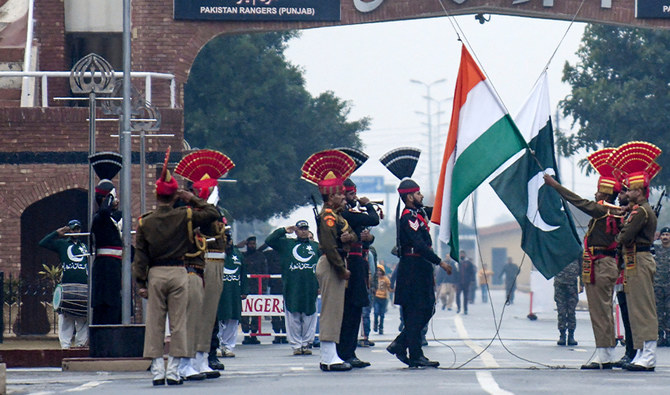
Indian Border Security Force personnel (dressed in brown) and Pakistani Rangers (dressed in black) take part in the Beating Retreat ceremony at the India-Pakistan border in Wagah, on January 6, 2020. (AFP/File)
Short Url
Updated 23 March 2021
Follow

Pakistan wants friendly ties with all neighbors, including India — envoy in Delhi

  • Pakistani Charge d’ Affairs Aftab Hasan Khan was addressing an event in New Delhi to mark Pakistan Day
  • “To achieve peace both countries shall resolve all outstanding issues ... through dialogue,” Khan says

ISLAMABAD: Pakistan’s acting high commissioner to New Delhi on Tuesday said Islamabad wanted friendly relations with all its neighbors including India, adding that peace was inevitable in the South Asian region, local media reported.
India and Pakistan are holding the first meeting in three years today, Tuesday, of a commission on water rights from the Indus River in what is being seen as a further sign of rapprochement in relations frozen since 2019 during disputes over Kashmir.
Last month, India and Pakistan announced a rare agreement to stop firing on the bitterly-contested Kashmir border
“For the larger interest of the region peace within South Asia is inevitable,” Pakistani Charge d’ Affairs Aftab Hasan Khan was quoted by Pakistani media as saying while addressing an event in New Delhi to mark Pakistan Day.
According to the statement issued by the Pakistani mission in New Delhi, Khan said Pakistan wanted to have friendly relations with all countries including India.
“To achieve peace between Pakistan and India both countries shall resolve all outstanding issues ... through dialogue,” he said.
Pakistan and India have for decades sparred over the disputed Himalayan region of Kashmir which they both rule in part but claim in full. 
The ongoing Indus water talks are the latest in both nations’ tentative efforts to re-engage after a 2019 suicide bomb in Indian Kashmir that New Delhi blamed on Pakistan-based guerrillas, a charge Islamabad denies, and India’s move later that year to strip Kashmir’s constitutional autonomy.


Pakistan says responding to Afghan ‘offensive operations’ after border fire as tensions escalate

Updated 26 February 2026
Follow

Pakistan says responding to Afghan ‘offensive operations’ after border fire as tensions escalate

  • Afghan Taliban spokesperson says “large-scale offensive operations” launched against Pakistani military bases
  • Pakistan says Afghan forces opened “unprovoked” fire across multiple sectors along shared border

ISLAMABAD: Afghanistan’s Taliban authorities said on Thursday they had launched “large-scale offensive operations” against Pakistani military bases and installations, prompting Pakistan to say its forces were responding to what it described as unprovoked fire along the shared border.

The escalation follows Islamabad’s weekend airstrikes targeting what it said were Tehreek-e-Taliban Pakistan (TTP) and Daesh militant camps inside Afghanistan in response to a wave of recent bombings and attacks in Pakistan. Islamabad said the strikes killed over 100 militants, while Kabul said dozens of civilians were killed and condemned the attacks as a violation of its sovereignty.

In a post on social media platform X, Afghan government spokesperson Zabihullah Mujahid said Afghanistan had launched “large-scale offensive operations” in response to repeated violations by the Pakistani military.


Pakistan’s Ministry of Information said Afghan forces had initiated hostilities along multiple points of the frontier.

“Afghan Taliban regime unprovoked action along the Pakistan–Afghanistan border given an immediate, and effective response,” the ministry said in a statement.

The statement said Pakistani forces were targeting Taliban positions in the Chitral, Khyber, Mohmand, Kurram and Bajaur sectors, claiming heavy Afghan casualties and the destruction of multiple posts and equipment. It added that Pakistan would take all necessary measures to safeguard its territorial integrity and the security of its citizens.


Separately, security officials said Pakistani forces had carried out counterattacks in several border sectors.

“Pakistan’s security forces are giving a befitting reply to the unprovoked Afghan aggression with full force,” a security official said, declining to be named. 

“The Pakistani security forces’ counter-attack destroyed Taliban’s hideouts and the Khawarij fled,” they added, referring to TTP militants. 

The claims from both sides could not be independently verified.

Cross-border violence has intensified in recent weeks, with Pakistan blaming a surge in suicide bombings and militant attacks on militants it says are based in Afghanistan. Kabul denies providing safe havens to anti-Pakistan militant groups.

The clashes mark the third major escalation between the neighbors in less than a year. Similar Pakistani strikes last year triggered weeklong clashes before Qatar, Türkiye and other regional actors mediated a ceasefire in October.

The 2,600-kilometer (1,600-mile) frontier, a key trade and transit corridor linking Pakistan to landlocked Afghanistan and onward to Central Asia, has faced repeated closures amid tensions, disrupting commerce and humanitarian movement. Trade between the two nations has remained closed since October 2025.