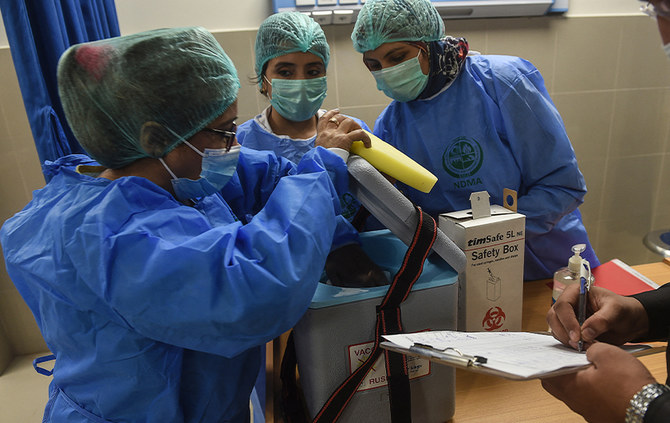
ISLAMABAD: A representative of Pakistani private pharmaceutical company AGP Limited has said China’s CanSino Biologics coronavirus vaccine would be brought in bulk in Pakistan and from next month would be packed at a filling plant at the National Institute of Health, Pakistan media reported on Tuesday, adding that the country would soon start manufacturing the vaccine itself through ‘technology transfer’ from China.
On Monday, an AGP official told media the company would begin receiving shipments of China’s CanSino Biologics COVID-19 vaccine this week for commercial sale.
“It will reduce the price of the vaccine by up to 30pc (around Rs3,000),” technical Adviser to AGM Pharma, Dr. Hassan Abbas Zaheer, told Pakistan’s Dawn newspaper, referring to the vaccine being packed at the NIH in the future. “At a later stage, it will be manufactured in Pakistan through transfer of technology. This has been made possible because the clinical trial of Cansino was held in Pakistan.”
Zaheer said though Pakistan was a vaccine insecure country currently, “soon it would become a secure country as vaccine production would begin here and dependence on other nations would end.”
“The vaccine will be manufactured under a public-private partnership project,” Zaheer added. “Currently India’s vaccine manufacturing industry is worth $5 billion. Pakistan can also start producing a number of vaccines including Covid-19.”
Pakistan, one of the first countries in the world to allow private imports of COVID-19 vaccines, last week received a batch of the Russian Sputnik vaccine. The batch has been imported by AGP which is working with the government to set a price cap for privately imported vaccines before it can use the doses for commercial sale.


China’s CanSino vaccine to be made in Pakistan soon through ‘technology transfer’ — media
https://arab.news/wm6tv
China’s CanSino vaccine to be made in Pakistan soon through ‘technology transfer’ — media

- Pharma company AGP says company would begin receiving shipments of CanSino vaccine this week for commercial sale
- CanSino vaccine to be brought in bulk in Pakistan and from next month packed at plant at National Institute of Health, AGP says

Pakistan engages Saudi Arabia, China in bid to ease surging Middle East tensions
- Pakistan’s foreign minister stresses need for de-escalation in conversations with Chinese, Saudi counterparts
- Tensions in the Middle East continue to remain high as conflict between US, Israel and Iran intensifies
ISLAMABAD: Pakistan’s Deputy Prime Minister Ishaq Dar spoke to the foreign ministers of Saudi Arabia and China on Tuesday, stressing the importance of diplomatic engagement to de-escalate tensions in the Middle East as the Iran war intensifies.
Pakistan has constantly engaged regional countries in efforts to broker a ceasefire in the Middle East, after the US and Isreal launched coordinated strikes against Iran on Feb. 28.
Iran launched fresh attacks on Gulf countries on Tuesday morning, where it has targeted US military bases in recent weeks. In addition to firing missiles and drones at Israel and American bases in the region, Iran has also been targeting energy infrastructure which, combined with its stranglehold on the Strait of Hormuz, has sent oil prices soaring worldwide.
Dar spoke to Saudi Foreign Minister Prince Faisal bin Farhan to discuss developments in the Middle East and ongoing deliberations at the UN Security Council, Pakistan’s foreign office said in a statement.
“DPM/FM shared Pakistan’s perspective, underscoring the importance of continued coordination and diplomatic engagement to support de-escalation and promote peace and stability across the region and beyond,” the statement said.
Dar, who also serves as Pakistan’s foreign minister, spoke to Chinese foreign minister Wang Yi over the telephone separately. The two discussed the evolving regional situation and broader global developments.
Dar underscored the need to ease tensions in the Middle East and the wider region during the conversation, the foreign office said.
Yi appreciated Pakistan’s constructive efforts aimed at promoting de-escalation and stability in the region, it added.
“The two leaders stressed the importance of de-escalation and emphasized the need to pursue dialogue and diplomacy in accordance with the principles of the UN Charter,” the foreign office’s statement said.
The conflict in the Middle East has hit Pakistan hard as well, forcing Islamabad to hike petrol and diesel prices by Rs55 per liter last Friday.
Pakistan’s government has also announced a set of austerity measures, which include closing schools and cutting down on government expenditures, as it evaluates petrol stocks and looks for alternative supply routes.


