

Aramco expects higher oil demand this year as it declares a $75bn dividend

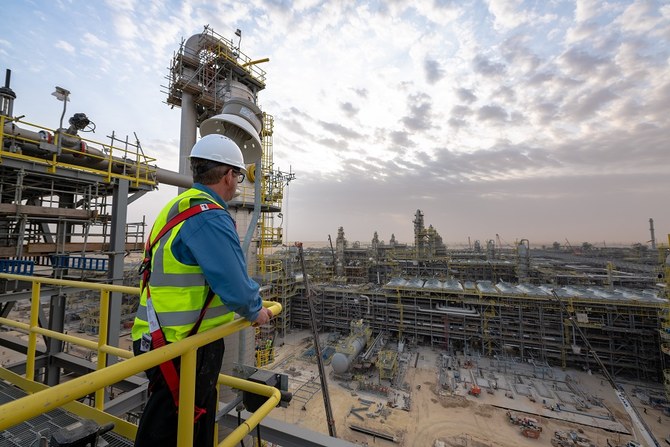
Earlier the world’s biggest oil company reported a 44.4 percent drop in net income to $49 billion in 2020. (Supplied)
Short Url
Updated 21 March 2021
Follow

Aramco expects higher oil demand this year as it declares a $75bn dividend

  • Outlook based on increasing demand from China that is approaching pre-pandemic levels
  • World’s biggest oil company reported a 44.4 percent drop in net income to $49 billion in 2020

DUBAI: Saudi Aramco’s CEO Amin Nasser expects oil demand to rise this year as the company declared a full year dividend of $75 billion.
He said that the outlook was based on improving demand from China that was approaching pre-pandemic levels as well as the global roll-out of vaccines.
Earlier the world’s biggest oil company reported a 44.4 percent drop in net income to $49 billion in 2020, as the global energy industry emerged from the impact of lower crude oil prices and the COVID-19 pandemic.
The company, listed on the Saudi stock exchange, said revenues declined 30.5 percent to $204.83 billion.

“In one of the most challenging years in recent history, Aramco demonstrated its unique value proposition through its considerable financial and operational agility,” said Nasser. “Our exceptional performance during such testing times owed much to the unwavering spirit and resilience of our employees, who set operational records and continued to meet the world’s energy needs both safely and reliably,” he added.
Aramco shares gained about 0.4 percent in early trade.
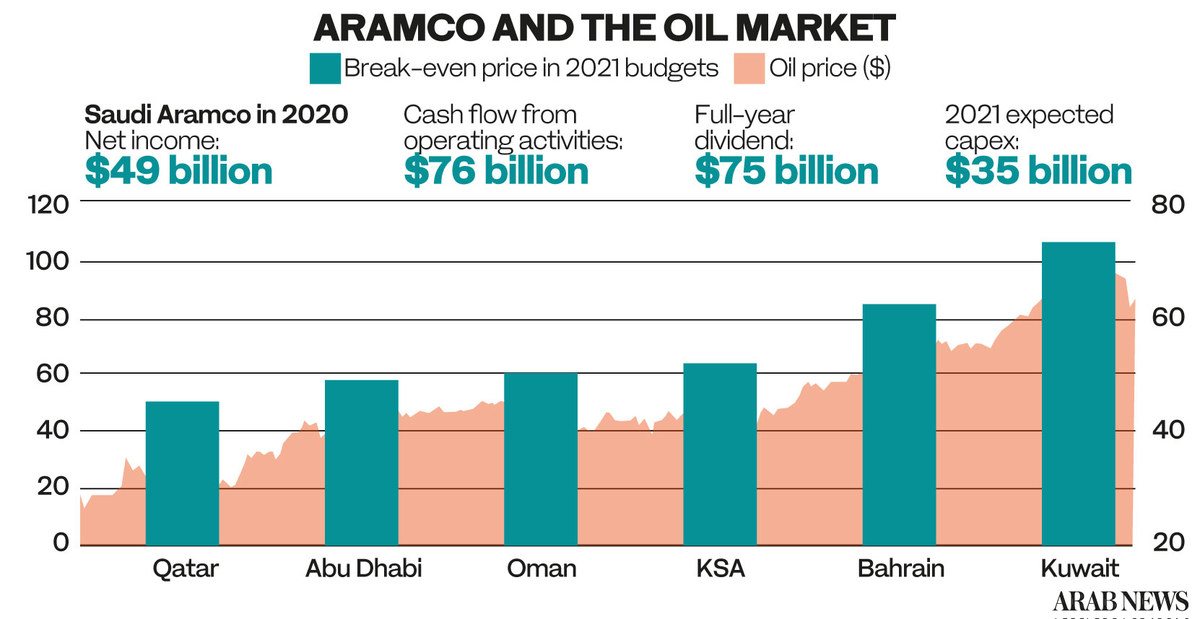
In 2020, Aramco’s average hydrocarbon production was 12.4 million barrels per day of oil equivalent, including 9.2 million barrels per day (mmbpd) of crude oil, the company said.
A massive contraction in global oil demand that followed the first pandemic-related lockdowns a year ago has been a major blow to international oil companies as they rapidly re-shape their businesses in response to rapidly changing consumer demand.
Earnings among major global producers such as Royal Dutch Shell and BP fell sharply in 2020 while Exxon Mobil, the largest US energy company, reported its first annual loss.

“Looking ahead, our long-term strategy to optimize our oil and gas portfolio is on track and, as the macro environment improves, we are seeing a pick-up in demand in Asia and also positive signs elsewhere. We remain confident that we will emerge on the other side of this pandemic in a position of strength,” said Nasser.
Aramco said that its international bond issuance in the fourth quarter achieved record demand for a 50-year tranche and was 10 times oversubscribed compared to its initial offering size


Reforms target sustained growth in Saudi real estate sector, says Al-Hogail

Updated 26 January 2026
Follow

Reforms target sustained growth in Saudi real estate sector, says Al-Hogail

RIYADH: The Real Estate Future Forum opened its doors for its first day at the Four Seasons Riyadh, with prominent global and local figures coming together to engage with one of the Kingdom’s most prospering sectors.

With new regulations, laws, and investments underway, 2026 is expected to be a year of momentous progress for the real estate sector in the Kingdom.

The forum opened with a video highlighting the sector’s progress in the Kingdom, during which an emphasis was placed on the forum’s ability to create global reach, representation, as well as agreements worth a cumulative $50 billion

With the Kingdom now opening up real estate ownership to foreigners, this year’s Real Estate Future Forum is placing a great deal of importance on this new milestone and its desired outcomes and impact on the market. 

Aside from this year’s forum’s unique discussions surrounding those developments, it will also be the first of its kind to launch the Real Estate Excellence Award and announce its finalist during the three-day summit.

Minister of Municipalities and Housing and Chairman of the Real Estate General Authority Majed Al-Hogail took to stage to address the diverse audience on the real estate market’s achievements thus far and its milestones to come.

Of those important milestones, he underscored “real estate balance” as a key pillar of the sector’s decisions to implement regulatory tools “with the aim of constant growth which can maintain the vitality of this sector.” He pointed to examples of those regulatory measures, such as the White Land Tax.

On 2025’s progress, the minister highlighted the jump in Saudi family home ownership, which went from 47 percent in 2016 to 66 percent in 2025, keeping the Kingdom’s Vision 2030 goal of 70 percent by the end of the decade on track.

He said the opening of the real estate market to foreigners is an indicator of the sector’s maturity under the leadership of Crown Prince Mohammed bin Salman. He said his ministry plans to build over 300,000 housing units in Riyadh over the next three years.

Speaking to Arab News,  Al-Hogail elaborated on these achievements, stating: “Today, demand, especially local demand, has grown significantly. The mortgage market has reached record levels, exceeding SR900 billion ($240 billion) in mortgage financing, we are now seeing SRC (Saudi Real Estate Refinance Co.) injecting both local and foreign liquidity on a large scale, reaching more than SR54 billion”

Al-Hogail described Makkah and Madinah as unique and special points in the Kingdom’s real estate market as he spoke of the sector’s attractiveness.

 “Today, the Kingdom of Saudi Arabia has become, in international investment indices, one that takes a good share of the Middle East, and based on this, many real estate investment portfolios have begun to come in,” he said. 

Al-Ahsa Gov. Prince Saud bin Talal bin Badr Al-Saud told Arab News the Kingdom’s ability to balance both heritage sites with real estate is one of its strengths.

He said: “Actually the real estate market supports the whole infrastructure … the whole ecosystem goes back together in the foundation of the real estate; if we have the right infrastructure we can leverage more on tourism plus we can leverage more on the quality of life … we’re looking at 2030, this is the vision … to have the right infrastructure the time for more investors to come in real estate, entertainment, plus tourism and culture.”