Pakistan prime minister has ‘very mild’ COVID-19 symptoms, health chief says 

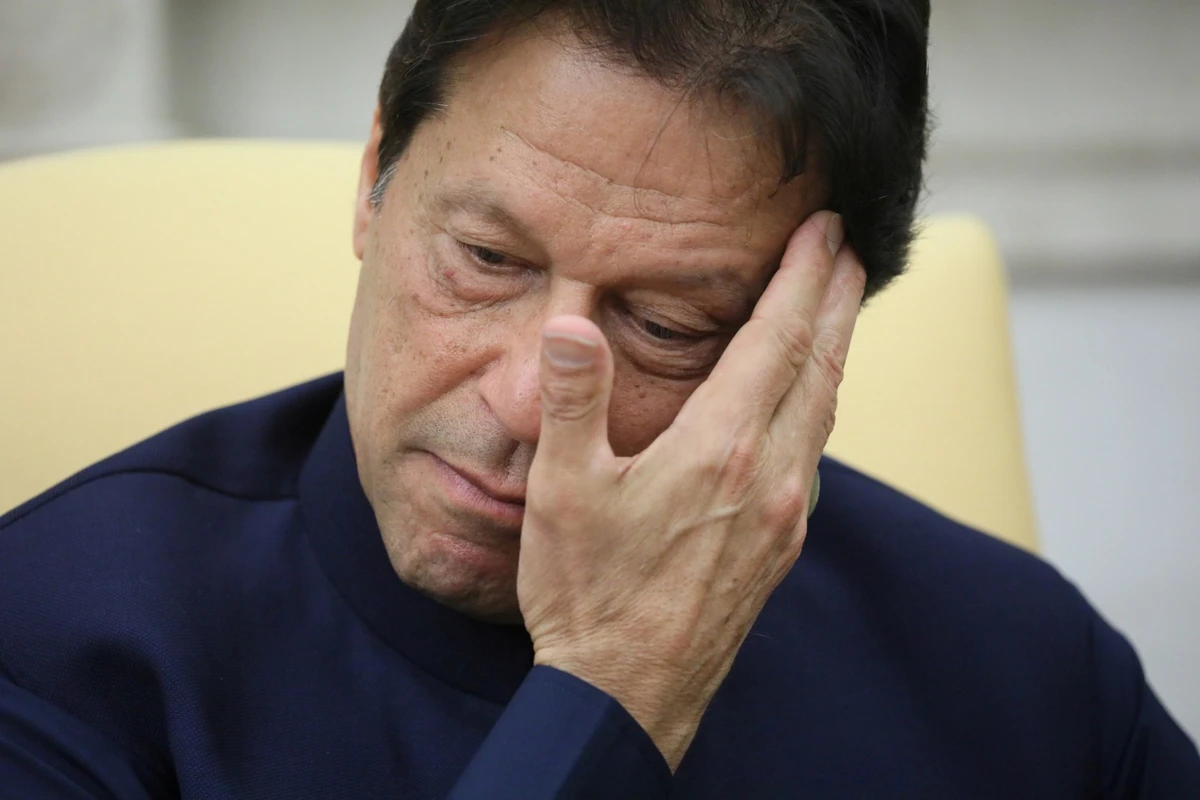
Pakistan Prime Minister Imran Khan listens while meeting with U.S. President Donald Trump at the Oval Office of the White House in Washington on July 22, 2019. (REUTERS)
Short Url
Updated 21 March 2021
Follow

Pakistan prime minister has ‘very mild’ COVID-19 symptoms, health chief says 

  • Imran Khan takes to social media to thank for all get-well wishes
  • Prime minister, first lady tested positive for COVID-19 on Saturday

ISLAMABAD: Prime Minister Imran Khan has very mild coronavirus symptoms, Pakistan’s health chief said on Saturday evening, after announcements earlier in the day that the PM and the first lady had tested positive for COVID-19.

Khan, 68, tested positive for the virus just two days after he received his first injected dose of the COVID-19 vaccine, as Pakistan earlier this month launched a coronavirus vaccination drive for the general public, starting with those above the age of 60.

“He is in good sprits. His symptoms are very mild. At this time, he does not need direct treatment or intervention,” Dr. Faisal Sultan said in a video press conference.

As a wave of messages wishing the prime minister a speedy recovery followed the news of his illness, Khan on Sunday took to the social media to thank everyone.

“I want to thank everyone for their good wishes and prayers,” he said in an Instagram post. 

Khan is self-isolating at home, a close aide of the PM said on Saturday, with another adviser confirming that first lady also had the disease.

“Prime Minister Imran Khan tests positive for coronavirus, is experiencing ‘mild symptoms’. He will self-quarantine at home however will continue to work from home,” Faisal Javed Khan, a senator from the PM’s Pakistan Tehreek-e-Insaf (PTI) party, said in a tweet.

The PM’s adviser on overseas Pakistanis, Sayed Zulfiqar Bukhari, wished the PM and first lady a speedy recovery on Twitter:

To prevent speculation that the PM’s illness is related to vaccination, Planning Minister Asad Umar took to Twitter to say that Khan must have contracted the virus prior to receiving his vaccine jab.

“The symptoms take a few days before manifesting. Hence it is certain that PM had been infected PRIOR to vaccination,” Umar said in a tweet, as he urged others to not to hesitate to get vaccinated.

The incubation period of COVID-19 — the time between exposure to the virus and symptom onset — is on average five to six days.

It takes at least two weeks after vaccination for the body to acquire immunity against the virus that causes COVID-19.

Pakistan is observing a surge in COVID-19 infections. It reported 3,667 new cases in the last 24 hours.

At least 626,802 COVID-19 cases and 13,843 related deaths have been recorded in the country of 220 million since the beginning of the outbreak.



Pakistan, global crypto exchange discuss modernizing digital payments, creating job prospects 

Updated 05 December 2025
Follow

Pakistan, global crypto exchange discuss modernizing digital payments, creating job prospects 

  • Pakistani officials, Binance team discuss coordination between Islamabad, local banks and global exchanges
  • Pakistan has attempted to tap into growing crypto market to curb illicit transactions, improve oversight

ISLAMABAD: Pakistan’s finance officials and the team of a global cryptocurrency exchange on Friday held discussions aimed at modernizing the country’s digital payments system and building local talent pipelines to meet rising demand for blockchain and Web3 skills, the finance ministry said.

The development took place during a high-level meeting between Finance Minister Muhammad Aurangzeb, Pakistan Virtual Assets Regulatory Authority (PVARA) Chairman Bilal bin Saqib, domestic bank presidents and a Binance team led by Global CEO Richard Teng. The meeting was held to advance work on Pakistan’s National Digital Asset Framework, a regulatory setup to govern Pakistan’s digital assets.

Pakistan has been moving to regulate its fast-growing crypto and digital assets market by bringing virtual asset service providers (VASPs) under a formal licensing regime. Officials say the push is aimed at curbing illicit transactions, improving oversight, and encouraging innovation in blockchain-based financial services.

“Participants reviewed opportunities to modernize Pakistan’s digital payments landscape, noting that blockchain-based systems could significantly reduce costs from the country’s $38 billion annual remittance flows,” the finance ministry said in a statement. 

“Discussions also emphasized building local talent pipelines to meet rising global demand for blockchain and Web3 skills, creating high-value employment prospects for Pakistani youth.”

Blockchain is a type of digital database that is shared, transparent and tamper-resistant. Instead of being stored on one computer, the data is kept on a distributed network of computers, making it very hard to alter or hack.

Web3 refers to the next generation of the Internet built using blockchain, focusing on giving users more control over their data, identity and digital assets rather than big tech companies controlling it.

Participants of the meeting also discussed sovereign debt tokenization, which is the process of converting a country’s debt such as government bonds, into digital tokens on a blockchain, the ministry said. 

Aurangzeb called for close coordination between the government, domestic banks and global exchanges to modernize Pakistan’s payment landscape.

Participants of the meeting also discussed considering a “time-bound amnesty” to encourage users to move assets onto regulated platforms, stressing the need for stronger verifications and a risk-mitigation system.

Pakistan has attempted in recent months to tap into the country’s growing crypto market, crack down on money laundering and terror financing, and promote responsible innovation — a move analysts say could bring an estimated $25 billion in virtual assets into the tax net.

In September, Islamabad invited international crypto exchanges and other VASPs to apply for licenses to operate in the country, a step aimed at formalizing and regulating its fast-growing digital market.