


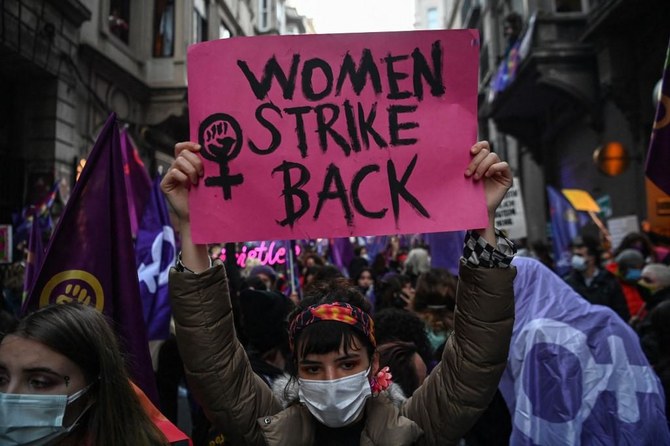
ISTANBUL: Turkey has pulled out of the world’s first binding treaty to prevent and combat violence against women by presidential decree, in the latest victory for conservatives in President Recep Tayyip Erdogan’s ruling party.
The 2011 Istanbul Convention, signed by 45 countries and the European Union, requires governments to adopt legislation prosecuting domestic violence and similar abuse as well as marital rape and female genital mutilation.
Conservatives had claimed the charter damages family unity, encourages divorce and that its references to equality were being used by the LGBT community to gain broader acceptance in society.
The publication of the decree in the official gazette early Saturday sparked anger among rights groups and calls for protests in Istanbul.
Women in Turkey waking up this morning to a presidential decree issued in the early hours of the morning withdrawing from the the Council of Europe Convention on Preventing and Combating Violence Against Women as femicides are on the rise. pic.twitter.com/YSfxUgzPth
— Ceylan Yeginsu (@CeylanWrites) March 20, 2021
Gokce Gokcen, deputy chairperson of the main opposition CHP party said abandoning the treaty meant “keeping women second class citizens and letting them be killed.”
“Despite you and your evil, we will stay alive and bring back the convention,” she said on Twitter.
Turkey had been debating a possible departure after an official in Erdogan’s party raised dropping the treaty last year.
Since then, women have taken to the streets in cities across the country calling on the government to stick to the convention.
Labour and social services minister Zehra Zumrut Selcuk told the official Anadolu news agency that Turkey’s constitution and domestic regulations would instead be the “guarantee of the women’s rights.”
“We will continue our fight against violence with the principle of zero tolerance,” she said Saturday.
Domestic violence and femicide remain a serious problem in Turkey.
A man was arrested on Sunday in the north of the country after a video on social media purportedly showing him beating his ex-wife on a street sparked outrage.
Last year, 300 women were murdered according to the rights group We Will Stop Femicide Platform.
The platform called for a “collective fight against those who dropped the Istanbul convention,” in a message on Twitter.
“The Istanbul convention was not signed at your command and it will not leave our lives on your command,” its secretary general Fidan Ataselim tweeted.
She called on women to protest in Kadikoy on the Asian side of Istanbul on Saturday.
“Withdraw the decision, implement the convention,” she tweeted.
Kerem Altiparmak, an academic and lawyer specializing in human rights law, likened the government’s shredding of the convention to the 1980 military coup.
“What’s abolished tonight is not only the Istanbul convention but the parliament’s will and legislative power,” he commented.
Rights groups accuse Erdogan of taking mostly Muslim but officially secular Turkey on an increasingly socially conservative course during his 18 years in power.
After a spectacular Pride March in Istanbul drew 100,000 people in 2014, the government responded by banning future events in the city, citing security concerns.
And in January Turkish police detained four people after artwork depicting Islam’s holiest site viewed as offensive by Ankara was hung at an Istanbul university at the center of recent protests.


