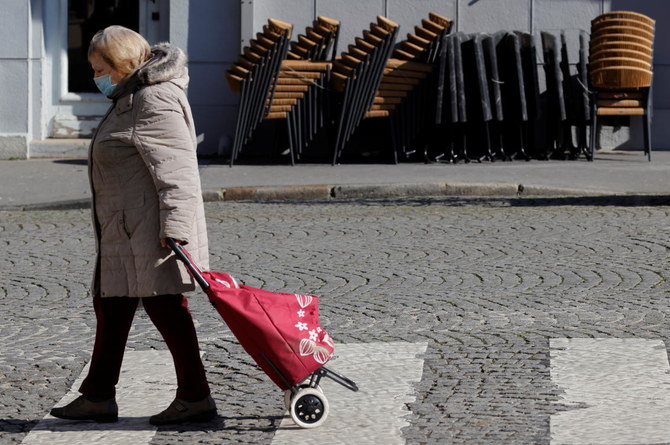
Parisians brace for new COVID-19 lockdown

Large numbers of Paris residents headed out of the city before the coronavirus restrictions, due to last for a month, come into force. (Reuters)
Short Url
Updated 19 March 2021
Follow

Parisians brace for new COVID-19 lockdown

  • Large numbers of Paris residents headed to railway stations on Friday morning so they could get out of the city before the restrictions

PARIS: Camila Campodonico was at work in Paris on Thursday evening when the government announced the city was entering a new lockdown to combat COVID-19, and she knew her plans for a get-together with friends this weekend were over.
“I heard that and I said: ‘Oh no, not again. A lockdown.’ I wasn’t very happy,” said Campodonico, a student from Argentina who is working temporarily for a marketing company.
French Prime Minister Jean Castex announced that, because intensive care units were close to over-flowing, Paris residents could only leave home for essential trips or exercise, and non-essential travel to other parts of the county was banned.
Large numbers of Paris residents headed to railway stations on Friday morning so they could get out of the city before the restrictions, due to last for a month, come into force at midnight.
At the Gare de l’Est station in Paris, there were long lines of people at the ticket office. People, some with pets, rushed to board trains heading for Strasbourg and Luxembourg.
Valentino Armilli, 27, was going to visit his parents in Thionville, in the Lorraine region in eastern France, for the weekend. He took the decision to go there on Thursday night, because of the new lockdown.
“My parents had COVID a month ago and I have not seen them since. This weekend is the last time for a long while that I’ll be able to see them,” he said.
There was relief though that the restrictions were less severe than in previous lockdowns. This time, for example, hairdressers can stay open.
“I think that it’s important for people’s mental health to have a decent hair style,” hairdresser Marie Leroy said at her salon in Joinville-le-Pont, just outside Paris.
“People are a bit depressed, they’re fed up I think at the moment so going to the hairdresser’s is important.”


As India claims fourth-largest economy spot, what it means on the ground

People gather to shop for clothes at a weekend market in Bengaluru, India, on Dec. 28, 2025. (AFP)
Updated 10 sec ago
Follow

As India claims fourth-largest economy spot, what it means on the ground

  • Indian government review says economy grew to $4.19 billion, overtaking Japan
  • Claim still needs IMF review as only organized sector counted, economist says

NEW DELHI: When Ramesh Chandra Biswal left his job as a space scientist in the US, he returned to eastern India and ran an agriculture startup on a promise of his country’s rapid economic growth.

Nine years on, as India positions itself as the world’s fourth largest economy, he is still waiting for the promise to come true.

India’s economy was the sixth largest in the world, valued at about $2.6 trillion in 2017, when Biswal launched his Villamart project in his home village in Odisha.

According to calculations in the Indian government’s end-of-year economic review, it has now grown to $4.19 trillion, overtaking Japan’s economy in terms of nominal Gross Domestic Product.

The review also projects that India will overtake Germany to become the world’s third-largest economy within the next three years, trailing only the US and China in economic weight.

But on the ground, Biswal was not sure what the projections meant because they had no impact on his life or business.

“The hype around India becoming the fourth largest economy is not grounded. People cannot relate to that,” he said.

“The number of people here in India is much more than Japan ... We have to improve the per capita income instead of telling the story of being the fourth largest economy.”

Over the years that he has been running his company, Biswal has not noticed much change, but hoped that the news of the country’s growth would at least create a positive hype and motivate everyone.

“People are trying. As an entrepreneur, we are also trying, struggling every day, trying to do something new,” he said.

“I’m getting some respect in society. That way, it is giving me the driving force.”

But not everyone was immediately optimistic. For Sarvesh Sau, a fruit seller in Delhi, it has been increasingly difficult to keep his family afloat.

“Rich people are getting rich, those who have resources ... but a low-income group person like me finds it difficult to manage a decent living despite putting in more than 12 hours of work every day.

“We are a big nation, and we will look big compared to others. Are we able to match Japan?”

The world’s most populous nation, India has about 1.46 billion people and a GDP per capita estimated by the World Bank to be about $2,700. It is about 12 times lower than Japan’s.

Yogendra Kumar, a plumber in Noida, said his income has been rising, but it is consistently outpaced by the cost of living, leaving him feeling poorer over time.

“I have heard that India has become the fourth largest economy, but I don’t know how to react to that. It does not make any difference to our lives. It sounds good that India is growing, but the matter of fact is that for people like me the struggle for survival is more acute now than before,” he said.

“Today I earn more but the inflation takes away all the money, and it makes it difficult to have a comfortable life,” he told Arab News. “Mustard oil was 50 rupees 10 years ago. It is now 200 rupees. A cooking gas cylinder used to cost 500 rupees — now it costs more than double. Everything is so expensive.”

While India’s claim of being the fourth-largest economy is still awaiting review by the International Monetary Fund, Prof. Arun Kumar, a development economist, does not expect it to be confirmed.

“Our GDP data, as the IMF has said, is suspect because it doesn’t include the informal sector ... According to my estimate, we are still the seventh largest economy, just ahead of Italy,” he told Arab News, also estimating India’s actual growth to be much lower than the government’s projection.

“Even though official data shows a 7 percent to 8 percent rate of growth, people realize that it’s not growing so well,” Prof. Kumar said.

“The rate of growth is only of the organized sector, not of the unorganized sector ... The unorganized sector is declining and that is where 94 percent of the employment is.”