

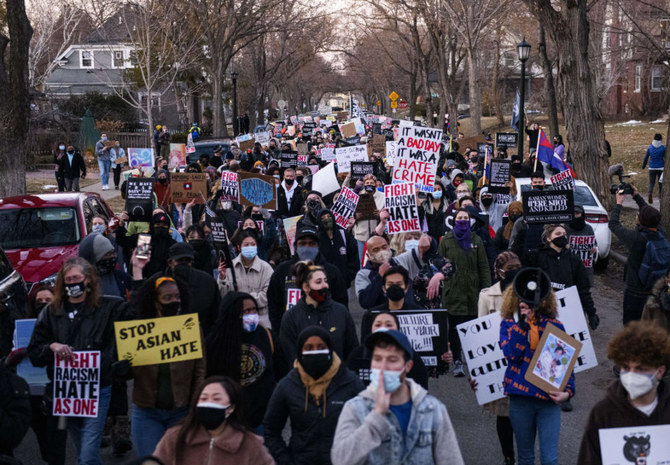

ATLANTA, USA: Asian-American communities were on alert Thursday after a shooting rampage that left six women of Asian origin dead and stoked fears in a population already alarmed by a surge in hate crimes during the coronavirus pandemic.
Three massage parlors around Atlanta were targeted Tuesday, before a 21-year-old man suspected of the killings was arrested in southwest Georgia hours later.
“It’s heartbreaking,” said Andrew Yang, a former Democratic presidential hopeful who is running for mayor of New York.
“I’ve been Asian all my life, and I remember — vividly — growing up with this constant sense of invisibility, mockery, disdain, a sense that you cannot be American if you have an Asian face,” Yang said.
“But this has metastasized into something new and deadly and virulent and hateful,” he told a press conference in New York alongside the Black civil rights activist Al Sharpton.
The White House announced that President Joe Biden and Vice President Kamala Harris, who were already scheduled to be in Atlanta on Friday, would meet Asian-American leaders to “discuss the ongoing attacks and threats against the community.”
Robert Aaron Long, of Woodstock, Georgia, faces eight counts of murder and one charge of aggravated assault for Tuesday’s attacks, in which six of the eight people killed were women of Asian descent.
He has admitted carrying out the attacks, according to law enforcement, but claims he was not motivated by racial hatred.
FBI Director Chris Wray reiterated in an interview with public radio station NPR on Thursday that the gunman’s motive was yet to be fully understood, but the shootings nevertheless struck a chord in a country where hate crimes against Asian Americans have been on the rise.
Chi-Chi Zhang, an Asian-American woman living in Cambridge, Massachusetts, described discussing race and hate crimes with her two young daughters, aged two and four.
“We started to talk about what our escape plan would be if we were to be attacked on the street,” she said. “How is that a normal conversation to have with a two-year-old?“
Zhang said that for much of her life she had been taught to conform to the idea of a “model minority” but added that the concept of keeping one’s head down was “the reason nobody pays attention to crimes against us.”
‘Pandemic of discrimination and hate'
In Washington, a House subcommittee discussed a worrying rise in anti-Asian sentiment, with chairman Steve Cohen describing Asians being subjected to “verbal harassment, being spat at, slapped in the face, lit on fire, slashed with a box cutter or shoved violently to the ground.”
“For many Asian-Americans, Tuesday’s shocking events felt like the inevitable culmination of a year in which there were nearly 3,800 reported incidents of anti-Asian hate,” the Democratic lawmaker from Tennessee said.
The surge, he said, had been fueled by references to coronavirus as the “China virus” — a term often used by Donald Trump, although Cohen did not cite the former president by name.
According to the sheriff’s office, “Long told investigators that he blames the massage parlors for providing an outlet for his addiction to sex” and the shootings were not racially motivated.
Atlanta Mayor Keisha Lance Bottoms said Long’s claims should be taken “with a grain of salt” while Sarah Park, of the Korean American Coalition-Metro Atlanta, said racism was clearly a factor.
Among those testifying before the House panel were four members of Congress of Asian origin.
“Asian-Americans must not be used as scapegoats in times of crisis — lives are at stake,” said Judy Chu, a Democrat from California. “It’s critical that Congress takes bold action to address this pandemic of discrimination and hate.”
‘Un-American'
The ranking Republican on the panel, Chip Roy of Texas, said the victims of the Atlanta shootings deserve justice but expressed concern about “policing” the right to voice criticism of China’s communist leadership.
Roy’s remarks drew an angry response from Meng, a Democrat from New York, who suggested Republican rhetoric on the pandemic had put “a bull’s eye on the back of Asian-Americans.”
Vigils were held in several US cities on Wednesday to mourn the victims of the shootings and condemn racially motivated violence.
Police in New York, Seattle, Chicago, San Francisco and other major cities stepped up patrols in areas with large Asian-American populations.
Biden ordered flags to be flown at half-staff at the White House and other public buildings until sunset on Monday as a mark of respect for the Atlanta victims.
Biden said that while the motive has not yet been fully established “what we do know is that the Asian-American community is feeling enormous pain.”
“The recent attacks against the community are un-American,” he tweeted. “They must stop.”
Georgia is home to nearly 500,000 people of Asian origin, or just over four percent of its population, according to the Asian American Advocacy Fund.
Fallout from the case extended to the Cherokee County sheriff’s department, where Captain Jay Baker was removed Thursday as his agency’s spokesman for its investigation, The New York Times reported.
Baker was the target of criticism after telling a news conference that Long committed the killings after “a really bad day.”
Scrutiny grew after a post purported to be from Baker’s private Facebook account showed him promoting T-shirts describing Covid-19 as an “imported virus” from China — raising questions about whether personal biases would affect his work on the case.


