MUMBAI/ISLAMABAD: India and Pakistan reported a big jump in new coronavirus infections on Thursday, driven by a resurgence in cases in their richest states.
While authorities in India have mainly blamed crowding and an overall reluctance to wear masks for its spike, Pakistan says the UK variant of the virus found in the country could also be a factor.
Maharashtra state, home to India’s commercial capital Mumbai, reported 23,179 of the country’s 35,871 new cases in the past 24 hours, and the fast-spreading contagion in major industrial areas raised risks of companies’ production being disrupted.
With the worst rise in infections since early December, India’s total cases stood at 11.47 million, the highest after the United States and Brazil. Deaths rose by 172 to 159,216, according to health ministry data on Thursday.
In Pakistan, 3,495 people tested positive in the past 24 hours, the most daily infections since early December. Total cases rose past 615,000. Deaths rose by 61 to 13,717.
Most of the new cases came from Pakistan’s largest and richest province, Punjab.
Pakistani minister Asad Umar said on Twitter that hospital beds were filling fast, warning of stricter curbs if rules were not followed.
“The new strain spreads faster and is more deadly,” he said on Twitter, referring to the UK variant.
India’s first wave peaked in September at nearly 100,000 cases a day, with daily infections hitting a low of just over 9,000 early last month.
India and Pakistan have a combined population of 1.57 billion, a fifth of humanity.
CURBS RETURN
Cases have been rising in Maharashtra since the reopening of most economic activity in February. Mumbai’s suburban trains, which carry millions daily, also resumed.
The state of 112 million people ordered a fresh lockdown in some districts and put curbs on cinemas, hotels and restaurants until the end of the month after infections rose to a multi-month high earlier this week
New cases have more than doubled in the past two weeks in Maharashtra’s industrial towns such as Pune, Aurangabad, Nashik and Nagpur, home to car, pharmaceutical and textile factories.
“We have asked industries there to operate with minimum manpower as much possible,” said a senior Maharashtra government official, declining to be named as he was not authorised to talk to the media. “Most of the IT companies have allowed their employees to work from home.”
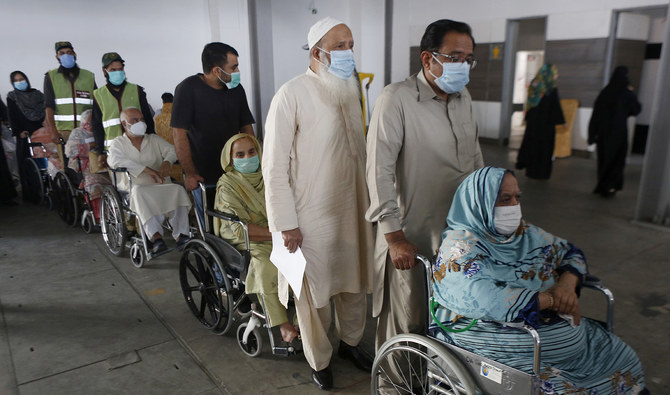
Hospital beds and special COVID-19 facilities were filling up fast, especially in Mumbai, Nagpur and Pune, said another state official.
Earlier this month, more than 80% of oxygen and intensive-care beds in Maharashtra were unoccupied.
Half a dozen other states, such as Punjab and Madhya Pradesh, have also seen a rise in cases this month.
Prime Minister Narendra Modi on Wednesday asked state leaders to quickly increase testing and expand vaccination to “stop the emerging second peak of corona”.
India has administered more than 37 million vaccine doses since the middle of January.

India and Pakistan suffer new COVID-19 surge
https://arab.news/8tkw6
India and Pakistan suffer new COVID-19 surge
- Indian authorities mainly blame crowding and an overall reluctance to wear masks for its spike
- Pakistan says the UK variant of the virus found in the country could also be a factor in the surge
How decades of deforestation led to catastrophic Sumatra floods
- At least 1.4m hectares of forest in flood-affected provinces were lost to deforestation since 2016
- Indonesian officials vow to review permits, investigate companies suspected of worsening the disasters
JAKARTA: About a week after floods and landslides devastated three provinces in Indonesia’s Sumatra island, Rubama witnessed firsthand how the deluge left not only debris and rubble but also log after log of timber.
They were the first thing that she saw when she arrived in the Beutong Ateuh Banggalang district of Aceh, where at least two villages were wiped out by floodwaters.
“We saw these neatly cut logs moving down the river. Some were uprooted from the ground, but there are logs cut into specific sizes. This shows that the disaster in Aceh, in Sumatra, it’s all linked to illegal forestry practices,” Rubama, empowerment manager at Aceh-based environmental organization HAKA, told Arab News.
Monsoon rains exacerbated by a rare tropical storm caused flash floods and triggered landslides across Aceh, North Sumatra, and West Sumatra in late November, killing 969 people and injuring more than 5,000 as of Wednesday, as search efforts continue for 252 others who remain missing.
In the worst-hit areas, residents were cut off from power and communication for days, as floodwater destroyed bridges and torrents of mud from landslides blocked roads, hampering rescue efforts and aid delivery to isolated villages.
When access to the affected regions gradually improved and the scale of the disaster became clearer, clips of washed-up trunks and piles of timber crashing into residential areas circulated widely online, showing how the catastrophic nature of the storm was compounded by deforestation.
“This is real, we’re seeing the evidence today of what happens when a disaster strikes, how deforestation plays a major role in the aftermath,” Rubama said.
For decades, vast sections of Sumatra’s natural forest have been razed and converted for mining, palm oil plantations and pulpwood farms.
Around 1.4 million hectares of forest in Aceh, North Sumatra and West Sumatra were lost to deforestation between 2016 and 2025 alone, according to Indonesian environmental group WALHI, citing operations by 631 permit-holding companies.
Deforestation in Sumatra stripped away natural defenses that once absorbed rainfall and stabilized soil, making the island more vulnerable to extreme weather, said Riandra Purba, executive director of WALHI’s chapter in North Sumatra.
Purba said the Sumatra floods should serve as a “serious warning” for the government to issue permits more carefully.
“Balancing natural resource management requires a sustainable approach. We must not sacrifice natural benefits for the financial benefit of a select few,” he told Arab News.
“(The government) must evaluate all the environmental policies in the region … (and) implement strict monitoring, including law enforcement that will create a deterrent effect to those who violate existing laws.”
In Batang Toru, one of the worst-hit areas in North Sumatra where seven companies operate, hundreds of hectares had been cleared for gold mining and energy projects, leaving slopes exposed and riverbeds choked with sediment.
When torrential rains hit last month, rivers in the area were swollen with runoff and timber, while villages were buried or swept away.
As public outrage grew in the wake of the Sumatra floods, Indonesian officials, including Environment Minister Hanif Faisol Nurofiq, have moved to review existing permits and investigate companies suspected of worsening the disaster.
“Our focus is to ensure whether company activities are influencing land stability and (increasing) risks of landslides or floods,” Nurofiq told Indonesian magazine Tempo on Saturday.
Sumatra’s natural forest cover stood at about 11.6 million hectares as of 2023, or about 24 percent of the island’s total area, falling short of the 30 to 33 percent forest coverage needed to maintain ecological balance.
The deadly floods and landslides in Sumatra also highlighted the urgency of disaster mitigation in Indonesia, especially amid the global climate crisis, said Kiki Taufik, forest campaigner at Greenpeace Indonesia.
Over two weeks since floods and landslides inundated communities in Sumatra, a few villages remain isolated and over 800,000 people are still displaced.
“This tropical cyclone, Senyar, in theory, experts said that it has a very low probability of forming near the equator, but what we have seen is that it happened, and this is caused by rapid global warming … which is triggering hydrometeorological disasters,” Taufik told Arab News.
“The government needs to give more attention, and even more budget allocation, to mitigate disaster risks … Prevention is much more important than (disaster) management, so this must be a priority for the government.”


