

REVIEW: ‘Cherry’ struggles under its own weight

“Cherry” is an Apple TV+ crime drama. (Supplied)
Short Url
Updated 18 March 2021
Follow

REVIEW: ‘Cherry’ struggles under its own weight

  • Russo brothers’ first post-Marvel movie takes them far from superhero land

LONDON: After revolutionizing the world of blockbuster moviemaking with their “Avengers” movies, the Russo brothers had little choice but to go slightly smaller scale with their next project —the Apple TV+ crime drama “Cherry.” Their ambition, however, is undiluted. The pair seek to carve out a decades-spanning story of young love, brutal warfare, failing support systems and a descent into criminality, with Marvel alumnus Tom Holland in the title role. Based on veteran Nico Walker’s memoir, “Cherry” follows a young man who drops out of college to serve as an army medic in Iraq, returning home with undiagnosed PTSD and no clue how to manage the trauma he endured. As he and his young wife Emily (played by Ciara Bravo) struggle to realize the life their young love promised, Cherry winds up robbing banks to keep them safe from shady figures.
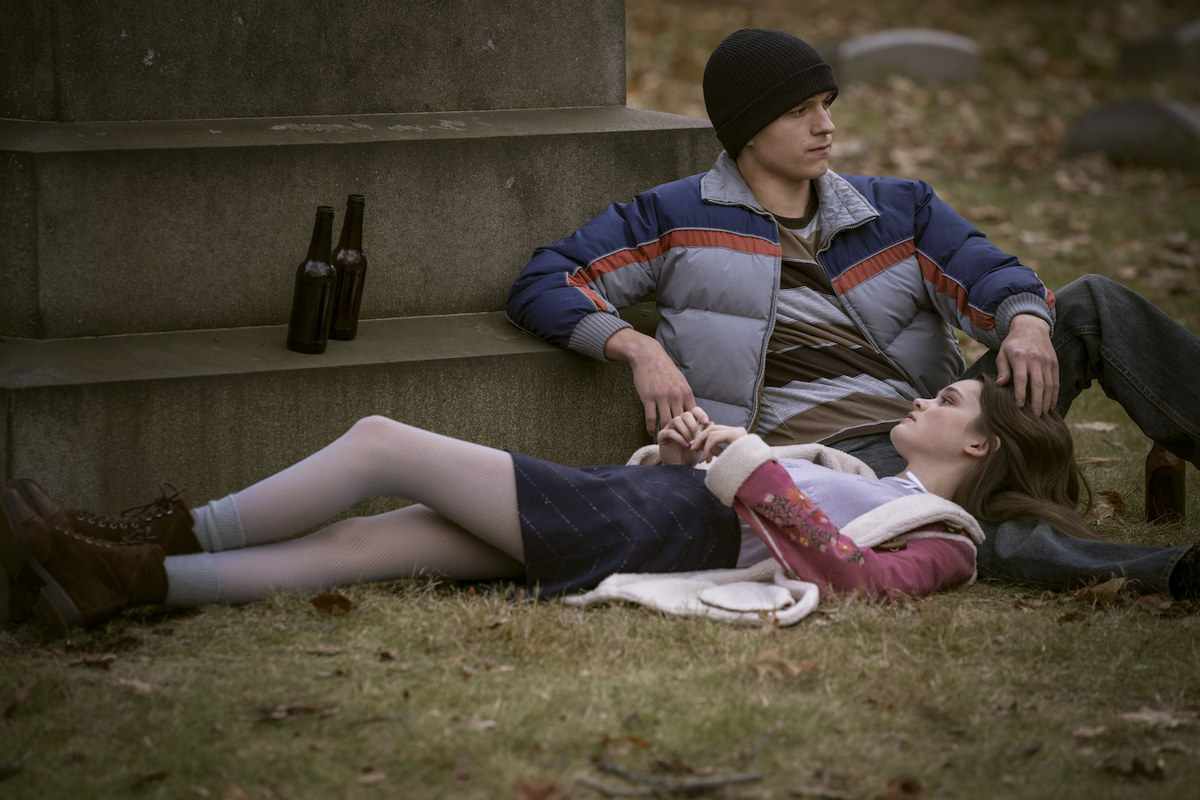


“Cherry” follows a young man who drops out of college to serve as an army medic in Iraq. (Supplied)

If nothing else, “Cherry” acts as a showcase for what a terrific actor Tom Holland has become. The young Brit displays a depth of feeling and visceral, emotional torment that is beyond his years. Unfortunately, while the Russo brothers’ ambition is commendable, the meandering narrative is riddled with tropes and largely predictable story spirals, and the tendency towards style over substance undermines much of the movie’s potential emotional heft.


There are some clever sequences, some stinging rebukes of the attitude towards war veterans, and some barbed jabs at corporate America as a whole, but an overreliance on voiceovers (which simply tell audiences, rather than show them) becomes repetitive, and a schmaltzy Hollywood ending undoes some of the character building by removing most of the story’s consequences.

Holland is great, though Bravo gets less to do than her brief appearances suggest she’s capable of. There’s a feeling of unfocused potential embedded in this (very long) movie. Perhaps it’s an ode to, or a reflection of, Cherry’s crippling lack of agency and direction. Or perhaps there’s simply too much here, a book’s worth of content crammed into a movie that doesn’t feel like quite the right fit.


Sale of Saudi artist Safeya Binzagr’s work sets record at Sotheby’s auction in Riyadh

Updated 01 February 2026
Follow

Sale of Saudi artist Safeya Binzagr’s work sets record at Sotheby’s auction in Riyadh

RIYADH: A painting by Saudi artist Safeya Binzagr sold for $2.1 million at Sotheby’s “Origins II” auction in Riyadh on Saturday, emerging as the top lot of the evening and setting a new auction record for a Saudi artist.

The work, “Coffee Shop in Madina Road” (1968), sold for $1.65 million before the buyer’s premium, the additional fee paid by the purchaser to the auction house on top of the hammer price.

The result nearly doubled the previous auction record for a Saudi artist and became the most valuable artwork ever sold at auction in the Kingdom. It also ranks as the third-highest price achieved for an Arab artist at auction.

It was presented as part of “Origins II,” Sotheby’s second auction staged in Saudi Arabia, comprising 62 modern and contemporary lots and bringing together Saudi artists alongside regional and international names.

Collectors from more than 40 countries participated in the auction, with around one-third of the lots sold to buyers within Saudi Arabia.

The sale totaled $19.6 million, exceeding its pre-sale estimate and bringing the combined value of works offered across “Origins” and “Origins II” to over $32 million.

Saudi artists were central to the evening’s results. All nine Saudi works offered found buyers, achieving a combined total of $4.3 million, well above pre‑sale expectations.

Ashkan Baghestani, Sotheby’s head of contemporary art for the Middle East, told Arab News at the auction that “Safeya made more than any other artist tonight, which is incredible.”

He said the results demonstrated Sotheby’s broader objective in the Kingdom.

“The results tonight show exactly what we’re trying to do here. Bring international collectors to Saudi Arabia and give them exposure to Saudi artists, especially the pioneers.”

All nine works by Saudi artists offered in the sale found buyers, generating a combined $4.3 million. Additional auction records were set for Egyptian artist Ahmed Morsi and Sudanese artist Abdel Badie Abdel Hay.

An untitled work from 1989 by Mohammed Al-Saleem sold for a triple estimate of $756,000, while a second work by the artist, “Flow” from 1987, achieved $630,000.

The sale opened with the auction debut of Mohamed Siam, whose “Untitled (Camel Race)” sold for $94,500. Also making his first auction appearance, Dia Aziz Dia’s prize-winning “La Palma (The Palma)” achieved $226,800.

The sale coincided with the opening week of the Contemporary Art Biennale in Riyadh, reinforcing the city’s growing role as a focal point for both cultural institutions and the art market.

Baghestani added that Saudi modern artists are now receiving long‑overdue recognition in the market.

“There’s so much interest and so much demand, and the price is where it should be,” he said.

International highlights included works by Pablo Picasso, Roy Lichtenstein, Andy Warhol and Anish Kapoor, underscoring Saudi Arabia’s growing role as a destination for major global art events and collectors.

Picasso’s “Paysage,” painted during the final decade of the artist’s life, sold for $1,600,000, becoming the second most valuable artwork sold at auction in Saudi Arabia.

Seven works by Lichtenstein from the personal collection of the artist and his wife, including collages, prints, works on paper and sculptures, all found buyers. Warhol was represented in the sale with two works: “Disquieting Muses (After de Chirico),” which sold for $1,033,200, and a complete set of four screenprints of “Muhammad Ali,” which achieved $352,000.

Baghestani said the strength of the results was closely tied to the material’s freshness. “These were not works from the trade. Some of them had not been seen since the 1970s,” he said.