
THATTA: For decades, grazing animals and loggers destroyed thousands of trees on Pakistan’s Indus River Delta, home to the largest arid mangrove forests in the world.
The Indus Delta has around 95 percent of the total mangrove forest cover of Pakistan and was once home to eight species of mangroves, which the Sindh Forest Department (SFD) says forest destruction reduced to half.
By 2005, mangrove cover had declined to 84,000 hectares — the lowest recorded level — from 260,000 hectares in the eighties.
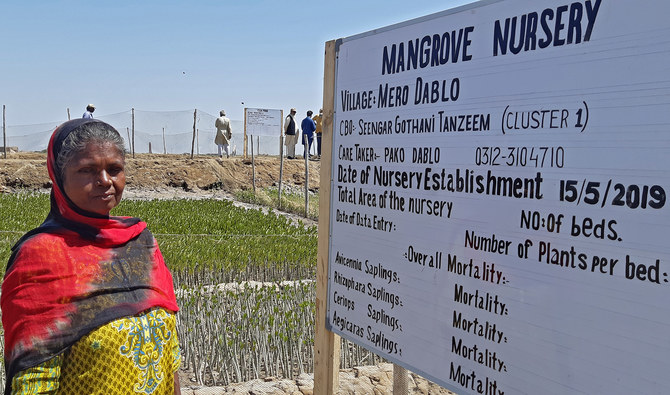
In 2019, as part of an ongoing campaign to improve forest cover, the Sindh Forest Department (SFD) collaborated with the World Wildlife Fund (WWF) to set up a mangrove nursery, hiring 250 women not just to plant new trees but also to guard them against threats from animals and humans.
Hired along with their families, the women, officially called eco-guards, played a “vital role in the protection of mangroves, which is a family unit job,” Riaz Ahmed Wagan, SFD’s chief conservator of mangroves, told Arab News.
Assessments by SFD showed that mangrove cover had increased once more to 210,000 hectares by 2020.
The women eco-guards, Wagan said, had a large role to play in the improving numbers.
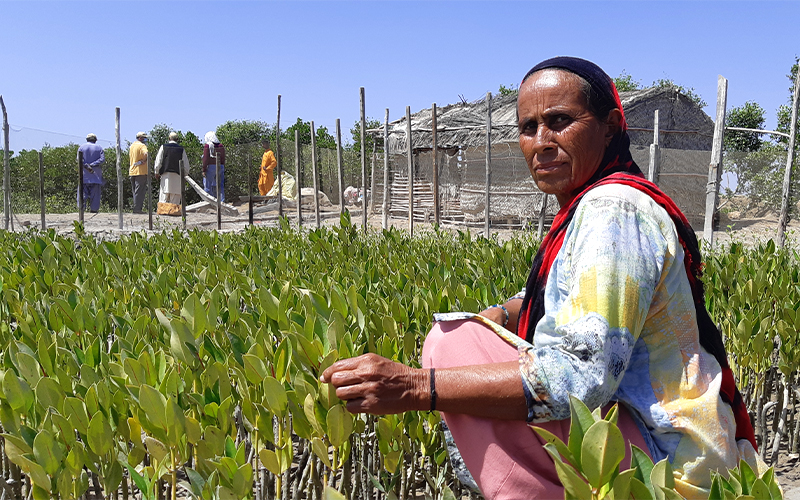
60-year-old forest worker Hawa Dablo poses at a mangrove nursery established by WWF-Pakistan in Mero Dablo village in Thatta, Pakistan, on March 09, 2021. (AN photo by Zulfiqar Kunbhar)
One of them, 60-year-old Hawa Dablo from Mero Dablo, a fishing village on the edge of the Arabian Sea, said she spent her days planting seeds, looking after saplings and standing guard, with other members of her family, against the trees being destroyed by roaming animals.
“I have been working here for the last two years since this [mangrove] nursery was established in my village,” Dablo told Arab News.She said the most vulnerable trees were young mangroves that had to be protected from grazing camels and buffaloes as well as from local loggers.
“In order to preserve mangroves, locals start initiatives from their own households and at the personal level,” Dablo said. “Every household or village will ensure that their animals are released for open grazing in only those areas where there are mature mangroves; locals will make sure that animals will not touch the areas where new plantations have been done.”
But she said illegal logging still remained a threat, although it was no longer rampant.
“In case any mangrove cutting activity comes under our notice we inform our male family members to take further action,” Dablo said. “In case there is deliberate cutting of mangroves, mostly by outsiders, we complain to local Sindh Forest Department officials through our male partners.”
Dr. Tahir Rasheed, the regional head for the Sindh and Balochistan wing of WWF-Pakistan, said that under the mangrove protection program, the women rangers were paid a small stipend and given incentives “including sewing machines to do stitch and embroidery work; ice boxes and ponds for fish keeping etcetera to improve livelihood.”
The incentives, he said, were important in an area where it is estimated that nearly 90 percent of the population lives below the poverty line.
Most households on the delta rely on fishing, and preserving mangroves was key to maintaining the marine ecosystem, another woman eco-guard explained, given that a wide variety of fish laid their eggs in mangrove bushes on the delta.
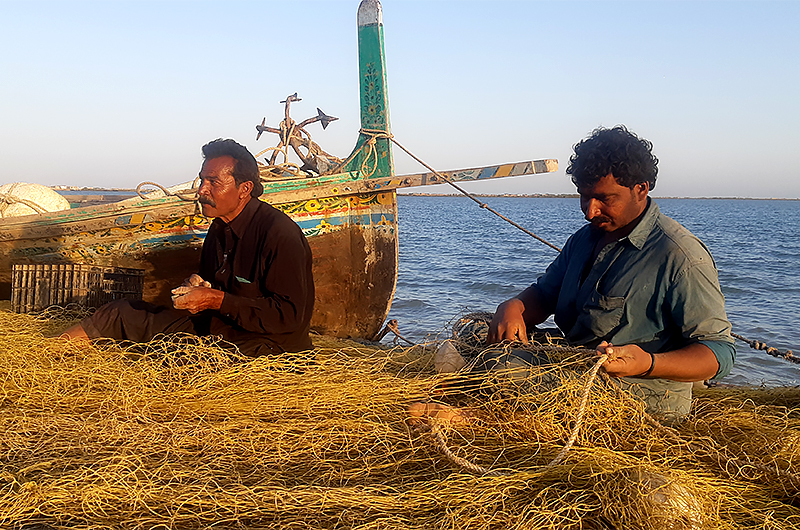
Fishermen making fishing nets at Khariyoon Takur, an island village located near the Indus Delta in Thatta, Pakistan, on March 09, 2021. (AN photo by Zulfiqar Kunbhar)
“We guard mangroves and don’t allow people to cut green mangroves,” said Razia Dablo from the island fishing village of Khariyoon Takur. “If there will be no more green mangroves, it will destroy the ecosystem of fish; that will directly negatively affect our livelihood.”
Besides employing the eco-guards, the Sindh Forest Department has given full-and part-time “green jobs” to over 50,000 people since 2000 — around 40% of them women.
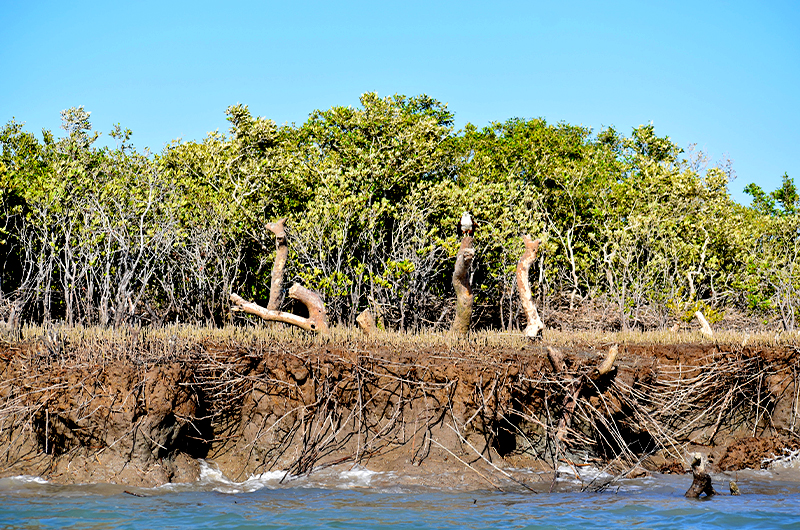
A view of a mangrove plantation on the Indus Delta’s Hajamro Creek in Thatta, Pakistan, on March 09, 2021. (Photo by Saeed ul Islam, Manager Mangroves Program, WWF-Pakistan)
“Despite social restrictions that put limitations on work on women outside their homes, women participation in afforestation at Indus Delta is almost half of the total forestation workforce, which is a great achievement,” SFD’s Wagan said. “For upcoming plantation projects on the Indus Delta and elsewhere, we are planning to achieve maximum women participation.”