UAE hospital offers free online COVID-19 rehabilitation to patients in Pakistan

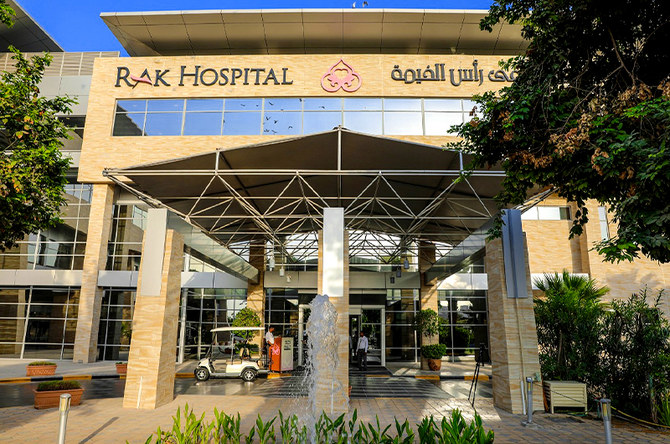
This undated photo shows the exterior view of RAK Hospital in Dubai. (Photo courtesy: RAK Hospital)
Short Url
Updated 17 March 2021
Follow

UAE hospital offers free online COVID-19 rehabilitation to patients in Pakistan

  • About 30 percent of coronavirus patients experience long-term aftereffects, requiring such multidisciplinary rehabilitation programs
  • The hospital aims to provide online health scans and medical prescriptions tailored to a patient’s needs

KARACHI: A leading medical facility in the United Arab Emirates has launched the Middle East’s first comprehensive online COVID-19 rehabilitation program that will also serve Pakistani patients and provide prescriptions tailored to their needs. 
According to a statement circulated by RAK Hospital on Wednesday, the program is free of cost and Pakistani citizens can register themselves to participate in it by logging on to www.rakhospitalrehab.com. 
The hospital intends to offer weekly webinars to guide patients on relevant medical issues and will give complimentary physical appointments wherever required. 
The management of the medical facility said in its statement that about 30 percent of COVID-19 patients experienced long-term debilitating or painful aftereffects of the disease which hamper their ability to perform simple daily tasks. 
The rehabilitation program is envisaged to help patients deal with such complications. 
“It is an exclusive program for patients from across the globe,” said Dr. Raza Siddiqui, executive director of the hospital in Ras Al-Khaimah. “Nothing like this exists at the moment and we are extremely proud of our unique initiative which is supported and patronized by ARISE UAE. Ours is the only initiative providing an integrated and holistic approach to COVID recovery and rehabilitation, offered complimentary to all recovering patients.” 
Led by the hospital’s wellness division, the comprehensive program combines the expertise of a multidisciplinary team of physicians, nutritionists, psychologists, and physiotherapists who collectively conceived the idea. 
“RAK Hospital introduced its physical post COVID recovery rehabilitation program last year,” said Professor Adrian Kennedy, who supervises the initiative. “However, we wanted to extend our reach to larger communities and wider geographies, thus, to support the community in the comfort of their homes, we created our online COVID Rehab product which assesses the recovering COVID patients’ medical details, test results, comorbidities, symptoms, etc. and instantly makes available a comprehensive online COVID rehab health prescription for a speedy recovery.”


Pakistani driver killed by missile debris in UAE, shattering economic future of families back home

Updated 20 min 34 sec ago
Follow

Pakistani driver killed by missile debris in UAE, shattering economic future of families back home

  • Pakistani driver killed by falling debris during missile interception in Abu Dhabi amid escalating Middle East conflict
  • Death leaves more than a dozen dependents in Pakistan without income after eight years of overseas work

ISLAMABAD: For days, Nazar Ali told his daughter-in-law a gentle lie: authorities in the United Arab Emirates (UAE) had confiscated all mobile phones and her husband, Mureeb Zaman, would call home as soon as he got it back.

In reality, Zaman, a 40-year-old Pakistani driver who had spent eight years working in the UAE to lift his family out of poverty, had already been killed by missile fragments during an aerial interception over Abu Dhabi amid an escalating conflict in the Middle East.

The conflict began on Feb. 28 after the United States and Israel launched strikes on Iran following weeks of escalating tensions between Tehran and its regional adversaries. The attacks triggered retaliatory drone and missile strikes by Iran targeting commercial and US-linked interests across the Gulf region, prompting air defense systems in several countries to intercept projectiles in the skies above major cities.

As interceptors met incoming missiles over the Emirati capital that night, falling debris struck Zaman, ending years of work he hoped would secure a better future for his five children in one of Pakistan’s most volatile regions.

“I found out the same day because nowadays it is the age of the Internet,” Ali, Zaman’s father, told Arab News during a condolence gathering at his residence last week.

“I myself was in the market at that time when I received the news [of his death], but I did not tell the family.”

Zaman had been supporting three households in his hometown in Pakistan’s northwestern Bannu district, including the family of his late younger brother. The region, located in the province of Khyber Pakhtunkhwa near the Afghan border, has witnessed a surge in militancy and counterinsurgency operations in recent years.

The 40-year-old was one of millions of Pakistani migrant workers in Gulf countries whose remittances are a vital source of foreign exchange for Pakistan’s fragile economy.

He is also among the first reported Pakistani casualties of the recent escalation. Two Pakistani nationals have been killed so far in aerial interceptions in the UAE, while another Pakistani died last week in a similar incident in Iranian waters off Pakistan’s southwestern Balochistan province, according to authorities.

Zaman’s life abroad was measured in long-distance phone calls and carefully saved earnings, while his wife, four daughters and one son lived in a single room at their family home in Bannu.

“He used to say that ‘When I come on Eid, God willing, I will build a room for you’,” Ali, his grieving father, said.

For Zaman, working in the UAE represented an escape from the insecurity and economic hardship that have long plagued his hometown, where militant attacks targeting security forces and civilians have periodically disrupted daily life.

Family members said he had hoped to return home for the upcoming Eid Al-Fitr holiday, encouraged by military operations against militant groups in Khyber Pakhtunkhwa that had raised hopes of greater stability in the region.

Adnan Gul, Zaman’s nephew, remembered his uncle as a warm and optimistic man who often spoke about building a better future for his family.

“His wish was to have a good home, a settled family, and a good, peaceful life,” Gul said.

Recalling Zaman as a cheerful man who loved food and rarely lost his temper, Gul added: “With younger people he behaved like one of them, and with elders he behaved like an elder.”

“He had many wishes, but unfortunately all those wishes remained unfulfilled.”

Now, Zaman’s death has left his extended family facing an uncertain future.

Relatives fear the loss of his income could disrupt the education of his children, who attend school while also memorizing the Holy Qur’an.

“He used to say these things and tell me ‘Not to tire yourself too much because you have already done a lot of hard work’,” Ali, his father, said, his voice trailing off.

“But such a day came that Allah Almighty once again left us [helpless], and we don’t know what will happen next.”

Buried in his hometown, Zaman is remembered through the photographs he shared with family members on WhatsApp and the Eid gifts he had already purchased before his death.

“When a person leaves this world, only memories remain,” Gul said.