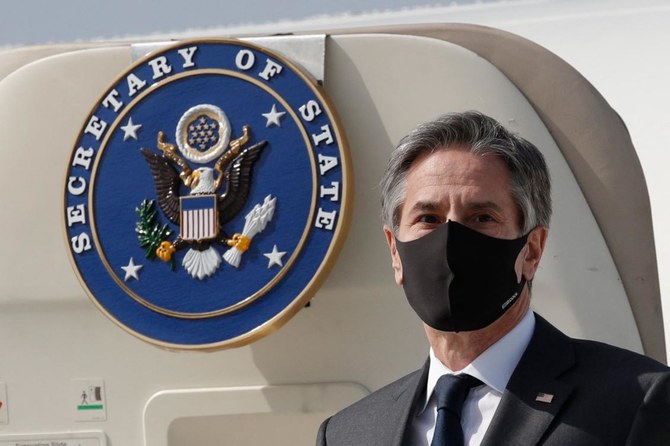
SEOUL: Pentagon chief Lloyd Austin arrived in Seoul on Wednesday with top US diplomat Antony Blinken following for talks with South Korean officials to bolster a united front against an increasingly assertive China and the nuclear-armed North.
The South is the second leg of their inaugural overseas trip, and like their first stop, Japan, a leading security ally of the United States.
The Biden administration is focused on rallying alliances with its key Asian partners to counter a rising China.
Before leaving Tokyo, Secretary of State Blinken accused Beijing of acting more repressively at home and “more aggressively abroad,” citing its activities in the East and South China Seas and toward Taiwan.
“It’s important for us to make clear together that China cannot expect to act with impunity,” Blinken said.
North Korea is likely to move up the agenda in the South, where the US stations 28,500 troops to defend it against its neighbor.
The allies kicked off joint military exercises last week and North Korean leader Kim Jong Un’s influential sister warned Washington this week against “causing a stink at its first step” if it wants to “sleep in peace for coming four years.”
The statement by Kim Yo Jong, a key adviser to her brother, was the reclusive state’s first explicit reference to the new leadership in Washington, more than four months after Joe Biden was elected to replace Donald Trump – although it still did not mention the 78-year-old Democrat by name.
The US envoys will meet on Thursday with President Moon Jae-in, who brokered the talks process between Kim and Trump in 2018.
Trump’s unorthodox approach to foreign policy saw him trade insults and threats of war with Kim Jong Un before an extraordinary diplomatic bromance that saw a series of headline-grabbing meetings.
But ultimately no progress was made toward Washington’s declared aim of denuclearizing North Korea, with a second summit in Hanoi in early 2019 breaking up without an agreement and Pyongyang still under multiple international sanctions for its banned weapons programs.
Blinken and Austin will consult on a review of Washington’s policy toward the North being carried out by the new administration.
But they have already called during their trip for “the complete denuclearization of North Korea.”
The phrase is anathema to Pyongyang, which prefers the broader and more ambiguous “denuclearization of the Korean peninsula,” which could be taken to include the US nuclear umbrella over the South.
Since Hanoi, Moon’s administration has repeatedly tried to reach out to Pyongyang but has been regularly rebuffed.


![]()

Top US officials arrive in Seoul with China, North Korea on agenda
Short Url
https://arab.news/bmez5
Top US officials arrive in Seoul with China, North Korea on agenda
- Biden administration focused on rallying alliances with its key Asian partners to counter a rising China


Latest updates


© 2026 SAUDI RESEARCH & PUBLISHING COMPANY, All Rights Reserved And subject to Terms of Use Agreement.