Kuwait airport will implement PCR verification for 8 countries this month

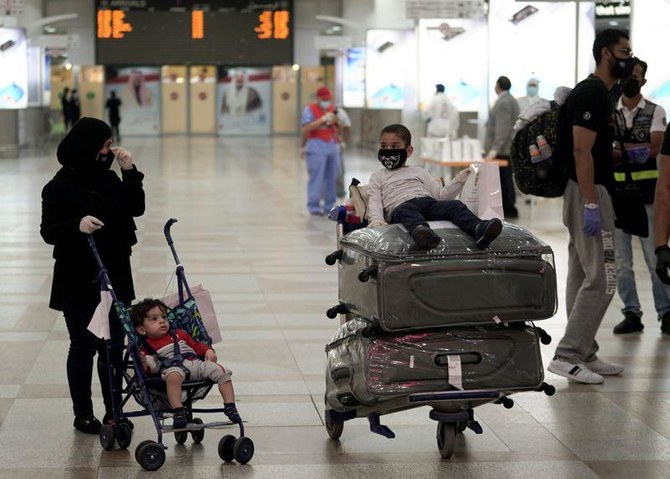
A Kuwaiti family repatriated from Amman, wearing protective face masks, prepare their luggage while arriving at Kuwait Airport, following the outbreak of the coronavirus disease (COVID-19), in Kuwait City, Kuwait April 21, 2020. (Reuters)
Short Url
Updated 17 March 2021
Follow

Kuwait airport will implement PCR verification for 8 countries this month

DUBAI: All airlines operating at Kuwait International Airport will start implementing a program to verify PCR certificates for eight countries starting March 25, according to local reports.
The countries included at the initial stage are UAE, Bahrain, Turkey, India, Philippines, Nepal, Sri Lanka and Bangladesh.
The new program requires arriving passengers from the above countries to have a negative PCR COVID certification and must not have any symptoms such as fever, coughing or sneezing.
The certificate must be valid for 72 hours after the swab test was made and must comply with those accepted by the MUNA Program for verifying PCR tests.
Movement at the airport has been slow after flights were limited in light of the health conditions imposed by the pandemic.
The airport has been allowing a small number of flights in addition to return trips for Kuwaitis abroad.


Ramallah talks focus on border crossings

Palestinian Prime Minister Mohammad Mustafa speaks during a press conference in Ramallah on March 24, 2025. (AFP)
Updated 31 January 2026
Follow

Ramallah talks focus on border crossings

  • The meeting discussed ways to upgrade infrastructure and facilities at the Karama crossing, particularly arrival halls and cargo and transport areas, automate procedures and services, strengthen staff capacities, and combat smuggling

RAMALLAH: Palestinian Prime Minister Mohammed Mustafa chaired a meeting at his office in Ramallah on Saturday to review developments at border crossings, including the Karama crossing in the West Bank and the Rafah crossing in the Gaza Strip, as well as ways to develop and upgrade the crossings.
The meeting focused on improving the management and governance system for Palestinian crossings to clearly define the roles, responsibilities, and tasks of the parties involved, thereby contributing to the national economy, commercial activity, and travel services.
Mustafa reiterated that the crossings issue is a priority at all levels, as it directly affects citizens. 
He stressed the need to intensify engagement with all parties to extend operating hours for passenger and cargo movement, and to develop travel and cargo transport mechanisms.
The meeting also discussed ways to upgrade infrastructure and facilities at the Karama crossing, particularly arrival halls and cargo and transport areas, automate procedures and services, strengthen staff capacities, and combat smuggling.
These measures aim to improve services for citizens, facilitate travel procedures, and enhance readiness to address congestion and travel crises, especially during the Umrah and Hajj seasons and holidays.
Meanwhile, according to local sources, Israeli forces forced Kamal Saeed Shawaneh, a Palestinian owner of a marble factory from the town of Kafr Thulth, south of Qalqilya, to carry out the demolition of his industrial facility located east of the town, on Saturday.
The facility, built on an area of roughly 300 square meters, suffered material losses estimated at more than $26,000. Israeli authorities claimed that Shawaneh did not have a permit for the factory’s construction. 
The sources added that Israeli forces threatened Shawahneh with heavy fines if he did not carry out the demolition, noting that he had previously received a stop-work order for the factory in 2018.