

Pakistani opposition alliance postpones ‘long march’ to capital after differences on assembly resignations

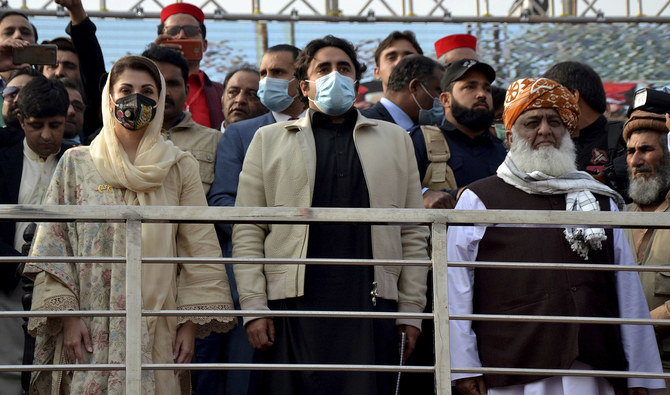
Maulana Fazal-ur-Rehman, right in front row, Bilawal Bhutto Zardari, center, Maryam Nawaz Sharif, left, leaders of the Pakistan Democratic Movement, an alliance of opposition parties, attend an anti-government rally in Peshawar on Nov. 22, 2020. (AFP)
Short Url
Updated 16 March 2021
Follow

Pakistani opposition alliance postpones ‘long march’ to capital after differences on assembly resignations

  • Nine parties were in favor of resignations and a long march but Pakistan Peoples Party had reservations, the president of the opposition alliance says
  • PPP co-chair Asif Ali Zardari says Nawaz Sharif should return to Pakistan before the joint opposition resigns from assemblies 

ISLAMABAD: An alliance of 11 opposition parties holding countrywide protests demanding that the government of Prime Minister Imran Khan step down has announced that it is postponing a planned ‘long march’ to the capital, the president of the movement, Maulana Fazl-ur-Rehman, said on Tuesday.

The announcement by the Pakistan Democratic Movement (PDM) comes amid reported reservations by the opposition Pakistan Peoples Party (PPP) to resign from assemblies, which Rehman has said is a precondition to launch the protest march to Islamabad. 

“Nine parties were in favor of resignations along with a long march but PPP had reservations,” Rehman told reporters, adding that the PPP would discuss the matter during the party’s upcoming central executive committee meeting.

“We will wait for their decision,” he said, adding: “March 26 long march should be considered postponed.”

In a meeting earlier in the day, PPP co-chairman Asif Ali Zardari said the head of the Pakistan Muslim League-Nawaz, three time prime minister of Pakistan, Nawaz Sharif, who is living in self-exile in London, should return to Pakistan before the joint opposition resigned from the assemblies in order to mount pressure on the government of PM Khan. 

Nawaz, who was serving a prison sentence over corrupt practices, has been living in London since November 2019 after he was allowed to leave the country for medical treatment by a top court. 

Last month, the PDM had announced a long march on March 26 against the PM Khan-led government.


Pakistan rice exports slump 40% as India’s return hits pricing power

Updated 5 sec ago
Follow

Pakistan rice exports slump 40% as India’s return hits pricing power

  • Statistics show non-Basmati shipments have fallen over 50 percent in July-January period
  • Government offers 9 percent tax drawback on premium Basmati exports to support sector

ISLAMABAD: Pakistan’s rice exports fell 40.5 percent to $1.31 billion in the first seven months of the fiscal year, official data showed on Tuesday, as India’s return to the global market squeezed Islamabad’s market share and pricing power.

According to the Pakistan Bureau of Statistics (PBS), non-Basmati exports dropped 50.8 percent to $827.8 million, with volumes falling to 2.0 million tons from 3.15 million tons a year ago. Basmati exports declined 6.62 percent to $477.7 million, with volumes easing to 436,484 tons from 487,278 tons.

The Ministry of National Food Security told a parliamentary committee in two separate meetings in December and January that India’s re-entry into the global rice market was a key factor behind the decline, saying increased Indian supplies had made Pakistani rice less competitive.

Officials told lawmakers that India benefits from free trade agreements and provides substantial support to its rice sector, putting additional pressure on Pakistani exporters.

In response, the Ministry of Commerce last month issued a notification under the “Drawback of Local Taxes and Levies for Rice Order, 2026,” allowing a rebate of 9 percent of the free-on-board (FOB) value for Basmati exports priced above $750 per metric ton.

The government said the measure, announced on January 23, aims to ease liquidity pressures on exporters and improve competitiveness.

While PBS data for July-January shows a 40.5 percent decline, figures from the Federal Board of Revenue (FBR) for July-December show an even steeper 47 percent drop to $973 million from $1.82 billion in the same period last year, reflecting a deficit of over $800 million.

Industry representatives say they are now focusing on market diversification to counter the slowdown.

“Currently Basmati is mainly exported to Middle East and EU. Non-Basmati is exported to Philippines, Indonesia, Malaysia and African countries,” Malik Faisal Jahangir, chairman of the Pakistan Rice Exporters Association, told Arab News last week.

“For the new markets for our non-basmati rice exports, we are looking to increase our volumes to China, Philippines, Indonesia and Bangladesh,” he added.