RIYADH: Saudi food giant Savola reported a 92 percent jump in profits last year driven by rising demand for frozen foods.
The company behind some of the Kingdom’s best known supermarket brands said net income jumped to SR910.8 million ($242.6 million) last year — even though overall sales rose only marginally to about SR21.7 billion.
The standout performer for the Jeddah-based group was its frozen food segment where revenues grew 18.8 percent.
“For the year 2020 as compared to last year, net profits from the food processing, frozen foods and investments increased by 6.4 percent, 57.1 percent and 15.6 percent, respectively,” the company said in a filing to the Tadawul stock exchange on Tuesday.
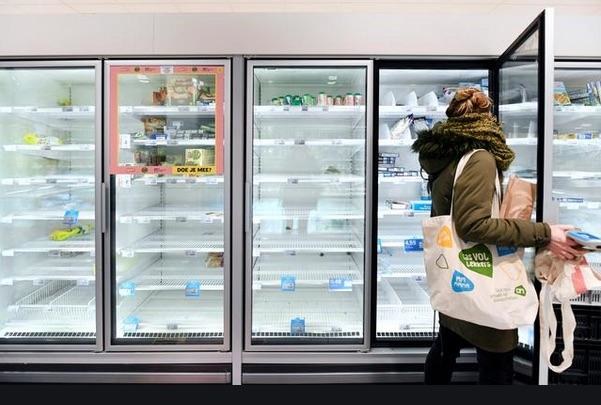
Frozen food sales surged worldwide last year, especially during the early days of the pandemic when consumers panic bought staple items through fear of shortages emerging.
Some of the world’s largest food producers including Nestle and Unilever have benefited from an increase in people eating at home during coronavirus lockdowns.
Gulf food producers are emerging from a tough trading period prior to last year as the introduction of value added tax in some countries and the departure of expats led to a lull in consumer spending that is now abating.

Savola profits surge as Gulf shoppers fill their freezers
https://arab.news/w7j2c
Savola profits surge as Gulf shoppers fill their freezers
- Overall sales see marginal rise
- Global surge in food buying
Multilateralism strained, but global cooperation adapting: WEF report
DUBAI: Overall levels of international cooperation have held steady in recent years, with smaller and more innovative partnerships emerging, often at regional and cross-regional levels, according to a World Economic Forum report.
The third edition of the Global Cooperation Barometer was launched on Thursday, ahead of the WEF’s annual meeting in Davos from Jan. 19 to 23.
“The takeaway of the Global Cooperation Barometer is that while multilateralism is under real strain, cooperation is not ending, it is adapting,” Ariel Kastner, head of geopolitical agenda and communications at WEF, told Arab News.
Developed alongside McKinsey & Company, the report uses 41 metrics to track global cooperation in five areas: Trade and capital; innovation and technology; climate and natural capital; health and wellness; and peace and security.
The pace of cooperation differs across sectors, with peace and security seeing the largest decline. Cooperation weakened across every tracked metric as conflicts intensified, military spending rose and multilateral mechanisms struggled to contain crises.
By contrast, climate and nature, alongside innovation and technology, recorded the strongest increases.
Rising finance flows and global supply chains supported record deployment of clean technologies, even as progress remained insufficient to meet global targets.
Despite tighter controls, cross-border data flows, IT services and digital connectivity continued to expand, underscoring the resilience of technology cooperation amid increasing restrictions.
The report found that collaboration in critical technologies is increasingly being channeled through smaller, aligned groupings rather than broad multilateral frameworks.
This reflects a broader shift, Kastner said, highlighting the trend toward “pragmatic forms of collaboration — at the regional level or among smaller groups of countries — that advance both shared priorities and national interests.”
“In the Gulf, for example, partnerships and investments with Asia, Europe and Africa in areas such as energy, technology and infrastructure, illustrate how focused collaboration can deliver results despite broader, global headwinds,” he said.
Meanwhile, health and wellness and trade and capital remained flat.
Health outcomes have so far held up following the pandemic, but sharp declines in development assistance are placing growing strain on lower- and middle-income countries.
In trade, cooperation remained above pre-pandemic levels, with goods volumes continuing to grow, albeit at a slower pace than the global economy, while services and selected capital flows showed stronger momentum.
The report also highlights the growing role of smaller, trade-dependent economies in sustaining global cooperation through initiatives such as the Future of Investment and Trade Partnership, launched in September 2025 by the UAE, New Zealand, Singapore and Switzerland.
Looking ahead, maintaining open channels of communication will be critical, Kastner said.
“Crucially, the building block of cooperation in today’s more uncertain era is dialogue — parties can only identify areas of common ground by speaking with one another.”