China to issue visas to foreigners, including Pakistanis, who take Chinese vaccine

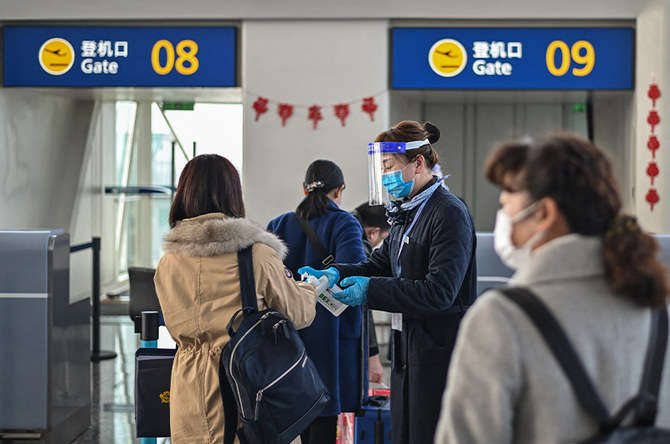
An airline worker wearing a face mask as a preventive measure against the Covid-19 coronavirus gives a passenger alcohol gel to wash her hands at Tianhe International Airport in Wuhan, China's central Hubei province on February 12, 2021. (AFP/File)
Short Url
Updated 16 March 2021
Follow

China to issue visas to foreigners, including Pakistanis, who take Chinese vaccine

  • China has been closed to most foreigners since last March to stem the spread of coronavirus
  • Chinese Embassy in US says will begin to process “visa applicants inoculated with Chinese Covid-19 vaccines“

BEIJING: China is poised to ease border restrictions to allow some foreigners — including from the US, India and Pakistan — back in, provided they have taken a Chinese-made Covid-19 vaccine.
The country has been closed to most foreigners since last March to stem the spread of coronavirus which it has largely brought under control at home, stranding many foreigners with jobs and family inside China overseas.
But Chinese embassies in several countries have issued notices saying the country will open visa applications to select people who have taken a China-made jab.
The Chinese Embassy in the US said in a statement dated Monday that it would begin to process “visa applicants inoculated with Chinese Covid-19 vaccines.”
This would apply from this week to those visiting the Chinese mainland for work resumption, business travel, or for “humanitarian needs,” such as reuniting with family members.
Beijing is driving forward its inoculation plan for its vast domestic population with four domestically produced vaccines approved so far. But it has yet to approve any foreign-made jabs.
China has also shipped its vaccines overseas as it works to blunt foreign criticism of the initial spread of the virus from its shores.
The embassy statement said this applied to those who had either had two doses of the vaccine or a single-dose at least 14 days before applying for the visa.
Chinese embassies in other countries including India, Pakistan, the Philippines, Italy and Sri Lanka have published similar statements.
Those arriving in China will still have to face a gruelling quarantine of up to three weeks.
China’s vaccines have been rolled out in several countries around the world, including Turkey, Indonesia and Cambodia.
The Philippines received 600,000 vaccine doses from China two weeks ago, kickstarting its inoculation drive.
But they are not readily available everywhere, including in India or Sri Lanka.
And Beijing has struggled to gain international trust for its vaccine candidates, hindered by a lack of transparency on test results.
But Chinese companies are still set to export nearly 400 million doses of home-grown vaccines overseas, state media has reported.


Pakistan’s deputy PM says country will not send forces to Gaza to disarm Hamas

Updated 27 December 2025
Follow

Pakistan’s deputy PM says country will not send forces to Gaza to disarm Hamas

  • Ishaq Dar says Pakistan open to peacekeeping but Gaza’s internal security is Palestinian responsibility
  • Pakistan’s top religious clerics from different schools have warned against sending forces to Palestine

ISLAMABAD: Deputy Prime Minister Ishaq Dar said on Saturday Pakistan was willing to contribute to an international peacekeeping force in Gaza, though it would not deploy troops to disarm or de-weaponize Hamas.

The statement follows media reports saying Washington views Pakistan as a potentially significant contributor given its battle-hardened military and wants it to be part of International Stabilization Force (ISF), which is part of United States President Donald Trump’s 20-point framework for a Gaza peace plan.

The plan announced by Trump at the White House on September 29 was formally adopted at the Sharm El-Sheikh Peace Summit in October. Co-chaired by Trump and Egyptian President Abdel Fattah El-Sisi, the summit brought together leaders from 27 countries to sign the “Trump Declaration for Enduring Peace and Prosperity.”

Deployment of troops from Muslim-majority countries during a transitional stabilization phase is a key part of the plan before the war-ravaged Palestinian territory moves toward reconstruction and a longer-term political settlement.

“If they say that we should go and start fighting, disarm Hamas, de-weaponize them, and go and destroy the tunnels that Hamas has built until now, that is not our job,” Dar, who is also the country’s foreign minister, told reporters during a year-end briefing in Islamabad.

He emphasized there was clarity between Pakistan’s civil and military leadership over the matter.

“We have a very complete understanding on this matter that we cannot do that kind of work,” he added.

The deputy prime minister said Pakistan had been using the term “peacekeeping” and had never used the phrase “peace enforcement” while discussing the force.

“I have been very clear: Pakistan will be happy to join if the mandate is not peace enforcement and disarming and de-weaponizing Hamas.”

The government’s stance comes amid growing domestic pressure over the issue.

On Monday, a group of Pakistan’s top religious leaders, chaired by prominent scholar Mufti Taqi Usmani, warned the government against yielding to what they described as international pressure to send forces to Gaza.

In a joint statement from Karachi, the clerics — representing Deobandi, Barelvi, Ahl-e-Hadees and Shia schools of thought — said that Washington wanted Muslim countries to send their forces to Gaza to disarm Hamas.

“Several Muslim governments have already refused this, and pressure is being increased on Pakistan,” it added.

Addressing such concerns, Dar said Pakistan would not land its forces in Palestine to “fight Muslims.”

Israel has repeatedly called for the disarmament of Hamas as a precondition for any long-term settlement, and the United Nations Security Council has also endorsed the ISF framework in November.

However, Dar maintained during the media briefing the internal security of Gaza was the Palestinian responsibility.

“The Palestinian Authority, their government, it is their job, it is the job of their law enforcement agency,” he said

The deputy prime minister also highlighted Pakistan’s involvement in the “Arab Islamic Group of Eight,” including Saudi Arabia, Jordan, Egypt, the United Arab Emirates, Qatar, Turkiye and Indonesia, which has been coordinating on the crisis.

He said the efforts of these countries had brought some peace to Palestine and reduced bloodshed.

“Our declared policy is that there should be an independent two-state solution,” he continued while calling for pre-1967 borders.