



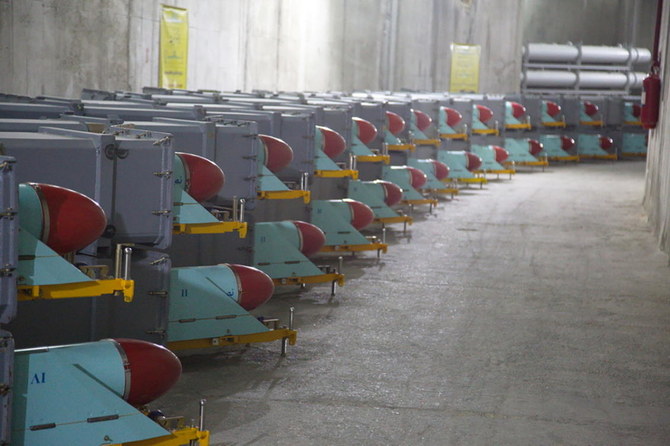


JEDDAH: Iran boasted on Monday that it had set up a new “missile city” packed with cruise and ballistic missiles and electronic warfare equipment.
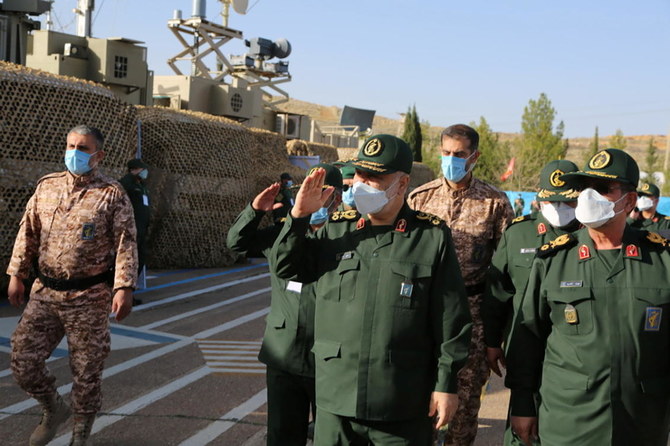
The base, operated by the Islamic Revolutionary Guard Corps, was unveiled by the IRGC leader Maj. Gen. Hossein Salami and the organization’s naval chief, Rear Adm. Ali Reza Tangsiri. Images and video footage of the missiles and their launch equipment were broadcast on state TV.
“What we see today is a small section of the great and expansive missile capability of Revolutionary Guards’ naval forces,” Salami said.
He said the new missiles and missile equipment had “advanced operational capabilities, such as accurate firing from underground launchers and civil defense sites.”
Salami said: “The new equipment in the missile city can launch mines in various ranges, allow for 360-degree and mobile firing operations, be used in electronic warfare, and enhance the IRGC naval forces’ fire range and destructive power in combat.”
The IRGC claimed that the new missiles and launch equipment had been designed and manufactured by Iran’s own defense ministry, military companies and IRGC naval research organizations.
The IRGC said last year it had built a number of underground and offshore “missile cities” on the Arabian Gulf coast and the Sea of Oman, which would be “a nightmare for the enemy.” Adm. Tangsiri said Iran’s adversaries knew the bases existed “but their information is not accurate.”
The new missile bases “show how Iran is not only hardening its underground facilities but also testing and constructing new variants of missiles,” security analyst Dr. Theodore Karasik told Arab News.
“The optics play well for Iran, domestically and internationally,” said Karasik, senior adviser to Gulf State Analytics in Washington, D.C. “But the truth of the matter is that this type of behavior illustrates Iranian thinking regarding maritime security and potential war scenarios and is part of IRGC culture in terms of asymmetrics.”
Iran and its proxies in the region have launched hundreds of attacks with missiles and armed drones in the past year, targeting civilians and energy infrastructure in Saudi Arabia. The creation of “missile cities” raises questions about the commitment by the US and European powers to revive the Joint Comprehensive Plan of Action (JCPOA), the 2015 agreement to curb Iran’s nuclear program in return for the lifting of sanctions.
Donald Trump withdrew the US from the deal in 2018, and began restoring sanctions, but President Joe Biden wants to return to the agreement. The Kingdom and its allies believe any new agreement should be extended to address Iran’s ballistic missile program and regional aggression.
The Saudi political analyst Dr. Hamdan Al-Shehri told Arab News: “The international community has full knowledge of Iran’s regional ambitions and increased involvement in regional affairs. These new images and videos are more than enough proof to implicate Iran, as this can be considered a blunt admission about their missile capabilities, but the international community is still at a standstill.
“The world heard senior Iranian officials boast about their support for the Houthi militia recently, they have shown time and time again that they are militarizing the region to make it more volatile and less stable as it continues to expand its capabilities and role as both a conventional and unconventional threat in the Middle East.
“If the international community continues to stay silent in the face of this aggression, then they will be the ones bearing the responsibility.”

keywords


